
The Resurgence of .info: A Deep Dive into its 2010 Growth and Enduring Digital Impact
In the rapidly evolving landscape of the internet, domain names serve as the fundamental addresses for online presence. Among the myriad of available options, the .info domain stands out as one of the original “new” generic Top-Level Domains (gTLDs), specifically designed to represent “information.” While the digital world constantly shifts, a look back at its historical performance provides valuable insights into its trajectory. The year 2010 marked a particularly impressive period for the .info domain, witnessing a substantial spike in its registered base, a phenomenon meticulously documented by its registry operator, Afilias.
This remarkable growth was detailed in the 2010 .Info Annual Report, released by Afilias even before the year concluded. The strategic timing of this report’s publication, likely coinciding with a key ICANN (Internet Corporation for Assigned Names and Numbers) meeting in Colombia and the broader media attention surrounding the advent of new TLDs, underscored Afilias’ commitment to highlighting the domain’s sustained relevance and success in an increasingly crowded digital space. This move was a clear signal to stakeholders and potential registrants about the robust health and growing adoption of the .info extension.
Afilias’ 2010 .info Annual Report: A Snapshot of Success
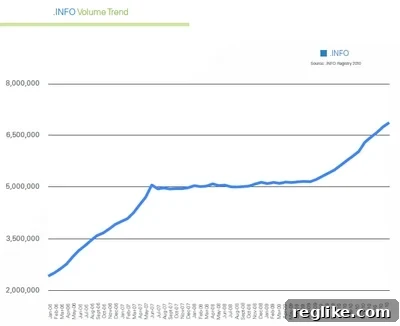
Afilias has long championed .info as the internet’s inaugural “new TLD,” a claim that reflects its pioneering role in expanding the domain name system beyond the traditional trio of .com, .net, and .org. Indeed, the statistics from 2010 strongly supported this assertion, showcasing how .info had effortlessly outpaced many of its contemporary rivals in terms of total registrations. By the close of September 2010, the .info domain celebrated a significant milestone: a formidable 6.8 million domain name registrations. This figure wasn’t just a number; it represented a clear and substantial uptick compared to the registration volumes observed in previous years, signaling a renewed vigor and expanding appeal for the domain.
The consistent growth trajectory was further evidenced by the average registration rate throughout 2010. The .info registry reported an impressive average of 300,000 new registrations every month. This sustained momentum underscored the domain’s growing popularity and its increasing acceptance among individuals, businesses, and organizations looking for a credible and globally recognized online identity. This period of rapid expansion solidified .info’s position as a viable and attractive alternative or complement to the more established domain extensions, particularly for projects and websites centered around providing information.
Unpacking the .info Landscape: Usage, Geography, and Identity
Beyond Registrations: Active Website Usage
While registration numbers provide a quantitative measure of success, the true value of a TLD often lies in the actual usage of these registered domains. The 2010 report shed light on this critical aspect, revealing that approximately 20% of all .info domain names were actively being used for genuine websites featuring original content. This statistic is particularly insightful, indicating a significant portion of the registered base was contributing to the active internet ecosystem, rather than merely being parked or held for speculative purposes. For a domain extension, having a substantial percentage of active, content-rich websites enhances its perceived credibility and search engine optimization (SEO) value, signaling to both users and search algorithms that .info domains are often associated with valuable information.
The remaining 80% of registrations, while not necessarily hosting active content at that moment, still contribute to the TLD’s overall market presence. These might include domains held for future development, defensive registrations by brands protecting their online identity across multiple extensions, or domains used for email services without a public website. Understanding this balance is crucial for assessing the comprehensive impact and utility of the .info domain.
Global Reach: North America and Europe Lead the Way
The geographic distribution of .info registrations offered another layer of fascinating insight into its global adoption. According to the report, North America accounted for a dominant 58% of all registered .info domains, while Europe followed with a significant 27%. This concentration suggests that these regions were early and strong adopters of the .info extension, possibly due to higher internet penetration rates, earlier exposure to new TLDs, or more aggressive marketing campaigns in these markets. The generic nature of “information” transcends linguistic barriers, making .info a universally understandable and appealing option, which likely contributed to its broad international uptake, with a distinct stronghold in technologically advanced regions.
The Promise and Challenge of Internationalized Domain Names (IDNs)
In an effort to promote internet inclusivity and enable users to register domain names in their native scripts, Afilias made .info available in 10 Internationalized Domain Names (IDNs) at the second level. IDNs allow domain names to contain characters from non-Latin scripts, such as Arabic, Cyrillic, or Chinese. Despite this progressive step, the adoption of .info IDNs remained relatively modest in 2010, with fewer than 30,000 registered. This highlights the early challenges associated with IDNs, including browser compatibility issues, user awareness, and the slower adoption curve compared to traditional ASCII domains.
Interestingly, among the registered .info IDNs, German scripts led the way, accounting for a substantial 82%. This disproportionate representation points to a specific regional interest or early market success within German-speaking communities, possibly driven by localized promotional efforts or a strong demand for native-script domain names in Germany, Austria, and Switzerland. The potential of IDNs to unlock new markets and cater to diverse linguistic communities remains immense, even if their widespread adoption was still in its nascent stages in 2010.
The Enduring Challenge: .com’s Shadow and User Behavior
Despite the impressive growth and positive statistics presented in the .info annual report, one particular example served as a stark, yet important, reminder of the persistent dominance of the .com domain. The report highlighted “MoveYourMoney.info,” a website that gained national attention when it was featured on the CBS Sunday Morning Show in February 2010. This exposure provided a significant opportunity for the .info domain to capture public interest and drive traffic. However, the subsequent events dramatically illustrated deeply ingrained user habits.
On that very same day the show aired, “MoveYourMoney.COM”—a completely different and unrelated website—received an astonishing 27,000 visitors. These visitors were almost certainly looking for the .info site mentioned on national television but, out of habit or lack of awareness, automatically appended “.com” to the domain name. This phenomenon, known as “type-in traffic” or “domain habituation,” underscores the immense power and ubiquity of the .com extension in the collective digital consciousness. For decades, .com has been the default for internet users, creating a powerful psychological bias that even strong media exposure for other TLDs struggles to overcome immediately.
For .info domain holders, this incident serves as a crucial lesson in branding, user education, and strategic marketing. Overcoming the .com default requires proactive measures, such as:
- Clear Communication: Emphasizing the full domain name, including the extension, in all marketing and promotional materials.
- Strong Branding: Creating a memorable brand that is not easily confused with a .com counterpart.
- SEO Optimization: Ensuring the .info site is highly optimized for search engines so that users can find it even if they initially search for the brand name without a specific TLD.
- Defensive Registrations: In some cases, businesses might consider registering the .com version of their .info domain (if available) to redirect traffic and protect their brand, especially if their name gains significant public attention.
The MoveYourMoney example, while a cautionary tale, also highlights the importance of TLDs like .info in providing alternative spaces when the desired .com name is unavailable. It reinforces the need for a multi-pronged approach to establish and maintain an online presence that can thrive amidst the enduring legacy of .com.
The Strategic Vision of Afilias and the Future of .info
Afilias, as the registry operator for .info, plays a pivotal role not just in managing the technical aspects of the domain but also in its strategic positioning and promotion. The release of comprehensive annual reports, coupled with active participation in global internet governance forums like ICANN, demonstrates a forward-thinking approach to sustaining the value and relevance of the .info TLD. These actions are vital for ensuring that .info remains a competitive and attractive option in an increasingly crowded domain name market, which has seen the introduction of hundreds of new gTLDs since 2010.
Looking ahead, the future of .info hinges on its ability to continue carving out a distinct niche for itself. Its original purpose as a domain for “information” remains a powerful and universally understood concept. As the digital world continues to expand, the demand for reliable and accessible information will only grow. .info can strategically position itself as the go-to extension for encyclopedias, news portals, educational resources, blogs, and any entity focused on content dissemination. By emphasizing its core identity and leveraging its generic appeal, .info can maintain and even enhance its relevance in the long term.
Continuous innovation in security features, robust infrastructure, and targeted marketing efforts will be essential for Afilias to ensure the sustained growth and perceived value of .info domains. The journey from 2010’s impressive surge to its current standing reflects a dynamic adaptation to the internet’s evolving demands, underscoring .info’s enduring legacy as a significant player in the digital information age.
Conclusion: .info’s Enduring Legacy in the Digital Information Age
The year 2010 marked a period of significant triumph for the .info domain, demonstrating its capacity for robust growth and widespread adoption. With 6.8 million registrations by September and an average of 300,000 new domains added each month, the .info TLD solidified its position as a leading generic extension, particularly for information-centric websites. The insights gleaned from Afilias’ annual report, including usage statistics and geographic distribution, painted a picture of a healthy and actively utilized domain name.
However, the compelling narrative of “MoveYourMoney.info” against “MoveYourMoney.COM” served as a powerful reminder of the enduring psychological and habitual dominance of the .com extension. This challenge, while significant, also highlights the critical role that alternative TLDs like .info play in providing valuable online real estate when .com options are scarce. For any entity seeking an online presence, understanding the nuances of user behavior and strategically leveraging the unique identity of each TLD is paramount.
As the internet continues its relentless expansion and diversification, .info maintains its unique value proposition as a clear, concise, and globally recognized identifier for information. Its journey, marked by periods of growth and adaptation, reinforces its status as an important and credible option for individuals and organizations worldwide who wish to establish a strong, information-focused digital presence. The legacy of .info is not just in its numbers but in its steadfast commitment to being a dedicated space for knowledge and connectivity in the vast expanse of the World Wide Web.