
The Persistent Challenge: Why Non-.com Domains Still Struggle with Universal Acceptance
In the vast and ever-expanding landscape of the internet, domain names serve as the fundamental addresses that guide users to their desired destinations. For decades, the digital world largely revolved around a handful of established top-level domains (TLDs), with .com reigning supreme as the undisputed king. However, approximately ten years ago, a new era dawned with the introduction of hundreds of new TLDs, promising greater choice, innovation, and global inclusivity. From industry-specific extensions like .tech and .app to geographic markers like .london and brand-specific domains, the vision was to unlock unprecedented creativity and relevance online.
Despite this ambitious expansion, a critical hurdle continues to impede the seamless integration of these modern domain names: the pervasive issue of “Universal Acceptance.” This concept is not merely a technical nicety but a cornerstone of a truly open and accessible internet. As articulated by ICANN, the global multi-stakeholder organization responsible for coordinating the internet’s naming systems, Universal Acceptance (UA) is defined as:
Universal Acceptance (UA) ensures that all domain names, including new top-level domains (TLDs), Internationalized Domain Names (IDNs), and email addresses are treated equally and can be used by all Internet-enabled applications, devices, and systems. UA provides the gateway to the next billion Internet users.
In essence, UA means that every valid domain name, regardless of its ending – be it .com, .org, .net, or a newer TLD like .tube, .codes, or even domains in non-Latin scripts – should function correctly everywhere on the internet. This includes being recognized in web browsers, working as valid email addresses, being clickable in messaging apps, and being accepted in online forms. The aspiration is clear: no domain name should be an outcast in the digital realm. Yet, the current reality paints a far less optimistic picture.
The Disconnect: When Digital Paths Lead to Dead Ends
The journey towards Universal Acceptance has been fraught with challenges, revealing a significant gap between the intended vision and the lived experience of users and domain owners. Anecdotal evidence and widespread reports indicate that many newer TLDs still encounter compatibility issues across various digital platforms, creating friction and undermining their utility.
Messaging Apps: The WhatsApp Quandary
A recent lament from Rami Schwartz, CEO & Founder of .Tube, vividly illustrates this ongoing struggle. He expressed frustration that .tube domains are often not recognized as clickable links within WhatsApp, the popular messaging application owned by Meta Platforms. This isn’t an isolated incident affecting only .tube; Schwartz’s analysis of over 1,000 TLDs revealed a systemic problem: many new domain extensions fail to function correctly in WhatsApp unless the full “https://” prefix is explicitly typed before the domain name. While other social media platforms and messaging apps appear to have better mechanisms for accepting a broader range of TLDs, WhatsApp’s inconsistency highlights a significant user experience flaw.
This issue extends beyond mere inconvenience. For businesses and individuals who have invested in a new TLD to build their online presence, the inability to share their website link seamlessly in a widely used communication tool like WhatsApp can translate into lost engagement, reduced traffic, and a diminished return on their digital investment. Schwartz critically remarked, “Com used to be the standard, now it’s the Gold Standard,” attributing this perception partly to what he views as ICANN’s failure to adequately enforce or facilitate its Universal Acceptance mandate across the industry.
The technical reasons behind such inconsistencies are often rooted in the legacy codebases of older applications. Many systems were developed when .com, .org, and .net dominated the internet, leading developers to hardcode validation rules or regular expressions that only recognize these traditional patterns. Updating these systems to accommodate hundreds of new TLDs requires conscious effort, resource allocation, and a proactive approach from platform providers, which hasn’t always been a priority. This digital inertia, where established platforms lag in adapting to internet evolution, creates unnecessary friction for modern domain usage.
Email Reliability: A Persistent Thorn
Perhaps one of the most critical areas where Universal Acceptance falters is in email communication. An email address is often the primary digital identity for individuals and businesses, crucial for registrations, transactions, and direct communication. The reliability of an email address is paramount.
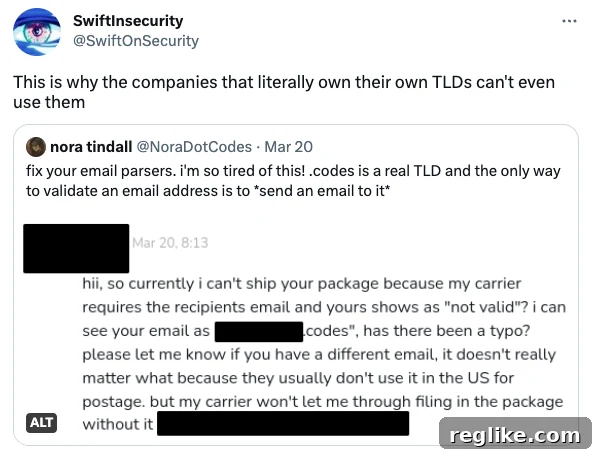
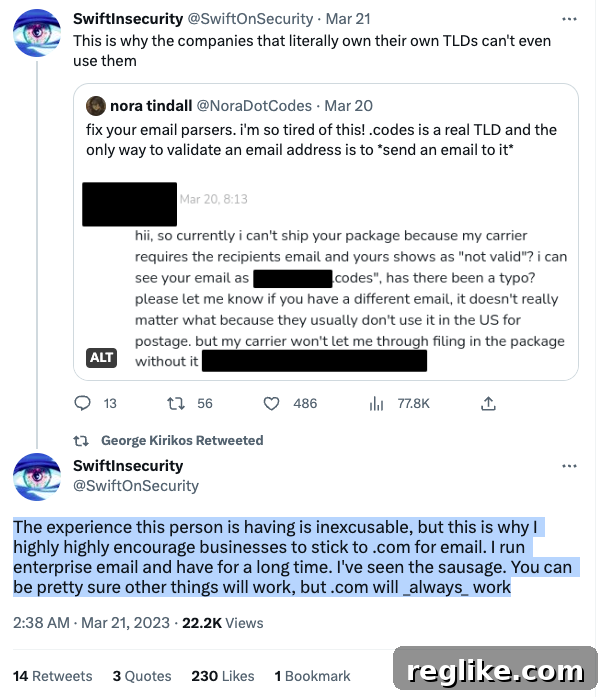
Consider the complaint of a .codes domain owner on Twitter, who faced a service refusing to recognize their email address as valid. This scenario is unfortunately common and can have severe consequences, from being unable to sign up for essential services to missing vital communications. The esteemed InfoSec account SwiftOnSecurity responded to this predicament with a pragmatic, albeit disheartening, piece of advice:
The experience this person is having is inexcusable, but this is why I highly highly encourage businesses to stick to .com for email. I run enterprise email and have for a long time. I’ve seen the sausage. You can be pretty sure other things will work, but .com will _always_ work
The “sausage” SwiftOnSecurity refers to encapsulates the often messy, complex, and sometimes archaic underpinnings of enterprise email systems. These systems, built over decades, frequently employ stringent, outdated validation algorithms that mistakenly flag non-.com email addresses as invalid or suspicious. This conservative approach, while intended to prevent spam and ensure deliverability, inadvertently penalizes legitimate new TLD users.
The implications for businesses are profound. Opting for an email address like ‘[email protected]’ or ‘[email protected]’ can project a modern, targeted image, but if customers cannot reliably send emails to it, or if registration forms reject it, the branding benefits are nullified. This forces many organizations back to the perceived safety of .com, stifling innovation and limiting choice for businesses aiming to craft a unique digital identity. It’s a classic example of legacy system limitations dictating modern business practices, rather than the other way around.
The Deeper Divide: Internationalized Domain Names (IDNs)
If new TLDs using Latin characters face an uphill battle, the situation for Internationalized Domain Names (IDNs) is even more dire. IDNs allow internet users to register domain names in their native languages and scripts, such as Arabic, Chinese, Cyrillic, or Devanagari. They represent a crucial step towards true global internet inclusivity, enabling billions of users worldwide to navigate the internet in their mother tongues.
However, the technical and operational challenges for IDNs are significantly amplified. Many applications and systems that struggle to recognize a simple .tube domain are completely unprepared for the complexities of non-Latin character strings. While mechanisms like Punycode exist to convert IDNs into an ASCII-compatible format for system processing, the user-facing acceptance remains deeply flawed. A domain name that appears perfectly valid in its native script might be rendered unusable in a web form or email client due to a lack of UA support.
This failure to fully support IDNs creates a significant barrier to entry for non-English speaking communities, effectively marginalizing a vast segment of the global internet population. Universal Acceptance is not just about expanding commercial options; it is about digital equity and ensuring the internet truly belongs to everyone, regardless of their linguistic background or geographical location. The vision of a truly global internet remains incomplete until IDNs are universally accepted.
Why the Lag? Unpacking the Roots of Non-Acceptance
The slow pace of Universal Acceptance can be attributed to several interlocking factors:
- Legacy Systems and Outdated Code: Many core internet infrastructures, applications, and validation libraries were built decades ago when the domain name system was much simpler. Updating these complex systems is a substantial undertaking, often deprioritized against other development tasks, leading to technical debt that hinders innovation.
- Developer Awareness and Education: A lack of awareness among software developers about the expansion of the TLD space and the importance of UA often leads to the perpetuation of outdated validation rules. Many developers simply aren’t aware of the full scope of valid domain names.
- Cost and Resource Allocation: For companies, particularly those with vast, intricate systems, updating all points of domain validation can be costly and resource-intensive, making them hesitant to invest without clear immediate benefits or regulatory pressure. The business case for UA can be hard to quantify in the short term.
- Lack of Enforced Standards: While ICANN champions UA through various initiatives and outreach programs, it largely relies on advocacy and community engagement rather than direct enforcement. There isn’t a universally mandated technical standard or certification that compels platforms to update their systems, leading to a fragmented adoption landscape.
- User Perception and Inertia: Users have been conditioned over decades to trust and expect .com domains. This inertia, combined with the real-world compatibility issues, fosters a preference for traditional TLDs, inadvertently reducing the pressure on platforms to adapt. If users don’t demand full UA, platforms are less likely to prioritize it.
The Path Forward: A Collaborative Effort for an Inclusive Internet
Overcoming the hurdles of Universal Acceptance requires a concerted, multi-stakeholder effort. It’s not merely a technical fix; it’s a commitment to an inclusive and innovative internet:
- Continued Advocacy and Education: ICANN and domain registries must intensify efforts to educate developers, software vendors, and platform owners about the importance of UA and provide them with the necessary tools and guidelines. Workshops, webinars, and accessible documentation are crucial.
- Updated Development Resources: Creating and promoting robust, up-to-date validation libraries and code examples that fully support all valid TLDs (including IDNs) is crucial. These resources need to be easily integrated into modern development frameworks.
- Industry Leadership: Major technology companies – the Meta Platforms, Googles, Apples, and Microsofts of the world – hold immense influence. Their proactive adoption and full support for new TLDs across their products and services could set a powerful precedent for the entire industry, driving widespread change.
- Policy and Best Practices: Encouraging the development and adoption of industry-wide best practices for domain and email address validation can help standardize acceptance. This could involve industry groups collaborating on universal validation schemas.
- User Empowerment: As more users demand the functionality of their chosen new TLDs, the collective pressure on platforms to adapt will inevitably grow. Users can actively report issues and advocate for better support.
Conclusion: Embracing the Future of Digital Identity
The introduction of new top-level domains represented a significant step forward for the internet, offering unprecedented opportunities for unique branding, localization, and innovation. However, the promise of this expansion remains largely unfulfilled as long as the fundamental principle of Universal Acceptance is not fully realized. The struggles encountered by non-.com domains in messaging apps, email systems, and especially for Internationalized Domain Names, underscore a critical need for widespread platform updates and a renewed commitment from the internet community.
Achieving Universal Acceptance is not just about ensuring technical compatibility; it’s about fostering digital inclusivity, empowering businesses and individuals with greater choice, and unleashing the full potential of a truly global internet. Only when every valid domain name is treated equally by every internet-enabled system can we truly welcome the next billion internet users and build a digital future that is accessible, innovative, and equitable for all. The journey towards Universal Acceptance continues, and its successful completion is vital for the internet’s ongoing evolution.