
The Landmark Supreme Court Decision: Booking.com Secures Trademark Recognition
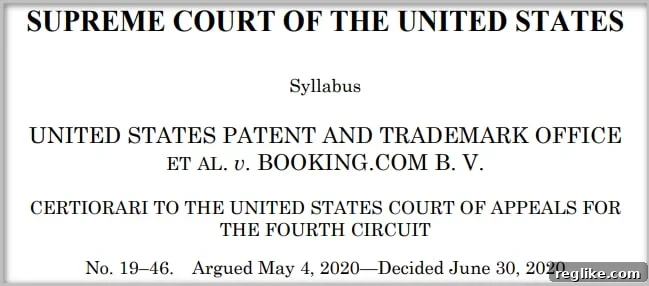
In a pivotal ruling with significant implications for digital branding and intellectual property law, the Supreme Court of the United States has affirmed that “Booking.com” can indeed be registered as a trademark. This 8-1 decision, announced today, overturns earlier rejections by the U.S. Patent and Trademark Office (USPTO) and carves out a specific pathway for domain names combining generic terms with top-level domains to achieve trademark protection. The ruling delves into the complexities of consumer perception in the digital age, challenging long-held assumptions about distinctiveness in online branding and setting a new precedent for businesses navigating the digital marketplace.
Understanding Trademark Law and the “Generic” Challenge
At its core, trademark law is designed to prevent consumer confusion by identifying the source of goods or services. A strong trademark distinctively points to a single entity, allowing consumers to differentiate products and services in the marketplace. Trademarks are typically categorized along a spectrum of distinctiveness, ranging from highly protectable (fanciful, arbitrary, suggestive) to non-protectable (generic).
- Fanciful marks are invented words with no inherent meaning (e.g., Kodak).
- Arbitrary marks use existing words but in an unrelated context (e.g., Apple for computers).
- Suggestive marks hint at the product’s nature without directly describing it (e.g., Coppertone for suntan lotion).
- Descriptive marks directly describe a product or service but can gain protection if they acquire “secondary meaning”—meaning consumers associate the term with a specific source (e.g., American Airlines).
- Generic marks, however, refer to the common name of a product or service itself (e.g., “shoe” for footwear). These are generally considered unprotectable, as granting exclusive rights would effectively monopolize a term essential for all competitors to use.
The term “booking” falls squarely into the generic category for services related to making reservations. It describes the very essence of what hotel reservation services do. This inherent genericity formed the foundation of the USPTO’s initial refusal to grant Booking.com a trademark. The USPTO argued that merely adding “.com” to a generic term, much like adding “Company” or “Inc.” to a generic business name, does not magically transform it into a source-identifying mark. From their perspective, “Booking.com” simply meant “a company that offers booking services on the internet,” a description applicable to any entity in the industry.
This legal standoff presented a crucial question: Can a term that is undeniably generic on its own become distinctive when combined with a top-level domain like “.com,” especially in the unique context of the internet where a specific domain name can only be held by one entity?
The Supreme Court’s Groundbreaking Reasoning
The Supreme Court, in its majority opinion penned by Justice Ruth Bader Ginsburg, fundamentally disagreed with the USPTO’s strict interpretation. The Court emphasized that the critical test for genericity is whether the term, taken as a whole, signifies to consumers the class of online hotel-reservation services rather than a specific provider.
That premise is faulty, for only one entity can occupy a particular Internet domain name at a time, so a “generic.com” term could convey to consumers an association with a particular website.
This statement encapsulates the core of the Court’s reasoning. Unlike adding “Company” to a generic term, where multiple “Booking Companies” could conceivably exist, the internet’s structure ensures that “Booking.com” can only be used by one entity globally. This exclusivity, the Court posited, creates a unique environment where the combination of a generic term and “.com” has the potential to function as a source identifier in the minds of consumers. The digital landscape transforms the meaning, allowing the combined term to acquire secondary meaning through extensive use and consumer recognition.
To further illustrate this point, the Court offered a compelling thought experiment, challenging the notion that “Booking.com” is merely generic:
Under these principles, whether “Booking.com” is generic turns on whether that term, taken as a whole, signifies to consumers the class of online hotel-reservation services. Thus, if “Booking.com” were generic, we might expect consumers to understand Travelocity—another such service—to be a “Booking.com.” We might similarly expect that a consumer, searching for a trusted source of online hotel-reservation services, could ask a frequent traveler to name her favorite “Booking.com” provider.
The absurdity of these scenarios, in the Court’s view, highlights that consumers do not perceive “Booking.com” as a generic class of services but rather as a specific brand. When a consumer says “I’m going to use Booking.com,” they are not referring to any online booking service; they are specifically referring to the well-known platform operated by Booking Holdings Inc. This distinction in consumer perception was crucial in establishing that the combined term “Booking.com” had acquired distinctiveness, thus qualifying for trademark protection.
Implications and the Specific Scope of Protection
While the ruling marks a significant victory for Booking.com and potentially for other businesses operating under “generic.com” domain names, the Supreme Court was careful to delineate the specific, and somewhat limited, scope of this newfound protection. The decision does not open the floodgates for every generic term combined with a top-level domain to become a strong trademark. Instead, it suggests that such trademarks can be acquired under specific circumstances where consumer perception clearly demonstrates distinctiveness and a singular association with a particular source.
A “Weak” Mark with Targeted Protections
A crucial aspect of the Court’s decision, and one acknowledged by Booking.com itself, is that the “Booking.com” mark will likely be considered a “weak” mark. This means its scope of protection is narrower compared to inherently distinctive marks like “Google” or “Xerox.” The Court explicitly stated:
Guarding against the anticompetitive effects the PTO identifies, several doctrines ensure that registration of “Booking.com” would not yield its holder a monopoly on the term “booking.”
This distinction is vital for maintaining a competitive marketplace. The trademark protection granted to “Booking.com” does not give Booking Holdings Inc. exclusive rights over the generic term “booking” itself. Competitors are still free to use “booking” in their descriptive marketing materials, service names, or even as part of their own domain names, provided such use does not create a likelihood of confusion with Booking.com specifically. For example, a new service could still legitimately be called “Easy Booking Solutions” or operate under a domain like “citybooking.net,” as long as it doesn’t try to impersonate or create confusion with the established Booking.com brand.
Indeed, Booking.com has acknowledged that its trademark would not allow it to pursue legal action against entities like “ebooking.com,” “BookIt.com,” or others who incorporate “booking” into their names or domain names in a way that is clearly distinguishable. The protection primarily guards against direct impersonation or highly confusing similarities. This means that the trademark primarily protects against situations where another entity might attempt to pass itself off as Booking.com, for example, by creating a website specifically named “Booking.com” or actively promoting themselves under that precise brand name, thereby deceiving consumers into believing they are interacting with the original platform.
This nuanced approach reflects a careful balancing act by the Supreme Court:
- Preventing Monopolies: The ruling ensures that common, generic words remain in the public domain for descriptive use by all, preventing any single entity from monopolizing an entire class of services.
- Protecting Consumer Expectations: It acknowledges that in the digital realm, a specific combination like “Booking.com” can indeed acquire a unique identity and strong brand recognition in the minds of consumers.
- Promoting Fair Competition: By clarifying the limitations of such trademarks, the Court aims to foster an environment where businesses can brand their online services effectively without stifling legitimate competition or hindering others from describing their own services.
The Evolving Landscape of Digital Branding and Intellectual Property
The “Booking.com” decision represents a significant development in intellectual property law, particularly as it pertains to the internet and domain names. It underscores the judiciary’s recognition of how branding and consumer interaction have evolved in the digital age. For businesses operating online, a well-chosen and heavily marketed domain name can indeed transcend its generic components to become a powerful brand identifier, much like a coined word.
Key Takeaways for Businesses and Legal Professionals:
- Consumer Perception is Paramount: The ruling reinforces that the ultimate test for trademark distinctiveness often hinges on how consumers actually perceive and interpret a mark in the marketplace. Extensive market research, consumer surveys, and evidence of substantial marketing efforts can be crucial in proving secondary meaning for “generic.com” terms.
- Not a Blanket Rule: This decision is not a universal green light for all “generic.com” terms. Each case will still need to demonstrate that the combined term has acquired distinctiveness and functions as a source identifier, rather than merely describing a category of services. Companies cannot simply add “.com” to any generic word and expect automatic trademark protection.
- Strategic Branding is Key: Companies investing heavily in their domain names as their primary brand identity may now have a clearer path to securing intellectual property protection, but they must be prepared to demonstrate strong brand recognition and consumer association built over time.
- Careful Enforcement: Trademark holders of “weak” generic.com marks will need to be judicious in their enforcement strategies, focusing on direct confusion or deliberate passing off, rather than trying to assert ownership over the underlying generic term itself.
The internet has fundamentally changed how businesses operate and how consumers interact with brands. Domain names, once merely technical addresses, have evolved into critical components of brand identity and consumer trust. This ruling reflects an adaptation of traditional trademark principles to accommodate these modern realities. It signals a pragmatic approach by the Supreme Court, acknowledging that while generic terms must remain free for public use, a specific online identifier, through consistent use and widespread recognition, can indeed achieve the distinctiveness required for trademark protection in a digital context.
Conclusion: A New Chapter for Online Trademarks
The Supreme Court’s decision to allow Booking.com to trademark its name marks a significant moment for intellectual property in the digital era. It acknowledges the unique function of domain names as singular online identifiers and recognizes that consumer perception, shaped by market realities, can transform a seemingly generic term into a distinctive brand. While providing a pathway for other “generic.com” domains to seek protection, the ruling also thoughtfully maintains crucial safeguards against monopolizing common language, ensuring that the delicate balance between brand protection and fair competition is preserved. This landmark ruling will undoubtedly shape how businesses approach online branding and how courts interpret trademark law for years to come, further integrating intellectual property rights into the evolving landscape of the internet economy.
The full decision, offering comprehensive legal analysis, can be accessed here (PDF).