
MarkMonitor’s Unique Position: Enabling WHOIS Privacy for .US Domains
For many years, the ability for average consumers and small businesses to register a .us domain name with WHOIS privacy has been significantly curtailed. This policy, established through a decision by the National Telecommunications and Information Administration (NTIA), was designed to foster transparency and accountability within the United States’ country-code top-level domain (ccTLD). However, a closer examination of current registration practices reveals a striking inconsistency: while the general public faces stringent disclosure requirements, leading brand protection entities appear to be operating under a different set of rules, effectively offering WHOIS proxy services for .us domains to their high-profile corporate clients.
This situation ignites a crucial discussion about fairness, the practical enforcement of domain policies, and the rapidly evolving landscape of digital identity management. Is the domain ecosystem inadvertently creating a two-tiered system where large corporations benefit from privileges not extended to individual registrants? This article delves into the specifics of this intriguing scenario, focusing on MarkMonitor and its subsidiary DNStination Inc., and explores the broader implications for domain governance and online transparency in the digital age.
The Restrictive Environment of .US Domain Registration and WHOIS Policies
The .us domain serves as the official country-code top-level domain for the United States. Its primary objective is to provide a distinct and verifiable online identity for individuals, businesses, and organizations with a genuine connection to the U.S. Unlike many other global TLDs, .us has always maintained specific “nexus” requirements, meaning registrants must either be U.S. citizens or residents, or entities with a demonstrable presence in the U.S. This emphasis on domestic connection is a fundamental pillar of the .us domain’s identity and its governance, which falls under the purview of the NTIA.
NTIA’s Historical Stance on .US WHOIS Privacy: A Commitment to Transparency
Several years ago, the NTIA made a pivotal decision that largely eliminated the availability of WHOIS privacy services for .us domain registrations. The underlying rationale for this policy was rooted in a strong desire for maximum transparency and accountability. The NTIA posited that by making registrant information publicly accessible, it would enhance trust, effectively deter abusive practices such as cybersquatting, and provide clear channels for law enforcement and intellectual property rights holders to contact domain owners when necessary. This decision, as documented by reports and public outcry, including petitions launched by major registrars like GoDaddy, generated considerable debate, with many individual registrants and smaller entities feeling it encroached upon their personal privacy and left them vulnerable to unwanted solicitations and spam.
For a significant period following this policy shift, any entity attempting to register a .us domain – from an independent content creator to a local small business – was typically required to have their personal or organizational details (including name, physical address, email, and telephone number) openly displayed in the public WHOIS database. This mandate starkly contrasts with the widespread availability of WHOIS privacy services for generic top-level domains (gTLDs) such as .com, .net, and .org, where such services commonly mask the true registrant’s details with those of a proxy provider.
Demystifying WHOIS: The Public Ledger of Domain Ownership
To fully appreciate the significance of MarkMonitor’s activities, it’s crucial to understand the fundamental nature of WHOIS and why the concept of its privacy has become such a contentious and often debated issue. WHOIS is a query and response protocol used to query databases that store information about the registered users or assignees of an Internet resource. This includes vital data pertaining to domain names, IP address blocks, or autonomous systems. Essentially, performing a WHOIS lookup provides comprehensive information about who owns a specific domain, the date of its registration, its expiration date, and the registrar through which it was acquired.
The Evolving Purpose of WHOIS and the Emergence of Privacy Concerns
While originally conceived to ensure accountability and facilitate direct communication between parties, the inherently public nature of WHOIS data has progressively sparked significant privacy concerns. Although undeniably beneficial for legitimate purposes, such as combating cybercrime, enforcing trademark rights, and resolving technical issues, the open availability of personal information has regrettably also led to its misuse. Registrants frequently report experiencing an onslaught of unsolicited spam, targeted phishing attempts, and even various forms of harassment, which collectively fuel a robust and growing demand for effective privacy protection measures.
In response to these burgeoning concerns, WHOIS privacy services emerged as a crucial solution. These services, typically offered by domain registrars themselves or through specialized third-party providers, replace the actual registrant’s personal or organizational details with their own information. This mechanism effectively shields the true owner’s identity from public scrutiny, allowing them to maintain a valuable level of anonymity while simultaneously adhering to the essential requirements of domain registration.
MarkMonitor and DNStination Inc.: Exploiting a Loophole for Major Brands?
Against the backdrop of a strict regulatory environment governing .us domains, the operational practices of MarkMonitor, a recognized global leader in enterprise brand protection, present a particularly compelling case study. MarkMonitor offers an extensive and integrated suite of services specifically designed to safeguard corporate brands across the digital landscape, encompassing everything from comprehensive domain portfolio management to sophisticated anti-fraud and anti-piracy measures. A critical and integral component of their advanced domain management strategy is their wholly-owned affiliate, DNStination Inc., which functions as a dedicated proxy service exclusively for MarkMonitor’s diverse clientele.
The “BadDairy” Case Study: Revealing the Proxy Mechanism
A recent observation vividly highlights this operational distinction and its implications. A substantial number of domain names related to dairy products, including potentially contentious or defensive registrations such as BadDairy.com, DairyBad.com, and Bad-Dairy.com, were recently registered. What makes these registrations particularly noteworthy is their broad reach across multiple top-level domains, including .net, .info, .biz, and, most crucially, .us. When scrutinizing the WHOIS records for the .us versions of these domains, a specific registrant organization consistently appeared: DNStination Inc.
For instance, a WHOIS record check for BadDairy.us definitively lists DNStination Inc. as the registered entity, rather than the ultimate brand owner behind these defensive registrations. Furthermore, the contact email associated with DNStination Inc., [email protected], is linked to approximately 20,000 domain names, unequivocally indicating a vast and systematic operational scale. This is not merely an incidental administrative contact; DNStination Inc. is unequivocally acting as a public-facing proxy for the true registrant, whose identity remains strategically obscured from public view.
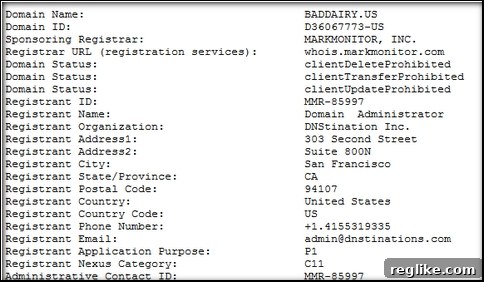
This situation directly challenges the spirit, if not the precise letter, of the NTIA’s long-standing policy regarding .us WHOIS transparency. While individual registrants are unequivocally compelled to disclose their identities, MarkMonitor’s corporate clients, operating through the DNStination Inc. proxy, appear to retain the distinct ability to register .us domains with a significant and effective degree of privacy. This raises pertinent questions about policy interpretation and consistent application across all segments of the domain community.
Why Leading Brands Prioritize WHOIS Privacy for Even .US Domains
The motivation for large corporations and established brands to utilize sophisticated proxy services, even for country-code TLDs like .us, is multifaceted and deeply strategic. Unlike individual registrants who primarily seek to protect personal information from spam or harassment, corporations often have distinct and compelling business reasons for maintaining anonymity during critical domain registrations.
Strategic Domain Acquisitions and Proactive Brand Protection
- Stealth Acquisitions: Corporations frequently acquire domains in preparation for future product launches, new service offerings, or as essential defensive measures. Prematurely revealing their identity could inadvertently alert competitors, potentially inflate domain acquisition costs, or attract undesired media scrutiny before a strategic announcement is fully prepared. WHOIS privacy allows them to conduct these operations discreetly and effectively.
- Negative or Defensive Registrations: As exemplified by the “BadDairy” instance, proactive brands often register domains that incorporate potentially negative keywords or anticipate criticisms (e.g., [Brand]Sucks.com). This is a crucial, forward-thinking measure to prevent opportunistic cybersquatters or malicious detractors from acquiring and misusing such domains to tarnish the brand’s reputation. Having these sensitive domains directly linked to the brand could paradoxically amplify negative perceptions or invite further unwanted scrutiny.
- Legal Strategy and Enforcement: In anticipation of complex legal disputes, trademark enforcement actions, or intellectual property litigation, a company might strategically register specific domains. Revealing their involvement too early could potentially undermine legal tactics, provide opposing parties with advance notice of intent, or compromise sensitive negotiations.
- Preventing Market Speculation: Any significant or unusual domain activity undertaken by a major brand has the potential to trigger market speculation, which could directly impact stock prices, investor confidence, or crucial business partnerships. Maintaining privacy helps companies control the flow of information and manage public perception more effectively.
MarkMonitor specializes precisely in these complex scenarios, offering a suite of services that empower brands to manage their extensive digital footprint both strategically and defensively. DNStination Inc. is therefore a critical and indispensable component of this offering, ensuring that brand protection efforts can proceed without immediately revealing the true identity of the client, thereby preserving competitive advantage and strategic flexibility.
The Enduring Ethical and Policy Debate: Transparency Versus Corporate Strategy
The clear observation of MarkMonitor’s operations involving .us domains reignites a long-standing and often passionate debate within the domain industry, among policymakers, and within the broader public: where should the delicate balance lie between the imperative for transparency and the legitimate privacy needs, particularly those of large, globally operating corporations?
Arguments Championing Transparency and Accountability
Staunch advocates for strict WHOIS transparency argue that its full disclosure is absolutely vital for several critical reasons:
- Combating Cybercrime: Law enforcement agencies heavily rely on accurate and publicly accessible WHOIS data to trace and apprehend perpetrators involved in phishing scams, malware distribution, online fraud, and other illicit digital activities.
- Intellectual Property Enforcement: Trademark and copyright holders require the ability to readily identify domain registrants to initiate effective legal action against infringement, cybersquatting, and other forms of intellectual property theft.
- Consumer Protection: For consumer confidence and protection, particularly in the realm of e-commerce, it is often deemed essential for consumers to know the identity of the entity behind a website to ensure accountability and recourse.
- Fairness and Equity: A consistently applied policy ensures that all registrants, irrespective of their organizational size, influence, or financial power, adhere to the same foundational rules, thereby preventing the establishment of a “two-tiered” system that could erode public trust and foster resentment.
Arguments Supporting Corporate Privacy and Strategic Operations
Conversely, corporations present equally compelling and well-reasoned arguments for their critical need for WHOIS privacy:
- Protection of Competitive Intelligence: Safeguarding sensitive strategic initiatives, mergers, acquisitions, and product development plans from competitors who meticulously monitor domain registrations for early indicators.
- Security of Personnel: Preventing the inadvertent exposure of executive or employee contact details, which could regrettably lead to targeted harassment, sophisticated phishing attempts, or even physical threats against key personnel.
- Brand Reputation Management: Exercising meticulous control over brand narratives and preventing the unwarranted amplification of negative content, even when such domains are proactively registered for defensive or brand-protection purposes.
- Legal and Regulatory Compliance: Navigating the intricate landscape of complex international data privacy laws (such as GDPR, which profoundly reshaped WHOIS for EU registrants) while simultaneously managing expansive and globally diverse domain portfolios.
The current situation involving .us domains and MarkMonitor starkly highlights a fundamental tension between the NTIA’s historical mandate for national TLD transparency and the increasingly sophisticated and legitimate strategic needs of global brand protection in an ever-more complex and interconnected digital world.
Implications and the Future Trajectory for .US Domain Policy
This apparent discrepancy in the application of .us WHOIS privacy raises several profound and unavoidable questions. If a large, sophisticated brand protection firm can effectively navigate or even circumvent the NTIA’s established policy through the systematic use of a proxy service, does this not, in essence, undermine the policy’s original intent and effectiveness? Does it inadvertently create an uneven and potentially unfair playing field for smaller businesses and individual registrants who are unequivocally compelled to comply with full disclosure requirements?
The integrity and credibility of any domain policy are fundamentally contingent upon its consistent, transparent, and equitable enforcement. Should exceptions or systematic workarounds become commonplace for a select, influential group, it could legitimately trigger widespread calls for a comprehensive re-evaluation and potential revision of the policy itself. The NTIA, as the governing body, might find it imperative to clarify its stance on the permissible use of proxy services for .us domains, particularly when such services are utilized by large entities like DNStination Inc., which serve multiple corporate clients and effectively anonymize the ultimate registrant.
Furthermore, as the global digital landscape continues its rapid and dynamic evolution, the delicate balance between transparency and privacy will undoubtedly remain a constant and pressing point of contention. The need for corporate strategic anonymity will, in all likelihood, continue to grow, but so too will the increasing demands for greater accountability and verifiable identification in an era plagued by escalating online misinformation, cyber threats, and digital abuse. The compelling case of MarkMonitor and .us domains serves as a potent and timely reminder that domain governance is not a static construct; it must continually adapt and respond thoughtfully to emerging technologies, novel business practices, and evolving ethical considerations to ensure a fair and secure internet for all stakeholders.
Conclusion: Navigating the Complexities of Digital Domain Identity
The operational approach adopted by MarkMonitor, through its dedicated affiliate DNStination Inc., in providing WHOIS proxy services for .us domain registrations to its corporate clients, indeed presents a significant and thought-provoking paradox within the existing domain policy framework. While the National Telecommunications and Information Administration has historically maintained a strict and unwavering stance on transparency for .us domains, it is evident that large, influential brands appear to have found a legitimate, albeit indirect and perhaps unintended, pathway to achieving corporate privacy within this restrictive environment.
This intriguing scenario powerfully underscores the intricate and often tension-filled dance between policy intent, the rapid advancements in technological capability, and the sophisticated strategic needs of modern global businesses. It compels us to critically consider whether current regulations are sufficiently robust and agile to adequately address the multifaceted complexities of brand protection and digital identity management in the 21st century. It also raises the uncomfortable question of whether the current framework, perhaps inadvertently, creates a distinct privilege for the powerful. Ultimately, the future trajectory of .us domain policy, and indeed, the broader landscape of domain governance globally, will hinge upon the collective ability to forge a pragmatic, equitable, and sustainable balance that simultaneously upholds both the fundamental principles of transparency and the legitimate privacy interests of all stakeholders across the digital ecosystem.