
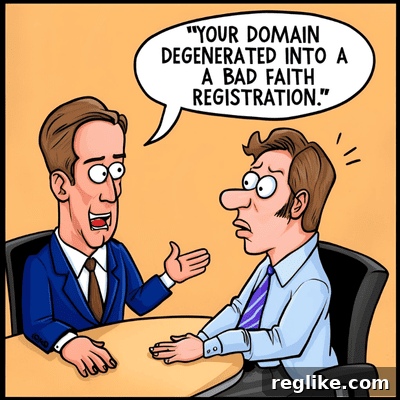
Also, it claims a domain can “degenerate” into a bad faith registration.
The Skytree Saga: A Peculiar Case of Reverse Domain Name Hijacking and the “Degenerating” Domain
In the evolving landscape of domain name disputes, rare are the cases that truly surprise seasoned observers. Yet, a recent decision by the World Intellectual Property Organization (WIPO) panel involving the domain name skytree.com managed to do just that. It unveiled a narrative so unusual it bordered on the surreal: a company not only threatened a “Plan B” to acquire a domain but then proceeded to execute a “Plan B” reverse domain name hijacking attempt, complete with novel, albeit baseless, legal arguments.
The WIPO panel delivered a conclusive verdict, finding Skytree B.V. guilty of reverse domain name hijacking (RDNH) in its claim against the long-held domain, skytree.com. This ruling serves as a stark reminder of the integrity of the Uniform Domain Name Dispute Resolution Policy (UDRP) and the risks faced by complainants who misuse the system for illegitimate domain acquisition.
Understanding the Core Dispute: Skytree B.V. vs. Skytree.com
Skytree B.V., a company specializing in innovative carbon capture technology, operates its business under the domain name skytree.eu. While a .eu domain is perfectly functional, many companies harbor a desire for the widely recognized and often more prestigious .com equivalent. This desire appears to be the genesis of the entire dispute. In September of last year, Skytree B.V. initiated contact with the registrant of skytree.com through GoDaddy’s domain brokerage service, expressing interest in purchasing the coveted digital asset.
The negotiations, or lack thereof, quickly escalated. The following month, the Complainant — Skytree B.V. — inquired with the broker about the expected timeline for a response. Crucially, they also ominously stated their intention to deploy a “plan B” before the end of November if the purchase attempt proved unsuccessful. This “Plan B,” it became abundantly clear, was none other than filing a cybersquatting dispute under the UDRP framework.
The “Plan B” Unveiled: A Deep Dive into Skytree B.V.’s Contentions
Panelist Adam Taylor, tasked with adjudicating this complex matter, meticulously summarized the Complainant’s arguments. For those familiar with UDRP case law, these contentions were, to put it mildly, unconventional and highly amusing:
- The .com Advantage: Skytree B.V. argued that a “.com” address was inherently “more suitable” for its operations than its current “.eu” domain, particularly given that the Complainant’s International Registration designated the U.S. This argument, while understandable from a business preference standpoint, holds no legal weight within the UDRP, which focuses on bad faith registration and use, not perceived suitability.
- Lack of Bona Fide Use: The Complainant contended that the Respondent had not made a “bona fide” offering of goods or services since 1998, alleging that the domain had been used for nothing other than being offered for sale. This argument attempts to twist the UDRP’s “legitimate interest” clause, but fails to account for a registrant’s right to hold a domain for future use or even for passive holding, especially when registered long before the complainant’s trademark rights arose.
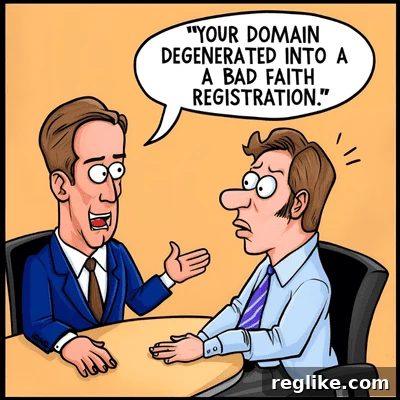
- The “Degenerated” Domain Theory: Perhaps the most bewildering argument was the assertion that the disputed domain name had somehow “degenerated” into being registered and used in bad faith. Skytree B.V. claimed this “degeneration” occurred because the Respondent was “blocking other interested parties, especially the Complainant,” from using the domain for their own legitimate offerings, including in the U.S. This specific claim of “degeneration” is unprecedented in UDRP jurisprudence and fundamentally misinterprets the concept of bad faith, which requires intent to profit from or disrupt a complainant’s trademark.
- Failure to Sell as Bad Faith: The Complainant further argued that the Respondent’s failure to respond to “serious third-party offers” to buy the domain name, despite having offered it for sale for several years, coupled with its lack of active use, constituted additional evidence of this alleged “degeneration” into bad faith. Again, a registrant is under no obligation to sell their domain, regardless of offers, and passive holding is often not considered bad faith if there’s no predatory intent.
- High Price as an Indicator of Bad Faith: Finally, the broker correspondence was cited as evidence that the Respondent was likely only willing to sell the domain for a “very high price,” which Skytree B.V. presented as another indicator of bad faith. While exorbitant asking prices can sometimes be a factor in bad faith *registration* (e.g., cybersquatting), simply demanding a high price for a domain legitimately owned for decades, and before any trademark existed, is not typically indicative of bad faith under UDRP.
The notion of a domain name “degenerating” into a bad faith registration is truly a first in the annals of UDRP. It represents a significant departure from established UDRP principles, which clearly define bad faith in terms of registration *and* use, typically requiring intent to exploit a complainant’s trademark at the time of registration or subsequent use.
Dead on Arrival: Why the Case Was Doomed from the Start
For any experienced UDRP practitioner, the Skytree B.V. case was, to borrow a common idiom, “dead on arrival.” The fundamental flaw lay in a cornerstone principle of UDRP: the timing of trademark rights versus domain name registration. The disputed domain, skytree.com, was registered way back in 1998. In stark contrast, Skytree B.V. asserted trademark rights that commenced significantly later, in 2014. This chronological discrepancy is a critical barrier to a successful UDRP complaint. A domain registered before a complainant’s trademark rights came into existence generally cannot be considered to have been registered in bad faith *in relation to that specific trademark*.
Despite this clear precedent, Skytree B.V. pressed forward, filing a complaint that seemed to disregard the very foundations of UDRP law. This disregard ultimately led Panelist Adam Taylor to a swift conclusion regarding reverse domain name hijacking.
The Judgment: A Clear Finding of Reverse Domain Name Hijacking
Panelist Adam Taylor articulated with little difficulty his reasons for finding Skytree B.V. guilty of reverse domain name hijacking. RDNH occurs when a complainant attempts to use the UDRP in bad faith to improperly seize a domain name from a legitimate registrant. Taylor’s findings were comprehensive and damning:
First, as set out in detail in section 4 above, the Complainant made an unsuccessful pre-filing attempt to buy the disputed domain name from the Respondent via the GoDaddy brokerage service. This initial attempt, coupled with the “Plan B” threat, clearly showed the Complainant’s true intent was acquisition, not genuine dispute resolution for cybersquatting.
Second, the Complaint itself acknowledged that the Respondent registered the disputed domain name in 1998 whereas the Complainant asserted trade mark rights that commenced only in 2014, thereby ignoring established Policy precedent that registration in bad faith could not arise in those circumstances. This disregard for fundamental UDRP principles was a major red flag, indicating either a lack of due diligence or a deliberate attempt to circumvent the rules.
Third, the Complaint raised implausible legal arguments focused more on the Complainant’s desire/alleged entitlement to obtain the disputed domain name than any bad faith on the part of the Respondent, e.g., claiming that the disputed domain name had “degenerated” into bad faith registration and use simply because it was blocking the Complainant from itself using the disputed domain name. Such arguments betray a misunderstanding or deliberate misrepresentation of what constitutes bad faith under the UDRP.
Fourth, in its Supplemental Filing, far from claiming any plausible legal basis for its Complaint, the Complainant acknowledged that it filed the Complaint because it saw no other way of engaging in the potential purchase of the disputed domain name from its unknown owner. It was entirely improper for the Complainant to use the UDRP – which potentially involved the registrant of the disputed domain name having to suffer the cost and/or inconvenience of defending its domain name – simply as a consequence of not knowing the Respondent’s identity or as a tool for the Complainant to uncover the Respondent’s identity in order to facilitate purchase negotiations. Despite the Complainant’s contentions otherwise, none of the following remotely constitute a plausible legal basis for the Complaint or otherwise justify its filing in the circumstances of this case: that the Complainant considered the disputed domain name to be “relevant”, that the disputed domain name had been dormant for many years; and that the Respondent did not respond to the broker enquiries, however surprising the Complainant might have found that. This point highlights the profound misuse of the UDRP as a discovery or acquisition tool, rather than a genuine anti-cybersquatting mechanism.
Finally, the Complainant objects to the Respondent’s hostility to the Complainant’s settlement communications. However, the Respondent was in no way obliged to discuss sale of the disputed domain name to the Complainant following the filing of the Complaint (or otherwise), and the Respondent’s tone is perhaps understandable in light of the Complainant’s misuse of the UDRP to further the Complainant’s attempted purchase of the disputed domain name. A domain owner, especially one facing an unwarranted dispute, has no legal or ethical obligation to engage in sales discussions with the complainant, particularly when the UDRP process is being abused.
The Role of Legal Representation in Domain Disputes
This case also underscores the critical role of specialized legal counsel in domain name disputes. Skytree B.V. was represented by Matchmark B.V., a trademark firm. Conversely, the domain owner of skytree.com benefited from the defense provided by Chestek Legal, a firm renowned for its expertise in domain name law. The outcome serves as a testament to the importance of engaging legal professionals who not only understand trademark law but are also intimately familiar with the nuances and precedents of the UDRP.
Implications for Domain Owners and Trademark Holders
The Skytree.com case provides valuable lessons for both domain owners and trademark holders:
- For Domain Owners: It reaffirms that legitimate domain registrants, even those passively holding domains, are protected under the UDRP against unwarranted attempts to seize their assets. Having a long registration history that predates a complainant’s trademark is a powerful defense.
- For Trademark Holders: It highlights the necessity of thorough due diligence before filing a UDRP complaint. Misusing the UDRP as a tactic for domain acquisition, especially when fundamental requirements like the timing of trademark rights are not met, can lead to severe penalties, including a finding of reverse domain name hijacking and reputational damage.
- Integrity of UDRP: The decision reinforces the UDRP’s purpose as a mechanism to combat cybersquatting, not as a tool for facilitating domain purchases or circumventing market prices. Panelists like Adam Taylor are vigilant in safeguarding the policy’s integrity.
In conclusion, the Skytree B.V. dispute against skytree.com stands as a cautionary tale. It vividly illustrates the perils of employing unconventional and legally unfounded arguments, such as a domain “degenerating” into bad faith, and attempting to manipulate the UDRP for strategic acquisition rather than genuine dispute resolution. The WIPO panel’s clear finding of reverse domain name hijacking sends a strong message: the UDRP is a robust framework designed to protect legitimate rights, and its misuse will not go unpunished.