
The Missed Opportunity of .LIVESTRONG: A Critical Analysis of a Brand gTLD Strategy
The advent of new generic Top-Level Domains (gTLDs) heralded an exciting era for internet branding, promising organizations unprecedented control and unique avenues for connecting with their audiences. From global corporations to non-profit entities, many saw these new digital extensions as a frontier for innovation. However, the path chosen by the Lance Armstrong Foundation (now known as the Livestrong Foundation) for its .livestrong domain application presents a compelling, if somewhat disheartening, case study of an opportunity squandered. What could have been a powerful tool for community empowerment and fundraising appears to have devolved into a strategically limited, financially questionable endeavor.
As the internet awaited the highly anticipated reveal of new gTLD applicants, the domain industry buzzed with speculation. My own thoughts, much like those of many observers, turned to how a globally recognized cause like Livestrong could leverage its own branded extension. On the eve of the announcement, I shared my vision:
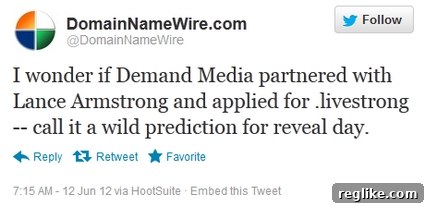
The Initial Vision: Empowering the Livestrong Community
My initial expectation for the .livestrong domain was deeply rooted in the extraordinary global support for the Lance Armstrong Foundation’s mission. I envisioned a dynamic ecosystem where the gTLD could serve as a direct extension of the yellow wristband phenomenon – a tangible symbol of solidarity and hope worn by millions worldwide. Why not translate this widespread personal connection into a digital identity?
A Digital Home for Every Supporter
Imagine millions of individuals, each dedicated to fighting cancer, having the opportunity to register a personalized name.livestrong domain. These unique digital addresses could serve as powerful platforms for personal storytelling, sharing experiences with cancer, coordinating local fundraising initiatives, and fostering a deeper sense of belonging within the broader Livestrong movement. While LiveStrong.com already provides a centralized hub for much of this activity, offering individual domains would have injected an unparalleled sense of ownership and personal empowerment, transforming passive support into active digital participation.
Beyond community building, this model presented a significant, sustainable fundraising opportunity. A nominal annual registration fee for each .livestrong domain, collected from millions of committed supporters, could have generated a substantial, predictable revenue stream. This capital, directly channeled into the Foundation’s vital work in cancer research, patient advocacy, and support services, would have dramatically enhanced its capacity to achieve its mission. It was a vision of synergy: digital identity, community engagement, and financial sustainability, all reinforcing the core values of the Livestrong brand.
A Divergent Reality: The Foundation’s Unexpected Strategy
While my prediction regarding the non-profit’s application for the .livestrong gTLD proved accurate, the subsequent revelations about their strategic implementation were startlingly different from expectations. The Foundation’s actual plan diverged sharply from a community-centric approach, leading to what many now view as a profound missed opportunity.
The Verisign-Demand Media Conundrum
One of the most surprising aspects was the Foundation’s choice of backend registry provider: Verisign. This decision raised considerable questions, particularly because the Lance Armstrong Foundation had a well-established and significant partnership with Demand Media. Demand Media was not only responsible for the operational management of the hugely popular Livestrong.com website but also had its own burgeoning registry services division, actively seeking gTLD clients.
The pivot from an integrated partner like Demand Media to Verisign, a behemoth in the domain world known for managing critical infrastructure like .com and .net, was perplexing. While Verisign’s reputation for reliability and scale is undeniable, bypassing an existing, intimately familiar partner suggested either a strategic preference for Verisign’s unparalleled experience, or perhaps underlying complexities in the relationship with Demand Media. This choice alone indicated a departure from a seemingly natural alliance, hinting at a very specific, and perhaps narrowly defined, agenda for the .livestrong domain.
A Closed Garden: Domains for Partners Only
The most significant departure from community expectations was the Foundation’s explicit declaration that .livestrong domains would not be available to the general public or its vast supporter base. Instead, access would be restricted to a select group of corporate partners. The Foundation’s application to ICANN clearly outlined this model, detailing how partners such as Nike would receive second-level domains, creating URLs like nike.livestrong.
The Foundation’s application presented this restrictive approach as an innovative benefit to internet users, stating:
We believe our innovative approach will increase our constituent’s user experience by eliminating confusion and creating a consistent, dedicated Top Level Domain for LIVESTRONG-branded product. Users will also benefit from the LIVESTRONG gTLD because they will have a warranty as to the origin, authenticity, and quality of goods and services offered thereunder since our only content, products, and services and⁄or our corporate partnersʹ and sponsorsʹ content, products,and services will be available thereunder.
While this justification emphasizes brand consistency and consumer trust, it overlooks a crucial point: whether a dedicated gTLD was truly necessary to achieve these specific objectives, especially at the expense of broader community engagement and potential revenue generation.
Deconstructing “Innovation”: An Expensive Redundancy
The Foundation’s characterization of its .livestrong strategy as “innovative” warrants closer examination. While technically utilizing a new technology, the application of this strategy appears to be a prime example of “dumb innovation”—employing a high-cost, high-complexity solution to address a need that could be met far more simply, economically, and inclusively.
The stated goals of eliminating confusion, creating consistency for Livestrong-branded products, and assuring authenticity for corporate partners are entirely legitimate. However, these objectives could have been easily, and far more cost-effectively, achieved by leveraging existing domain structures. The Foundation could have provided its limited number of corporate partners with third-level domains on its established Livestrong.com or Livestrong.org websites. For instance, nike.livestrong.com would offer the same level of brand consistency, implicit endorsement, and assurance of quality, all without the significant application fees, ongoing operational costs, and lost revenue potential inherent in managing a brand new gTLD.
The financial investment required to apply for a gTLD alone runs into hundreds of thousands of dollars, followed by substantial recurring annual fees and technical overhead. This capital, which could have been directly deployed into life-saving cancer programs, was instead diverted towards a domain strategy that offers marginal, if any, functional advantages over standard, pre-existing domain practices. This represents a significant dilution of resources that could have otherwise fueled the Foundation’s core mission.
User Experience: Potential for Confusion, Not Clarity
Despite the Foundation’s claim of “eliminating confusion,” this restricted .livestrong gTLD approach carries inherent risks for user experience. The pervasive habit of appending “.com” to domain names is deeply ingrained in internet users. A substantial portion of individuals attempting to access nike.livestrong will instinctively type nike.livestrong.com.
This common user behavior is likely to generate considerable “error traffic,” directing users to non-existent pages or, worse, to potentially unrelated or even malicious websites if the corresponding .com domain is not adequately managed. It raises questions about how LiveStrong.com, the existing flagship website, will interact with this new gTLD. The Foundation will need robust strategies for redirecting misdirected traffic and educating its audience, otherwise, its promise of “consistency” might ironically lead to user frustration and a fragmented online presence.
Beyond the .livestrong Case: Broader Implications for Brand gTLDs
The case of the .livestrong gTLD provides invaluable lessons for any organization, particularly non-profits, contemplating or managing their own brand extensions. While brand protection and control are valid objectives for any entity, the method and scope of this control, especially for a charitable organization, deserve careful scrutiny. The true transformative power of a dedicated gTLD often lies not merely in brand safeguarding, but in its capacity for fostering genuine innovation, deepening community engagement, and generating new value for all stakeholders.
In the realm of new gTLDs, genuine “innovation” should translate into unlocking novel possibilities, facilitating unique interactions, or delivering demonstrably enhanced user experiences that are difficult or impossible to replicate through conventional domain structures. The Livestrong Foundation’s strategy, by contrast, appears to have adopted an overly conservative, internally focused approach, inadvertently sidelining the very community whose passion and dedication have been instrumental to its global prominence.
This strategy also compels a broader discussion about resource allocation within non-profit organizations. When every dollar spent has the potential to directly impact lives, decisions regarding substantial investments like gTLD applications must be evaluated through the rigorous lens of maximum social impact and efficiency. The extraordinary opportunity to empower millions of supporters with their own digital identities, to cultivate a truly decentralized yet unified community, and to generate sustainable, mission-critical revenue, seems to have been forsaken in favor of a narrowly defined brand-control mechanism that could have been achieved with far less expenditure and complexity.
Conclusion: A Wasted Opportunity and Unfulfilled Potential
In summation, the implementation strategy for the .livestrong domain by the Lance Armstrong Foundation stands as a profound missed opportunity. What could have been a shining example of community empowerment, innovative fundraising, and robust digital identity for millions of cancer survivors and advocates, instead materialized as a restricted, partner-exclusive platform. The strategic decisions made, from the choice of registry provider to the severely limited domain availability, appear to have prioritized internal brand consistency and control over the far-reaching benefits of broader community engagement and direct financial support for the cause.
The significant financial investment—hundreds of thousands of dollars for the application alone, coupled with ongoing operational costs and the substantial forfeited revenue from potential individual registrations—underscores the true scale of this wasted opportunity. While the Foundation may continue to highlight the benefits of enhanced brand integrity for its corporate partners, the lasting legacy of this gTLD strategy may well be viewed as an expensive solution applied to a problem that already possessed simpler, more effective, and far more inclusive answers. The real innovation, it seems, would have been to leverage the .livestrong domain to amplify the voices and efforts of its most passionate advocates, transforming a mere brand extension into a vibrant, living digital community for good.