
The Battle for TrueReligion.com: Premium Denim Brand Files UDRP for Iconic Domain
In the digital age, a memorable and intuitive domain name is often as crucial as a company’s brand identity itself. For publicly traded True Religion (NASDAQ: TRLG), a renowned maker of premium denim products, the struggle for online dominance has led to a significant legal battle over the highly coveted domain name, TrueReligion.com. While the company proudly operates under the longer, more descriptive domain of TrueReligionBrandJeans.com, the desire to secure the shorter, more direct TrueReligion.com has driven them to file a Uniform Domain-Name Dispute-Resolution Policy (UDRP) complaint with the World Intellectual Property Organization (WIPO).
It’s an undeniable truth for many successful brands: a significant portion of their fan base and potential customers will instinctively type in the most straightforward version of their brand name when searching online. For True Religion, this means countless individuals likely attempt to reach their official website by simply entering “TrueReligion.com” into their browsers. This natural user behavior underscores the immense value and strategic importance of owning such a precise domain. The current legal action, initiated in 2013, highlights the company’s commitment to consolidating its digital footprint and protecting its brand from potential misdirection or dilution.
The Undeniable Allure of a Short, Brand-Matching Domain
For any business, especially one with global recognition like True Religion, a concise and easily recallable domain name is a powerful asset. TrueReligion.com offers a level of simplicity and directness that TrueReligionBrandJeans.com, while descriptive, simply cannot match. A shorter domain reduces the likelihood of typing errors, enhances brand recall, and provides an immediate, authoritative online presence. It acts as a primary gateway to the brand, guiding customers directly to products, information, and the unique True Religion experience.
Beyond ease of access, a perfect-match domain like TrueReligion.com carries significant SEO benefits. It reduces competition for organic search terms, improves click-through rates, and solidifies brand authority in search engine results. For a company heavily invested in its brand image and market position within the competitive premium denim sector, owning such a foundational piece of its digital real estate is not merely a preference but a strategic imperative to maintain and grow its customer base. The current dispute, therefore, isn’t just about a URL; it’s about safeguarding brand equity and optimizing digital outreach.
Understanding the UDRP Process: A Global Mechanism for Domain Disputes
True Religion’s choice to file a UDRP is a common and effective method for resolving domain name disputes without resorting to more complex and costly national court litigation. The Uniform Domain-Name Dispute-Resolution Policy, established by the Internet Corporation for Assigned Names and Numbers (ICANN), provides an administrative proceeding for trademark holders to challenge the registration and use of domain names that infringe upon their rights. To succeed in a UDRP complaint, the complainant (in this case, True Religion) must prove three cumulative elements:
- The domain name is identical or confusingly similar to a trademark or service mark in which the complainant has rights.
- The registrant (the current owner of TrueReligion.com) has no rights or legitimate interests in respect of the domain name.
- The domain name has been registered and is being used in bad faith.
The third element, proving both “bad faith registration” AND “bad faith use,” often presents the most significant hurdle, especially when historical factors come into play. WIPO, as one of the leading UDRP dispute resolution service providers, plays a crucial role in adjudicating such cases, offering an impartial platform for both parties to present their arguments.
The Historical Context: A Domain Predating the Brand
The complexity of this case stems significantly from the timeline of TrueReligion.com’s registration. The domain was originally registered in 1998, predating the founding of the True Religion brand itself in 2002. Public records indicate that TrueReligion.com has been owned by a man in Saudi Arabia since at least 2004, with the oldest historical WHOIS record confirming continuous ownership from that point. This temporal discrepancy — a domain name existing before the trademark it now supposedly infringes upon — introduces a critical challenge for True Religion in satisfying the “bad faith registration” prong of the UDRP criteria.
For many years, the company abstained from pursuing the domain, citing a plausible reason: the site was initially dedicated to Islam. This historical use as a non-commercial, religiously themed website would typically demonstrate a legitimate interest and a lack of bad faith at the time of its initial registration, even if it were registered by the current owner. This previous benign use strengthens the domain owner’s defense against claims of opportunistic registration aimed at the future True Religion brand.
The Pivotal Shift: From Religious Content to Commercial Exploitation
The landscape of the dispute dramatically changed around 2009. It was then that TrueReligion.com underwent a series of transformations, shifting away from its original religious content. Initially, it became a simple one-page website displaying various advertisements. This evolved into a parked page, a common sight for undeveloped domains, which often generates revenue through contextual ads. The most damning development for the domain owner, and the turning point for True Religion’s decision to file the UDRP, occurred when the site began to explicitly state that it was “for sale” and, crucially, included links to external sites where visitors could purchase True Religion jeans.
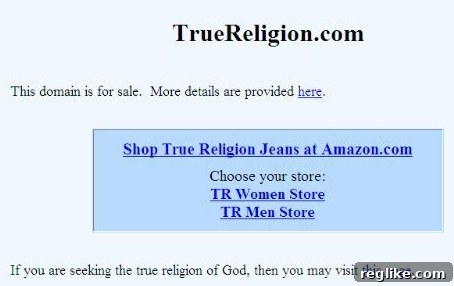
This explicit commercialization, directly referencing and promoting the complainant’s products, dramatically strengthens True Religion’s argument regarding “bad faith use.” By linking to True Religion merchandise, the domain owner appeared to be actively capitalizing on the goodwill and fame associated with the premium denim brand. This constitutes a clear attempt to divert traffic intended for True Religion’s official channels and potentially profit from consumer confusion, which is a key indicator of bad faith under UDRP policy. The company’s earlier “excuse” for delay became irrelevant once the domain’s purpose shifted from a benign, non-commercial use to one that directly capitalized on the True Religion trademark.
The Core Legal Challenge: Proving Bad Faith Registration
Despite the strong evidence of “bad faith use” after 2009, the most formidable obstacle for True Religion remains proving that the domain name was “registered in bad faith.” If the current owner indeed registered the domain in 1998, before True Religion existed, it becomes extremely difficult to establish that the original registration was with the intent to profit from a brand that hadn’t yet been conceived. UDRP panels generally require concrete evidence of such intent at the time of registration.
However, UDRP precedent also allows for nuanced interpretations. If the current owner acquired the domain *after* 2002 (when True Religion was founded), even if the domain was originally registered in 1998 by a different party, the “bad faith registration” argument could be applied to the *acquisition* by the current owner. The original text states “The oldest historical whois record for the domain dates to 2004, and the domain has had the same owner since then.” This phrasing leaves open the possibility that the current owner *acquired* the domain sometime between 1998 and 2004, or specifically in 2004. If the acquisition occurred post-2002, and the current owner later engaged in commercial use targeting True Religion, the argument for bad faith registration, even if indirect, becomes considerably stronger. The WIPO panel would need to carefully examine the chain of ownership and the registrant’s knowledge and intent at the time of their specific acquisition.
Implications and Broader Context for Brand Owners
The outcome of this UDRP case for TrueReligion.com will have significant implications not only for the parties involved but also for the broader domain name dispute landscape. A win for True Religion would reinforce the principle that even historically registered domains can be challenged if their use evolves to exploit a later-established trademark, especially where there’s evidence of commercial intent to divert traffic. Conversely, if the panel sides with the domain owner, it would highlight the formidable challenge of overcoming a “pre-dating registration” defense, even in the face of clear post-registration “bad faith use.”
This case serves as a crucial reminder for all brand owners about the importance of proactive domain name strategy. Early registration of key domain variations, including common misspellings and abbreviations, is often the most effective way to prevent future disputes. For brands like True Religion, whose identity is tightly woven into their name, securing a comprehensive digital presence is not just good practice but an essential defense against cybersquatting and trademark infringement in the ever-expanding online marketplace.
Conclusion: A Complex Balancing Act of Rights
The True Religion versus TrueReligion.com dispute encapsulates the intricate balance between legitimate domain registration rights and the protection of intellectual property. While the premium denim brand can strongly demonstrate its trademark rights and the current owner’s “bad faith use” since 2009, the critical element of “bad faith registration” remains a contentious point given the domain’s pre-2002 registration date. The WIPO panel will meticulously weigh the historical evidence, the specific timeline of ownership, and the evolution of the domain’s content to determine whether True Religion can successfully reclaim this highly desirable digital asset. The resolution of this case will undoubtedly offer valuable insights into the evolving interpretation of UDRP policy in an era where digital identity is paramount.