
Navigating the Tides of Domain Parking: Unveiling Revenue Trends and Strategic Insights
The digital landscape is in constant flux, and for domain owners, understanding the current state of domain monetization is paramount. Over recent years, whispers of steep declines in domain parking revenue have become widespread, with some speculating about catastrophic drops of 50% or more. These “horror stories” paint a grim picture, leading many to question the viability of parking as a core digital asset management strategy. However, a closer look at industry data suggests a more nuanced reality.
According to the self-reported findings from the 4th Annual Domain Name Wire Survey, a comprehensive pulse check among hundreds of domain owners, the situation, while challenging, might not be as dire as commonly feared. While the industry undoubtedly faced headwinds, the widespread catastrophic collapses often cited appear to be outliers rather than the norm. This survey offers a valuable counter-narrative, grounding the discussion in empirical data rather than anecdotal extremes.
Dispelling the 50% Decline Myth: What the Survey Really Reveals
The survey results provide critical clarity on the state of domain parking performance during the period. While it’s true that a significant portion of participants experienced a downturn, the overall picture was far from a universal collapse. Specifically, 45% of respondents indicated that their domain parking income had decreased in 2008. This figure, though substantial, is juxtaposed by other compelling statistics.
Notably, a robust 40% of domain owners reported that their parking revenue remained stable on a domain-by-domain basis. This segment represents a significant portion of the market that managed to weather the economic storm without experiencing drastic losses. Furthermore, a positive outlook was reported by 16% of participants who actually saw an increase in their parking revenue during the same period. These figures collectively suggest a market in flux, but one that also presented opportunities for stability and growth for a considerable number of participants.
Perhaps most importantly, when examining the extent of the decline, only 13% of domain owners reported a significant drop of 50% or more. While this group undoubtedly faced substantial challenges, it highlights that the most severe revenue contractions were not a universal experience across the entire domain industry. Compared to the tumultuous performance of other investment vehicles, such as the stock market during the same period – a period marked by global financial uncertainty – the resilience shown by a large segment of the parked domain market offers a compelling perspective. If only we could all say the same about our broader investment portfolios.
The visual representation below further illustrates these findings, depicting how domain owners fared in the competitive landscape of domain monetization strategies over the past year:
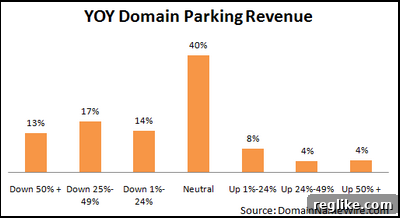
Naturally, the distribution is “skewed to the left,” indicating that more people experienced declines or stability than significant growth. However, this skew does not equate to widespread devastation, but rather a challenging market environment that required strategic navigation.
The Discrepancy: Public Reports vs. Private Portfolios
One of the most intriguing aspects of these survey results is the apparent disconnect between broad industry sentiment and specific corporate disclosures. For instance, at the time of the survey, a prominent public company in the digital advertising space reported a nearly 50% drop in parking revenue across its own extensive portfolio. This stark figure begs the question: why would a survey of 400 diverse domain owners not reflect such a drastic, across-the-board decline?
Several factors could contribute to this discrepancy. Firstly, the public company’s portfolio might be exceptionally large and homogenous, perhaps more susceptible to specific algorithmic changes or shifts within a particular ad network. In contrast, the survey respondents likely represent a more diverse array of portfolio sizes, domain types, and chosen domain parking providers, offering a more generalized view of the market. Furthermore, the survey’s “domain-by-domain” focus allows for individual assessment, whereas a large corporate report might present aggregated portfolio averages that mask individual domain performance.
Secondly, and critically, the level of domain optimization plays a pivotal role. It’s plausible that some large entities, despite their resources, may not be as agile or as meticulous in optimizing each domain for peak performance. In private conversations with owners of leading domain parking companies, it has become evident that while a decline was common in 2008, a 50% drop was considered significantly outside the typical experience for most actively managed portfolios. This suggests that proactive management and continuous optimization are key differentiators between those who merely ride the waves and those who actively steer their course.
The Art of Domain Optimization: Maximizing Your Digital Assets
Effective domain portfolio management, particularly for parked domains, is far from a passive endeavor. It requires strategic insight and ongoing effort. For those aiming to mitigate revenue drops and even achieve growth, mastering the art of domain optimization is crucial. This involves several key practices:
- Choosing the Right Parking Provider: Different providers excel with different types of traffic and domains. Researching and selecting a provider whose platform, ad partners, and optimization tools align with your portfolio’s characteristics can significantly impact RPMs (Revenue Per Mille/Thousand).
- Precise Categorization and Keyword Alignment: Accurate categorization of your domains is vital for ad relevancy. Ensuring that your parked pages are properly tagged with relevant keywords helps ad networks display highly targeted advertisements, thereby increasing click-through rates and earnings.
- A/B Testing Landing Page Templates: Many parking platforms offer various landing page designs and layouts. Experimenting with different templates, ad placements, and call-to-action buttons can reveal which configurations resonate most effectively with your specific domain traffic.
- Monitoring Traffic Quality and Sources: Not all traffic is created equal. Understanding where your traffic originates and its quality (e.g., direct navigation, type-ins, search referrals) allows for tailored optimization strategies and helps identify potential issues like bot traffic.
- Regular Performance Reviews: The digital advertising landscape evolves rapidly. Regularly reviewing the performance of individual domains and your portfolio as a whole allows you to quickly identify underperforming assets, adjust strategies, and capitalize on new opportunities.
- Understanding Ad Formats: Different ad formats (text ads, display ads, video ads) have varying performance metrics. Working with your parking provider to understand which formats are best suited for your domain types can optimize revenue streams.
Proactive and informed domain optimization can transform a potentially significant loss into a manageable dip, or even an opportunity for enhanced performance. It differentiates the truly successful domain investors from those who view domain parking as a ‘set it and forget it’ solution.
Glimpsing the Horizon: Domainers’ Expectations for 2009 and Beyond
Looking ahead, the survey also provided insights into domainers’ expectations for the immediate future. The sentiment for 2009 was cautious, to say the least. A substantial 44% of respondents anticipated lower RPMs, indicating a prevailing expectation of continued downward pressure on earnings. This outlook likely stemmed from a combination of ongoing global economic uncertainty, increased competition for online advertising dollars, and the continuous evolution of search engine algorithms which impact direct navigation traffic.
Conversely, a smaller but notable 21% of domain owners expected better results than in 2008. This segment might consist of those with highly optimized portfolios, those who had recently acquired premium domains, or those who anticipated a rebound in the advertising market. The remaining percentage likely expected stability, reflecting a diverse range of market predictions and individual circumstances.
This forward-looking perspective highlights the need for domain owners to not only adapt to current conditions but also to strategically plan for future shifts. The era of purely passive domain parking for significant returns was already showing signs of waning, pushing domainers towards more dynamic and diversified monetization strategies.
Adapting to Change: Strategies for Long-Term Domain Monetization
Given the fluctuating nature of domain parking earnings, a singular reliance on this method may no longer be sufficient for long-term profitability. Savvy domain owners are increasingly exploring alternative domain monetization models to diversify their income streams and build more resilient portfolios. These strategies include:
- Developing Domains into Mini-Sites or Lead Generation Hubs: Instead of a parked page, a domain can host a simple, content-rich website or a specialized lead generation page. This often provides more value to visitors and offers greater control over advertising, affiliate marketing, or direct lead sales.
- Affiliate Marketing: Building niche websites around valuable domains and integrating affiliate links to relevant products or services can generate significant passive income, often exceeding parking revenues for well-targeted sites.
- Selling Products or Services: For highly relevant domains, direct development into e-commerce stores or service portals can unlock substantial value, transforming a parked asset into an active business.
- Leasing Domains: Similar to real estate, domains can be leased to businesses that can benefit from their premium status or type-in traffic, providing a steady stream of income without requiring full development.
- Strategic Resale: Continuously evaluating the market for specific domains and identifying opportune times for resale can be a highly lucrative strategy, especially for strong brandable or generic keyword domains.
The shift from passive parking to active development or strategic leveraging of high-value domains is a clear trend. It underscores the importance of viewing domain names not just as static digital addresses, but as dynamic digital assets with immense potential for various forms of value creation.
The Evolving Landscape of Digital Assets
Domain names represent prime digital real estate. Their value, like physical property, is influenced by location (keyword relevance), branding potential, and utility. Even with the challenges faced by online advertising and domain parking, the intrinsic value of a well-chosen domain remains significant. They are foundational to online identity, brand recognition, and direct user access to information and services.
The domainers who thrive in this evolving environment are those who view their portfolios as dynamic entities requiring continuous care, adaptation, and strategic foresight. While the era of effortless parking profits may be largely behind us, the opportunities for intelligent monetization and value creation within the domain industry are as robust as ever for those willing to innovate and adapt.
Conclusion: Navigating Uncertainty with Strategy and Foresight
The 4th Annual Domain Name Wire Survey provided a vital snapshot of domain parking trends during a challenging economic period. It successfully debunked the myth of a universal 50% revenue collapse, revealing a more complex picture where many experienced stability or even growth, while others faced significant headwinds. The data unequivocally highlights that proactive domain management and meticulous optimization are not mere advantages but necessities in today’s competitive landscape.
As domainers look towards the future, the message is clear: vigilance, adaptation, and diversification are paramount. While a significant portion expects continued pressure on RPMs, the industry’s resilience and the numerous alternative monetization strategies available offer a pathway to sustainable success. By staying informed, embracing best practices in optimization, and exploring new avenues for value creation, domain owners can continue to unlock the full potential of their digital assets.
For a deeper dive into these fascinating findings and more comprehensive insights into the domain industry’s outlook, you can explore the complete results from the 2009 Domain Name Wire Survey.