
ICANN’s TLD Application System Security Flaw: An In-Depth Look at Industry Repercussions
The Internet Corporation for Assigned Names and Numbers (ICANN), the non-profit organization responsible for coordinating the global internet’s unique identifiers, faced a significant challenge when it publicly acknowledged a serious security vulnerability within its Top-Level Domain (TLD) Application System (TAS). This admission, following extensive public relations efforts to promote the ambitious New gTLD Program, quickly shifted the narrative from innovation and expansion to concern over data integrity and system reliability. The incident, which allowed applicants to potentially view confidential information belonging to others, sent immediate ripples through the domain name industry and raised critical questions about the robustness of processes underpinning the internet’s future.
This security lapse was more than just a minor technical hiccup; it represented a critical breach of trust for the myriad entities – from global corporations to small businesses and public interest groups – that had invested heavily in applying for new generic Top-Level Domains (gTLDs). The TAS was the central repository for highly sensitive data, including intricate business plans, strategic objectives, proposed domain strings, and financial details. The revelation of such a flaw necessitated an immediate response from ICANN, prompting an extension of application deadlines and triggering widespread discussion across the internet community about the implications for cybersecurity, internet governance, and the very foundation of digital trust.
The New gTLD Program: A Vision for Internet Expansion
Launched to expand the internet’s namespace beyond traditional TLDs like .com, .org, and country-code domains, ICANN’s New gTLD Program represented a monumental undertaking. Its goal was to foster innovation, increase competition, and offer greater choice to internet users by allowing almost any string to become a top-level domain. This initiative attracted thousands of applicants worldwide, each vying for the opportunity to operate a new gTLD, whether it be a brand-specific domain like .apple, a geographic one like .nyc, or a generic term like .shop.
The application process itself was notoriously complex, expensive, and time-consuming. Prospective registry operators had to submit comprehensive proposals detailing their technical capabilities, financial stability, marketing strategies, and operational plans. All this sensitive information was submitted and managed through the online TLD Application System (TAS). Given the high stakes involved – applications often cost hundreds of thousands of dollars, not including legal and consulting fees – the integrity and security of the TAS were paramount. It was designed to be a secure, confidential environment, safeguarding competitive information and ensuring a level playing field for all participants. The discovery of a flaw in this critical system therefore struck at the heart of the program’s credibility.
Dissecting the TAS Security Incident: A Crisis of Confidence
The core of the ICANN TAS security problem involved a vulnerability that could allow some applicants to inadvertently gain unauthorized access to data from other applicants. While ICANN acted swiftly to address the flaw upon discovery, the potential for exposure of confidential data, such as proposed gTLD strings, applicant identities, or even details of their business cases, was a significant concern. This incident immediately halted the application process, leading to a temporary shutdown of the system and an extension of key deadlines for the New gTLD Program.
The nature of the vulnerability meant that even if the exposure was accidental rather than malicious, the implications for competitive advantage were severe. An applicant gaining insight into a competitor’s strategy or desired gTLD could potentially adjust their own application, influence contention resolution processes, or exploit strategic information. This situation not only put individual applicants at risk but also cast a shadow over the fairness and transparency of the entire program, which ICANN had worked so diligently to establish. The crisis highlighted the critical need for robust cybersecurity measures, not just against external threats, but also against internal system logic flaws that could compromise data segregation and privacy.
The Digital Echo Chamber: Industry Reactions and Commentary
As the news of the TAS security flaw unfolded, the internet governance community, industry analysts, and the wider web quickly responded. The incident became a focal point for discussion, scrutiny, and often, pointed commentary, reflecting a mixture of concern, frustration, and even a degree of “I told you so” from long-time critics of the program’s scale and complexity.
The Best Headline: A Concise Expression of Disbelief
Among the immediate reactions, one headline particularly resonated for its succinct yet powerful summary of the situation:
“.Oops”: Glitch forces extension for new suffixes (Associated Press)
This headline perfectly captured the prevailing sentiment. The casual “Oops” conveyed a sense of almost ironic disbelief that such a fundamental error could occur in a multi-billion-dollar global initiative managed by ICANN, an organization entrusted with the stability of the internet. It subtly underscored the perceived technical misstep, while the “glitch forces extension” highlighted the tangible, disruptive consequences for an already tightly scheduled and high-pressure application process. For many, it was an indication that even with extensive planning and resources, the human element and technical intricacies could still lead to significant, publicly embarrassing failures.
Twitter’s Real-time Pulse: Frustration and Fast Information
Social media platforms, especially Twitter, became a rapid-fire channel for industry experts and observers to share their immediate thoughts and frustrations. These short, impactful messages offered a real-time pulse of the domain community’s sentiment:

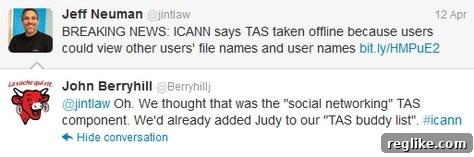
Courtesy of @BerryhillJ.
These tweets from figures like @BerryhillJ exemplified the quick dissemination of information and the immediate, often sharp, critique that characterized the online reaction. They demonstrated the profound concern among stakeholders who rely on ICANN’s operational excellence and security protocols. Such rapid public discourse not only heightened awareness but also placed additional pressure on ICANN to provide transparent updates and effective solutions.
Opportunistic Agenda Pushing: Questioning Program Viability
The security incident also served as a catalyst for deeper discussions and, in some cases, provided a platform for existing criticisms of the New gTLD Program to gain renewed traction. Questions about ICANN’s technical oversight and the inherent risks of such a massive expansion became more pronounced. A prominent example came from Mark Monitor, a leading brand protection and domain management company:
Is the New Top-Level Domains “Technical Issue” a Harbinger of Future gTLD Issues?
Courtesy of Mark Monitor.
This question was far from rhetorical. It tapped into a core anxiety within the domain industry: if such a fundamental system could experience a significant security flaw, what other unforeseen technical or operational challenges might lie ahead for the nascent gTLD ecosystem? For companies like Mark Monitor, whose clients’ brand integrity and digital presence are paramount, such an incident was a serious warning. It highlighted the need for continuous vigilance and robust technical safeguards, fueling broader debates about the scalability and inherent risks associated with expanding the internet’s root zone at such an unprecedented pace.
The Art of the Parenthetical Jab: Irony in Transparency
Amidst the serious technical and strategic discussions, there was also room for some astute, even humorous, commentary that highlighted the ironic nature of the situation. The timing of the security flaw revelation, just weeks before the eagerly anticipated “Big Reveal” day – when ICANN was scheduled to *publicly* disclose gTLD applications – offered a perfect opportunity for a sharp, parenthetical jab:
“The organization has also confirmed that it is still targeting April 30 for the Big Reveal day, when it publishes (deliberately) the gTLDs being applied for and the names of the applicants.”
Bada bing! Kevin Murphy will be here all week, folks. Remember to tip your waiters.
Attributed to Kevin Murphy of Domain Incite, this quote brilliantly underscored the paradox: ICANN was struggling with an *inadvertent* exposure of sensitive applicant data due to a system vulnerability, while simultaneously preparing for a *deliberate* and highly anticipated public disclosure of other key applicant information. The parenthetical “(deliberately)” served as a witty and pointed critique, drawing a stark contrast between the unintended breach and the planned transparency. It resonated with many who found the situation somewhat farcical, adding a layer of dry humor to an otherwise grave security incident and emphasizing the intricate dance between privacy and public information in the domain name space.
Broader Implications and Enduring Lessons for Cybersecurity
The ICANN TAS security vulnerability extended beyond the immediate disruption to the New gTLD Program; it offered invaluable, albeit hard-learned, lessons for internet governance, cybersecurity protocols, and the management of large-scale digital initiatives. For ICANN itself, the incident served as a potent reminder of the immense responsibility it carries in maintaining the stability, security, and trustworthiness of the internet’s core infrastructure. It prompted a rigorous re-evaluation of internal security audits, vendor management processes, and incident response frameworks. Rebuilding trust required not only technical remediation but also enhanced transparency and proactive, clear communication with its diverse global stakeholder community.
For the thousands of applicants, the event underscored the critical importance of conducting thorough due diligence when entrusting sensitive, proprietary data to any digital platform, irrespective of the perceived authority or reputation of the managing entity. It vividly highlighted the inherent risks in highly competitive processes where information leakage, accidental or otherwise, could have profound strategic, financial, and reputational consequences. Many organizations undoubtedly revisited their internal cybersecurity practices, data sharing policies, and contingency plans for future high-stakes digital engagements.
On a broader level, the incident reinforced the universal principle that cybersecurity is not a static destination but a continuous journey demanding perpetual vigilance, dynamic adaptation to emerging threats, and sustained investment. Even the most meticulously designed and rigorously tested systems can harbor vulnerabilities, and the speed, transparency, and effectiveness of discovery, containment, and communication are paramount. The ICANN TAS security problem became a compelling case study illustrating how a seemingly isolated technical flaw in a single, critical system could send pervasive ripples throughout an entire global industry, affecting multi-stakeholder trust and prompting a fundamental re-examination of operational best practices across the entire domain name system ecosystem.
Conclusion: A Continuous Commitment to Trust and Security
The security vulnerability within ICANN’s TLD Application System marked a pivotal moment in the ambitious trajectory of the New gTLD Program. It starkly illuminated the delicate balance between fostering innovation and ensuring robust security, between ambitious expansion and meticulous execution, and between planned transparency and unforeseen data protection challenges. While the immediate crisis was effectively managed through diligent system remediation and necessary program adjustments, its reverberations resonated far beyond the initial headlines, serving as a powerful and enduring reminder that in our intricately interconnected digital world, the integrity of even the most robust systems can be compromised, and the trust of stakeholders is an invaluable, fragile asset that must be ceaselessly earned and vigilantly protected.
Moving forward, the lessons gleaned from this incident underscore the imperative for ICANN and all other critical internet infrastructure providers to uphold an unwavering commitment to cybersecurity excellence, foster transparent communication, and implement proactive risk management strategies. As the internet continues its relentless evolution and new programs emerge to shape its future, the insights gained from the TAS security problem will undoubtedly serve as a crucial guiding principle, reinforcing the profound and enduring importance of security as the indispensable bedrock upon which the entire global digital landscape is built and sustained.