
Kassey Lee examines the market for .com domain names in China.
The Undisputed Reign: Why .Com Dominates China’s Digital Landscape
In a continuation of our extensive series exploring the nuanced and rapidly evolving Chinese domain market, following a panoramic overview of the broader context and an intricate dive into the national .cn domain, this article shifts its focus to the paramount importance and surging influence of .com domain names within China. This detailed analysis is built upon a foundation of meticulously collected data from China Internet Network Information Center (CNNIC) reports, spanning from 1997 to the present, offering a robust historical perspective on this critical digital asset.
The global internet landscape is undeniably shaped by the .com extension, and China, with its colossal online population and burgeoning digital economy, is no exception. Understanding the specific dynamics of .com within this powerful market is crucial for businesses, investors, and brand strategists alike. We delve into its market presence, significant valuation drivers, historical growth trends, and unique speculative phenomena that characterize its trajectory in the East.
A Closer Look at China’s Domain Preferences: Beyond the Surface
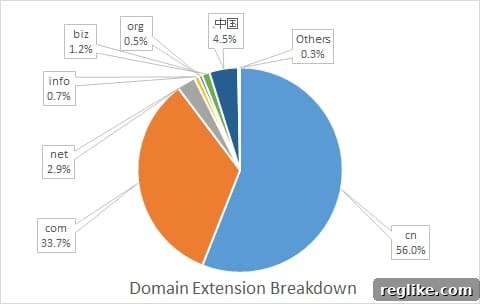
Observing the distribution of domain names registered within China as of December 2018, as depicted in the chart above, might initially suggest a lesser prominence for .com when compared to the national .cn extension based purely on volume. However, such a numerical interpretation would be misleading and fail to capture the profound strategic significance of .com. In reality, the opposite holds true: .com stands as the undisputed king in corporate China. Its prestige, global recognition, and inherent trust factor make it the preferred choice for established enterprises, ambitious startups, and international brands seeking to solidify their presence in the vast Chinese market.
The Unrivaled Value of .Com for Chinese Corporations
The dominance of .com in China transcends mere registration statistics; it is deeply rooted in its universal appeal and the unparalleled credibility it lends to businesses. For any Chinese company with aspirations of national leadership or global expansion, a .com domain is not just an address—it’s a statement of professionalism, stability, and international outlook. This perception is powerfully reflected in the market, where .com domains consistently achieve the highest prices in domain sales, showcasing their status as premium digital real estate. These record-breaking transactions highlight the strategic importance and significant investment Chinese businesses are willing to make to secure a compelling and globally recognized .com presence.
Consider these landmark sales, which underscore the immense value proposition of elite .com domains in the Chinese context:
- Voice.com – Acquired for an Astounding $30 Million (2019). This monumental transaction saw Hong Kong-based blockchain powerhouse block.one secure one of the most powerful generic domains globally. The acquisition of Voice.com signals a clear intention to establish a dominant international presence and leverage a universally understood brand identifier for cutting-edge technology.
- 360.com – A $17 Million Investment by Qihoo 360 (2015). Beijing-based cybersecurity leader Qihoo 360’s substantial investment in 360.com exemplifies the critical role a succinct and memorable .com plays in solidifying brand identity and market leadership, particularly in a high-trust industry like digital security.
- Le.com – $10 Million for a Media and Tech Giant (2015). Beijing-based Le TV, a key player in China’s rapidly expanding entertainment and technology sectors, invested heavily in Le.com. This acquisition demonstrates the profound link between a premium domain and brand resonance, essential for captivating audiences in the competitive digital media landscape.
- We.com – Ren Ren Dai’s $8 Million Strategic Acquisition (2015). Beijing-based peer-to-peer lending platform Ren Ren Dai’s purchase of We.com highlights the strategic foresight of financial technology companies. A short, impactful .com domain builds trust, enhances memorability, and fosters user engagement in a sector where credibility is paramount.
- Vivo.com – Secured for $2.1 Million by Vivo (2015). Guangdong-based smartphone manufacturer Vivo, a global consumer electronics brand, invested in its namesake domain. This reflects a commitment to a consistent and powerful online identity that resonates across international markets, critical for global brand recognition and expansion.
These transactions are not merely isolated incidents but rather illustrative examples of a consistent trend where Chinese enterprises view .com domains as invaluable strategic assets. They are foundational to building strong brands, expanding market reach, and ensuring long-term digital growth in an increasingly interconnected world.
The Expanding Horizon: Trends in .Com Registrations in China
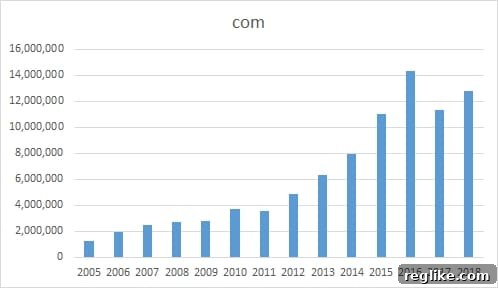
A comprehensive analysis of historical registration data reveals a compelling and generally upward trajectory for .com domain registrations linked to Chinese individuals and entities. As the chart above illustrates, this trend saw the number of registered .com domains reach approximately 12.8 million by December 2018. This sustained growth signifies the escalating digital maturity of the Chinese market, driven by increasing internet penetration, robust economic expansion, and a burgeoning ecosystem of online businesses and services. However, this figure, while impressive, only captures a part of the true picture.
Unveiling the True Scale: The Impact of Overseas Registrations
A crucial factor to consider when assessing the full scope of China’s engagement with .com domains is the significant number of Chinese-owned domains registered overseas, predominantly in the United States. This practice is influenced by a multitude of strategic and practical considerations, including perceived regulatory stability, streamlined international transaction processes, and the desire for a global digital infrastructure that supports worldwide reach. Prominent Chinese corporations and global brands such as Baidu.com, Tencent.com, JD.com, and DJI.com, in addition to the previously mentioned Voice.com, are all registered in the US, despite their core operations and ownership being firmly rooted in China.
Consequently, the true total count of .com domains under Chinese ownership far surpasses the 12.8 million reported as registered within China itself. This phenomenon introduces a vital nuance to understanding the sheer scale and profound influence of China in the .com ecosystem. When these substantial overseas registrations are accounted for, the strategic significance and economic power of .com for Chinese enterprises become even more pronounced, reflecting a sophisticated global approach to their digital asset management and branding strategies.
The “Chips” Phenomenon: A Dive into China’s Speculative Domain Market
The Chinese domain market, while characterized by consistent long-term growth and corporate adoption, also exhibits a distinct vibrancy driven by speculative surges. One of the most remarkable examples of this speculative energy occurred between 2015 and 2017 with the emergence of the “chips” investment theme. The term “chips,” a clever portmanteau of “[Chi]nese” and “[P]remium” (in plural form), originally referred to specific categories of domains believed to possess enhanced intrinsic value for the discerning Chinese investor.
Initially, “chips” domains were defined as those comprising only consonants, intentionally excluding the vowel letters (a, e, i, o, u). The rationale was that such domains would be more concise, universally pronounceable, and less prone to linguistic barriers, thereby holding broader appeal. This definition rapidly expanded to include numerical domains that specifically avoided the digits ‘0’ and ‘4’. The number ‘4’ is considered inauspicious in Chinese culture due to its phonetic similarity to the word for “death,” while ‘0’ can sometimes carry connotations of emptiness or lack of value. Domains free of these potentially negative associations were seen as inherently more valuable.
This unique and culturally specific classification ignited a frenzied period of intense speculation. A large number of enthusiastic investors and domainers rapidly acquired and registered a vast array of .com domains, specifically targeting categories such as 5-letter (5L) domains, 6-number (6N) domains, 7-number (7N) domains, and other permutations that met the “chips” criteria. The market witnessed a rapid inflation of prices, driven by the belief that these domains, tailored to specific cultural preferences and perceived universality, were guaranteed to appreciate exponentially. This speculative fervor created a significant market bubble.
However, as is often the case with such rapid accelerations, the “chips” boom proved unsustainable. The market reached its zenith and subsequently experienced a sharp correction and significant dip in 2017, as the bubble eventually burst. This period served as a stark reminder of the inherent volatility and risks associated with highly speculative markets. Despite this correction, the underlying strength and resilience of the broader .com market in China were undeniably demonstrated, as registrations and valuations notably recovered and resumed growth in 2018, reinforcing the fundamental demand that exists beyond transient investment fads.
The Enduring Appeal and Future Trajectory of .Com in China
When projecting the future, the outlook for the .com domain segment in China remains exceptionally robust and poised for sustained growth. The profound and consistent preference for .com is not merely a passing trend but is deeply embedded within the corporate ethos and the broader digital strategy of Chinese businesses. This enduring affinity is primarily fueled by .com’s unparalleled global recognition, its established credibility, and its status as the de facto standard for any legitimate and ambitious online entity. Absent any drastic and currently unforeseeable regulatory shifts that might specifically disadvantage .com domains—a scenario that appears highly improbable given its universal acceptance and critical role in global internet infrastructure—its preeminence is set to continue unabated for the foreseeable future.
However, it is equally vital to acknowledge a distinctive characteristic of the Chinese investment landscape: a pronounced cultural inclination towards speculation. This inherent trait strongly suggests that the “chips” boom, while a significant historical event, should not be viewed as an isolated anomaly but rather as a compelling precursor to future market phenomena. We can confidently anticipate that new, innovative, and potentially disruptive investment themes will inevitably emerge. These themes are likely to capture the imagination of various segments within the domain community, leading to further cycles of speculative fervor, market growth, and subsequent corrections. The “chips” boom of 2015-2017 thus serves as a vivid and instructive illustration—a mere preview—of the dynamic, sometimes volatile, yet consistently engaging future of domain investment and ownership within China’s rapidly evolving and increasingly influential digital economy.
As China continues its remarkable ascent as a global economic and technological superpower, the strategic imperative of securing and leveraging .com domains for establishing, protecting, and expanding digital identities will only intensify. The unique combination of a deep-seated corporate demand for stability, global recognition, and strong branding, synergistically coupled with a vibrant and often speculative investment undercurrent, positions the Chinese .com market as one of the most exciting and closely monitored segments on the global stage. A nuanced understanding of these complex dynamics is unequivocally key to fully appreciating the vast scope of China’s digital ambition and its intricate, enduring relationship with the internet’s most iconic domain extension.