
Navigating the Labyrinth of New TLD Pre-Orders: A Frustrating Reality for Domain Enthusiasts
The expansion of the internet’s naming system through new Generic Top-Level Domains (gTLDs) promised a revolution in online identity, offering brands and individuals unprecedented choice and specificity. Yet, for many enthusiasts and domain professionals, the journey into this brave new world remains fraught with unexpected challenges. Pre-ordering these sought-after new TLDs, a critical step for securing desirable addresses ahead of general availability, is proving to be a remarkably complex and often exasperating experience. What should be a straightforward transaction frequently devolves into a convoluted quest, testing the patience of even the most seasoned domain experts.
The Promise and Peril of New TLDs: More Than Just an Address
New gTLDs, such as .website, .app, .online, and hundreds more, were introduced to diversify the digital landscape beyond traditional .com, .net, and .org extensions. They offer opportunities for stronger branding, clearer identity, and niche market targeting. For businesses, securing a relevant new TLD can be a strategic move, while for individuals, it might mean finally owning that perfect, short, and memorable domain name. This potential drives significant interest in the pre-order phase, which often includes critical stages like “Sunrise” (for trademark holders), “Landrush” (premium pre-registration), and eventually “General Availability.”
Given the competitive nature of desirable domain names, pre-ordering is crucial. It offers a chance to stake a claim on a domain before the masses, often operating on a first-come, first-served basis once the registry opens. However, the technical intricacies behind the scenes, involving coordination between ICANN, registries, and registrars, create a fertile ground for user experience pitfalls. From navigating Trademark Clearinghouse (TMCH) notifications to understanding varied pricing structures and opaque registration rules, the process is far from seamless.
The Pre-Order Landscape: A Registrar’s Battlefield and User’s Maze
Registrars act as the crucial interface between domain seekers and the complex world of registries. Their ability to streamline the pre-ordering process, manage TMCH alerts, handle diverse payment methods, and provide clear communication is paramount. Unfortunately, many registrars struggle to deliver a consistently smooth experience. What I’ve observed firsthand is a landscape where solutions often feel “hacked together,” lacking the polish and intuitiveness one would expect from a mature industry. This disparity between the promise of new TLDs and the reality of pre-registration creates significant friction for users, turning what should be an exciting venture into a test of endurance.
GoDaddy: A Market Leader with Persistent Quirks
My pre-order journey often begins with GoDaddy, largely because they are perceived as one of the better-equipped registrars to handle new TLD launches. Their interface is generally fast and relatively clear in explaining options. On a recent attempt to pre-register 22 .website domain names, I found the lack of a bulk pre-registration tool somewhat inconvenient but manageable due to the site’s speed. Checking out was straightforward, setting a hopeful tone.
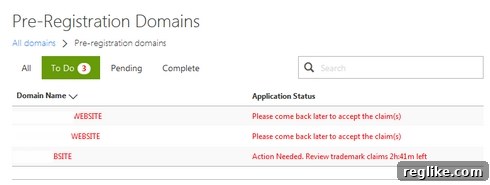
However, the smooth experience soon encountered its first hurdle: Trademark Clearinghouse (TMCH) alerts. These notifications are vital for trademark holders and require acknowledgment. Upon receiving three such alerts for my chosen domains, I diligently clicked through. The instruction to “Please come back later to accept the claim(s)” after logging in was both perplexing and concerning. The feeling of uncertainty – whether my domains would truly be secured without immediate acknowledgment – was palpable. Returning later, only one of the three domains allowed me to proceed, resulting in a vague error message, yet paradoxically, the claim was eventually acknowledged. The lack of clear communication around these critical steps can be a major source of anxiety for users.
The frustration escalated when attempting to pre-register an additional domain, let’s call it ABC.website. I was caught in a bewildering loop: an “unavailable” error during checkout, followed by the domain appearing “available” on the homepage, then “available” on the specific .website pre-order page, only to have my cart empty and be redirected to the homepage after attempting to add it. This inconsistent availability information and broken checkout flow not only wastes valuable time but also creates a significant trust issue, leaving users wondering if the domain is truly available or if the system is simply malfunctioning. Despite these frustrating hiccups, GoDaddy still often provides a less painful experience than many of its competitors, highlighting the pervasive nature of these issues across the industry.
101Domain: Value Proposition with Unforeseen Administrative Burdens
101Domain.com often attracts users with its extensive inventory of TLDs and competitive pricing – for example, offering .website domains at a compelling $9.99 compared to GoDaddy’s $14.99. My attempt to pre-order 23 .website domains followed a similar pattern of individual searches due to the absence of a bulk search function. While the site’s speed mitigated some of this tedium, several issues surfaced that transformed a cost-effective choice into an administratively heavy one.
The first point of confusion arose with the error message: “There is already an open order for ABC.website.” This message, while intended to inform users that a domain is already pre-ordered, misleadingly suggests that *I* had already placed an order, rather than another user. In a competitive pre-order environment, clear messaging is paramount; ambiguity can lead to wasted effort and missed opportunities. Secondly, the sheer volume of confirmation emails was staggering. For 19 domains pre-ordered in a single transaction, I received a baffling 40 separate email confirmations. This deluge clutters inboxes and undermines the professional image of the registrar. Lastly, 101Domain’s refund process for domains that aren’t secured at launch is notably slow, often taking several weeks. This ties up customer funds, which can be problematic for businesses or individuals managing tight budgets. While the low prices are appealing, users must weigh these administrative quirks against the financial savings.
The Gauntlet of Disappointment: Examining Other Registrars
My quest for a smooth pre-ordering experience led me to several other registrars, each presenting its own unique set of obstacles and deterrents.
Hexonet (1API): The “Deposit First” Dilemma
Hexonet initially appeared promising, particularly with its much-appreciated bulk search feature for new TLDs – a rare gem in this market. However, the excitement quickly dissipated upon discovering their payment model: users must first deposit funds into an account before placing orders. This “credit system” presents a significant disincentive. If the desired domains aren’t secured, users are left with credit rather than a direct refund, effectively tying up their capital. Furthermore, attempting to make a credit card deposit triggered a manual authentication process: an email to support, followed by a phone call for verification. In an age of instant online transactions, requiring a multi-step, human-mediated verification for a simple payment is a major barrier to entry, especially when speed is often of the essence in domain acquisition.
Name.com: The Mysterious “Try Again”
Name.com offered little clarity. Repeated attempts to search for a .website domain consistently resulted in a generic “please try again” message. Without any specific error code or explanation, it was impossible to discern the root cause – was it a technical glitch, an unsupported TLD, or perhaps an intentional shutdown of pre-orders ahead of launch, as is sometimes observed with registrars like eNom (its parent company)? Such opacity effectively bars users from participating, regardless of their intent.
United Domains: The Price Barrier
United Domains, for all its potential virtues, was quickly ruled out due to its pricing. At $29 for a .website domain, it significantly outpriced competitors offering the same TLD for $9.99 or $14.99. While premium services might justify higher costs, for many common new gTLDs, such a price difference makes it an unfeasible option for all but the most niche or critical domain acquisitions.
1&1: A Cautionary Tale of UX Catastrophe
My initial encounter with 1&1 was so frustrating that I abandoned it entirely. However, spurred by their competitive $9.99 price for .website domains and their reported $50 million advertising investment in new TLD pre-orders, I felt compelled to give them a second chance. This decision, unfortunately, led to one of the most perplexing and infuriating user experiences imaginable.
The core problem with 1&1 is a fundamental breakdown in user experience (UX) and site performance. The website operates at an excruciatingly slow pace, turning simple navigation into a test of profound patience. But beyond the speed, the usability is fundamentally broken. To illustrate, imagine this absurd retail scenario: You’re at an electronics store, carefully selecting a Blu-Ray player and adding it to your cart. Then, you pick up an HDMI cable. Suddenly, a store employee snatches the Blu-Ray player from your cart and vanishes. Undeterred, you find another player, only for the same employee to return and steal your HDMI cable. You manage to retrieve your items, add a couple of Blu-Ray discs, and head to checkout. Just as you add one last disc, the employee reappears, yells “ILLEGAL!”, dumps your entire cart, and confiscates everything. This ridiculous scenario perfectly mirrors the unpredictable and infuriating cart management system at 1&1.
Specifically, I would search for a .website domain, add it to my cart, and it would appear in a selection box. I would repeat the process for a few more domains. The site’s agonizing slowness made this a tedious process, but I persevered, seeing progress. Then, upon searching for yet another domain, I encountered a “warning” message. Mysteriously, *all but the first domain I had added to my cart vanished*. The explanation for this behavior was non-existent. The domains were not on any known name collision list, nor did they trigger Trademark Clearinghouse alerts. Even more bizarrely, sometimes repeating the search for the same “problematic” domain would yield no warning, allowing it to be added successfully. This inconsistent, unpredictable, and frankly, hostile user experience for something as crucial as a pre-order is simply unacceptable. It undermines trust, wastes time, and makes it virtually impossible to reliably secure multiple desired domains.
Conclusion: The Path Forward for Pre-Orders
The current state of new TLD pre-ordering is a clear indication that while the internet’s infrastructure is evolving, the user-facing tools are lagging significantly. The journey to secure a new domain, meant to be an empowering experience, is instead riddled with technical glitches, confusing communication, and fundamentally broken user interfaces. Registrars, despite significant investments in advertising, often fail to prioritize the basic tenets of good UX: clarity, consistency, and reliability.
For users eager to claim their piece of the new digital frontier, the current advice is cautionary: research registrars thoroughly, be prepared for potential frustrations, and consider distributing your pre-orders across multiple platforms if a domain is particularly critical. The lack of bulk registration tools, opaque TMCH processes, baffling cart management, and prohibitive payment requirements are not mere inconveniences; they are significant barriers to adoption and reflect a broader industry challenge. Until registrars collectively commit to investing in robust, user-centric pre-ordering platforms, the promise of new TLDs will continue to be overshadowed by the messiness of their acquisition process.