
Verisign Sounds Alarm: Is the Internet Truly Ready for New Top-Level Domains?
The landscape of the internet is constantly evolving, with new innovations and expansions shaping how we connect and interact online. One of the most significant shifts in recent years has been the introduction of new generic Top-Level Domains (gTLDs), promising a more diverse and organized online space. However, a recent report from Verisign, a cornerstone of the internet’s infrastructure, casts a shadow of doubt over the readiness of this ambitious undertaking, particularly concerning critical technical and operational aspects.
Verisign, the authoritative registry operator for the fundamental .com and .net domains and the administrator of the internet’s root zone, has delivered a comprehensive report to ICANN (Internet Corporation for Assigned Names and Numbers), the global body responsible for coordinating the internet’s naming system. This report, also filed with the U.S. Securities and Exchange Commission, essentially argues that the internet ecosystem, in its current state, is insufficiently prepared for the widespread delegation and integration of these new TLDs. This stark warning from such a critical player demands immediate attention from all stakeholders involved in the internet’s future.
Unpacking Verisign’s Core Concerns: A Call for Robust Preparation
The report meticulously highlights several pivotal issues that, according to Verisign, pose significant risks to the stability, security, and smooth operation of the internet should new gTLDs be rolled out without adequate preparation. These concerns span a range of technical, operational, and policy-related deficiencies that, if unaddressed, could lead to unforeseen complications.
Technical Integration and Root Zone Challenges
One primary concern revolves around the technical complexities of integrating new TLDs into the internet’s core infrastructure. Verisign, playing a crucial role in the management of the root zone—the authoritative database that lists all top-level domains—emphasizes the challenges associated with automated TLD additions. The process of safely and efficiently incorporating hundreds or potentially thousands of new TLDs into the root zone requires robust, tested, and secure mechanisms. Any misstep here could have ripple effects, impacting global DNS resolution and the overall accessibility of websites.
The report implies that the technical specifications and operational procedures for these critical updates may not be as mature or as thoroughly vetted as necessary. Given Verisign’s unique position at the heart of the DNS, their perspective on the technical feasibility and potential vulnerabilities of these automated processes is invaluable and cannot be overlooked. Ensuring the integrity and performance of the root zone is paramount for the entire internet to function reliably.
Operational Resilience: The Absence of Emergency Backend Providers
Another critical issue identified is the lack of provisions for emergency backend providers. In the domain name system, a registry operator is responsible for maintaining the technical infrastructure that keeps a TLD operational, including its zone files and DNS servers. The absence of readily available, pre-qualified, and tested emergency backend providers for new gTLDs raises serious questions about the resilience and continuity of these domains in the event of a primary registry operator failure, whether due to technical malfunction, cyber-attack, or other unforeseen circumstances.
Without established backup mechanisms, a disruption at a single registry could render entire TLDs and all the websites under them inaccessible. This directly impacts user trust and business operations. Verisign’s warning underscores the need for comprehensive disaster recovery and business continuity plans that are not merely theoretical but practically implementable across the entire new gTLD ecosystem.
Policy and Planning Gaps: Zone File and Escrow Uncertainty
The report also points to the lack of final plans concerning zone file and escrow arrangements. Zone files are the definitive lists of all domain names registered under a particular TLD, along with their associated IP addresses. Escrow services are crucial for safeguarding this vital data, ensuring that if a registry operator ceases to function or goes out of business, the zone data remains secure and accessible, allowing for a smooth transition to a new operator without interruption to domain services.
The absence of clear, stable, and finalized plans for these fundamental aspects introduces significant uncertainty. It impacts not only the technical continuity of a TLD but also raises legal and commercial questions regarding data ownership, portability, and registrant protection. Without robust zone file escrow, the long-term stability and trustworthiness of new gTLDs could be severely compromised, leaving registrants vulnerable to loss of their digital assets.
Verisign’s Perspective: An “ICANN-Centric” Approach?
Verisign’s report articulates a clear frustration regarding the planning process, suggesting a perceived imbalance in ICANN’s approach:
From our perspective as a large-scale registry operator, it is apparent that the new gTLD timelines provide little accommodation for the operator aspects of the process. That is, given the information to date, it seems as though ICANN has taken a very ICANN-centric role in establishing these timeliness, and gave little consideration to the fact that registry operators would need to ingest requirements, implement, specifications, pilot internally, prepare to accommodate test cases, consider the security implications and change management functions required, etc. It actually appears as though there is little to no time allotted for operators to adequately prepare, and the lack of stable fundamental specifications and test plans within days of publicly stated testing times illustrates a clear disconnect between aspirational timelines with the New gTLD program and operational realities with which various stakeholders are constrained.
This powerful statement highlights a critical disconnect. Verisign argues that ICANN’s aggressive timelines for the new gTLD program have been established with insufficient regard for the practical, operational realities faced by registry operators. Preparing to launch and manage a TLD is a complex undertaking, requiring extensive technical development, rigorous testing, comprehensive security audits, and meticulous change management processes. The lack of stable specifications and definitive test plans, even as public testing periods approach, indicates a significant gap between policy aspiration and operational capability. This could force operators to rush critical development and testing, potentially introducing vulnerabilities and instability into the system.
A Grave Warning: Implications for Internet Security and Trust
The report culminates in a stark warning that resonates across the entire internet community:
Any party concerned with consumer and operator privacy, trust, confidence, and overall security of new gTLDs and the broader Internet would be well served by the ICANN Board addressing these issues as appropriate before delegating any new gTLDs, as the risk of a misstep in this direction could have far-reaching and long-lasting residual implications.
This is not merely a technical complaint but a serious caution about the fundamental integrity of the internet. Verisign stresses that overlooking these preparatory issues could have profound and enduring negative consequences for consumer privacy, operator trust, user confidence, and the overall security of the entire internet. A rushed or flawed rollout of new gTLDs could inadvertently create new vectors for cyberattacks, erode user trust in domain names, or lead to widespread service disruptions. The implications extend far beyond the new gTLDs themselves, potentially impacting the stability of the entire global DNS. Ensuring a secure and trustworthy environment is paramount for the continued growth and utility of the internet.
Industry Voices Weigh In: Diverse Reactions and Perspectives
Verisign’s report quickly ignited discussions within the domain name industry, prompting responses from key figures. The immediate reactions underscore the differing perspectives and stakes involved in the new gTLD program.
Earlier that evening, Jeff Neuman, Vice President of Business Affairs at Neustar, Inc., another prominent registry service provider and an applicant for numerous TLDs, shared his thoughts via a tweet:
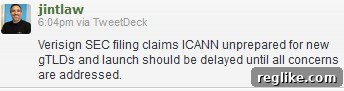
Neustar, like Verisign, plays a significant role in the backend infrastructure of the internet, operating various TLDs and providing registry services. Their insights, coming from a similar vantage point as Verisign but as a direct competitor in some aspects, offer a valuable parallel perspective on the operational challenges.
In response, Paul Stahura, co-founder of Donuts, Inc., the largest applicant for new TLDs with hundreds of applications, offered a different viewpoint:

Donuts represents the vanguard of the new gTLD movement, having invested heavily in the program. Their perspective often champions the innovation and expansion that new gTLDs promise, and they may be more inclined to push for progress and address issues dynamically rather than delaying the entire process. The contrast between these reactions highlights the tension between ensuring meticulous preparation and maintaining the momentum of a highly anticipated internet expansion.
Verisign’s Dual Role: Stakeholder and Guardian of the Root
It is also important to consider Verisign’s own stake in the new gTLD program. While raising concerns, Verisign is not merely an observer; it is also an active participant. The company has applied for 14 new TLDs itself and serves as the backend provider for over 200 other applications. This dual role means that Verisign has both an interest in the successful rollout of new gTLDs and a profound responsibility for the stability of the core internet infrastructure.
Regardless of any perceived self-interest or strategic positioning, Verisign’s unique and critical role managing the internet’s root zone and the massive .com registry means that its report carries immense credence and weight within the internet community as a whole. Their insights are not just those of a commercial entity but of an essential steward of the global DNS. When Verisign speaks about the technical readiness of the internet, the world listens, because the implications of their assessment affect every user, every business, and every government connected online.
Moving Forward: Balancing Innovation with Stability
Verisign’s comprehensive report serves as a critical wake-up call, urging ICANN and the broader internet community to pause and meticulously re-evaluate the foundational readiness for new Top-Level Domains. The ambition to expand the internet’s naming system is commendable, offering greater choice and specificity for online identities. However, this expansion must not come at the cost of the internet’s fundamental security, stability, and reliability.
Addressing the technical, operational, and policy gaps identified by Verisign—from ensuring robust automated TLD additions to establishing concrete plans for emergency backend providers and secure zone file escrow—is not merely a bureaucratic exercise. It is essential for safeguarding the integrity of the global Domain Name System and, by extension, the entire digital economy. The insights from key industry players like Neustar and Donuts, while varied, contribute to a necessary dialogue that must lead to actionable solutions. The path forward requires a delicate balance between fostering innovation and upholding the rigorous standards of preparation necessary to protect the internet for billions of users worldwide.