
Heads Up, Domain Sellers: PayPal Transaction Fees Are Set to Rise, Impacting Your Profit Margins
In an era defined by intense competition within the FinTech landscape, where countless payment processors vie for market share, one might intuitively expect a downward trend in transaction costs. The pursuit of customer acquisition and retention typically drives companies to offer more competitive rates. However, defying this conventional economic logic, PayPal, a titan in the digital payments arena, is preparing to implement a significant increase in its fees for digital transactions. This move, set to take effect next month, is poised to reshape the financial considerations for a wide array of online businesses and individuals, with a particularly pronounced impact on the domain name industry.
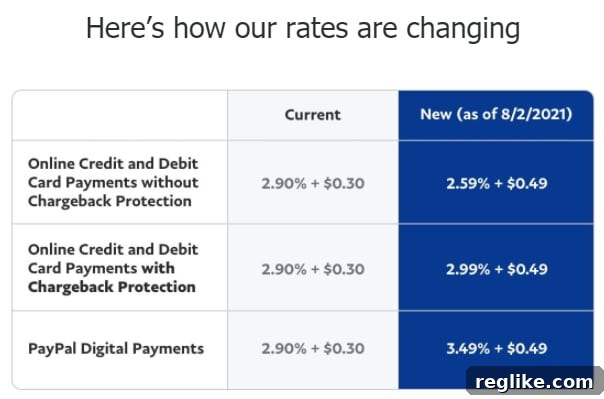
For years, businesses utilizing PayPal for digital payments became accustomed to a fee structure of 2.9% plus a fixed charge of 30 cents per transaction. This rate has been a standard benchmark for many online merchants. As of August 2nd, however, this structure will undergo a substantial revision. The new rate will climb to 3.49% of the transaction value, coupled with an increased fixed fee of 49 cents. This nearly half-percentage point increase, alongside a 63% rise in the fixed per-transaction cost, represents a non-trivial adjustment that warrants immediate attention from anyone conducting digital commerce, especially those involved in buying and selling valuable digital assets like domain names.
Understanding the New PayPal Fee Structure
The upcoming changes are not merely a minor tweak; they signify a noticeable shift in PayPal’s pricing strategy. Let’s break down what these new rates mean in practical terms. Previously, for a $1,000 domain sale, a seller would pay $29.00 (2.9%) plus $0.30, totaling $29.30 in fees. Under the new regime, that same $1,000 transaction will incur fees of $34.90 (3.49%) plus $0.49, amounting to $35.39. While the absolute dollar difference might seem modest on a single transaction, the cumulative effect over multiple sales, particularly for active domain investors or businesses with high transaction volumes, can quickly become substantial, directly eroding profit margins.
This fee hike specifically targets “digital payments.” In the context of domain sales, this typically refers to transactions where a buyer sends funds directly to a seller’s PayPal account, often facilitated through an invoice or a direct payment link. This applies broadly to scenarios where the payment is made digitally and processed by PayPal’s internal systems, distinct from payments processed via online credit or debit card networks through a merchant gateway where PayPal acts as an intermediary. The distinction is crucial because it highlights PayPal’s strategy to monetize its vast user base and the internal flow of funds within its ecosystem.
The Paradox: Competition vs. Rising Costs in FinTech
It’s tempting to assume that the proliferation of FinTech companies like Stripe, Square, Wise, and numerous others would naturally lead to a race to the bottom for transaction fees. The competitive landscape should, in theory, pressure payment processors to offer more attractive rates to attract and retain merchants. Yet, PayPal’s decision to increase fees runs counter to this expectation. This suggests a few possibilities: either PayPal feels confident enough in its market dominance and network effect to absorb potential merchant churn, or the underlying costs of maintaining its vast infrastructure and combating fraud are rising, necessitating a reevaluation of its pricing model.
PayPal’s long-standing advantage lies in its extensive user base. Millions of individuals and businesses globally already have PayPal accounts with existing balances. When a transaction occurs between two PayPal users, especially when the funds are already within the PayPal system, it can often be viewed as a “database transaction.” This means the money might not physically move through traditional banking or credit card networks, avoiding the associated interchange fees and processing costs that other payment methods incur. Despite this internal processing efficiency, PayPal continues to levy a significant percentage fee, indicating the premium it places on its convenience, security features, and brand recognition.
Significant Implications for the Domain Name Industry
The domain name industry, characterized by transactions that can range from a few dollars to several million, is particularly sensitive to payment processing fees. For low-to-mid value domains, even a small percentage increase can significantly impact the seller’s net profit. For example, a $100 domain sale, which might already have a thin margin after brokerage fees or time investment, will now see an extra $0.59 deducted by PayPal, relatively a 20% increase in the fee amount. When multiplied across hundreds or thousands of sales, this adds up to a considerable sum.
High-value domain transactions, while less impacted by the fixed 49-cent fee, will still feel the bite of the 3.49% rate. A $10,000 domain sale will now cost $353.90 in PayPal fees, compared to $293.30 previously – a $60.60 increase. While this might seem like a small fraction of the overall transaction, domain investors meticulously track every expense to maximize returns. These rising costs could prompt sellers to re-evaluate their pricing strategies, potentially passing on some of these increased costs to buyers, or exploring alternative payment methods more vigorously.
The Nuance of Chargeback Protection and Online Credit/Debit Cards
Interestingly, the new fee structure also includes a slight reduction in fees for online credit and debit card transactions, but with a significant caveat: merchants must opt out of chargeback protection. For standard online credit and debit card transactions, the fee will shift from 2.9% + 30 cents to 2.59% + 49 cents if chargeback protection is declined. While this might seem like an opportunity for savings, it introduces a substantial risk, especially in industries dealing with digital goods.
Chargeback protection is a critical safeguard for sellers of digital assets like domain names. Unlike physical goods that can be returned, a domain name, once transferred, is irrevocably in the buyer’s possession. The risk of a buyer initiating a chargeback after receiving the domain, claiming the transaction was unauthorized or that they never received the product, is a genuine concern. Waiving chargeback protection, even for a lower fee, is a gamble that most prudent domain sellers would be unwilling to take, particularly for high-value assets. The potential loss from a single fraudulent chargeback far outweighs any savings from reduced processing fees.
PayPal’s Enduring Advantages and the Cost of Convenience
Despite these rising fees, PayPal retains several key advantages that make it a ubiquitous choice for online transactions. Its global reach, ease of use, and established trust factor are unparalleled for many users. The ability for buyers to pay directly from their existing PayPal balance offers a level of convenience and speed that traditional bank transfers or credit card payments sometimes lack, especially for international transactions. For many, the perception of security that comes with PayPal’s buyer and seller protection programs, even with the increased cost, is a worthwhile trade-off.
However, the increasing fees highlight the cost of this convenience and network effect. While other processors like Stripe offer competitive rates (often around 2.9% + 30 cents for standard online transactions) and robust APIs for integrated checkouts, they might not have the same widespread “wallet” functionality or direct person-to-person payment ease that PayPal offers. For individual domain sellers, especially those who don’t run a full-fledged e-commerce site, PayPal often remains the simplest option for sending and receiving payments without needing a complex merchant account setup.
Exploring Alternatives for Domain Sales
The fee increase will undoubtedly prompt domain sellers to more seriously consider alternative payment methods. Here are some options and their general considerations:
- Escrow Services: Platforms like Escrow.com are widely used for higher-value domain transactions. While they come with their own fees (often a percentage split between buyer and seller), they offer unparalleled security and buyer/seller protection, mitigating the risks of fraud and chargebacks. For domains exceeding a certain value threshold, escrow services remain the gold standard.
- Wire Transfers: For very large transactions, traditional bank wire transfers are a common choice. They typically have low fixed fees, regardless of the amount, and are highly secure once cleared. The main drawbacks are slower processing times (especially internationally) and less buyer protection compared to credit card or escrow services.
- Stripe: A direct competitor to PayPal, Stripe offers robust payment processing for websites and businesses. Its fees are competitive, and it provides excellent tools for recurring payments and international transactions. However, it requires more technical integration for a simple transaction compared to sending a PayPal invoice.
- Cryptocurrency: With the rise of digital currencies like Bitcoin and Ethereum, some domain investors are exploring crypto payments. These can offer lower transaction fees (depending on network congestion) and faster international transfers, but come with volatility risks, less buyer protection, and a higher barrier to entry for many traditional buyers.
- ACH Transfers (for US accounts): Automated Clearing House transfers are electronic payments directly between bank accounts, common in the US. They offer very low fees but are slower than instant digital payments and primarily for domestic use.
Strategies for Domain Sellers to Mitigate Impact
Given these changes, domain sellers might need to adapt their strategies:
- Adjust Pricing: Sellers might consider slightly increasing the asking price for their domains to absorb the higher transaction fees, especially for lower-value assets where the percentage increase is more impactful.
- Offer Multiple Payment Options: Provide buyers with a range of payment methods. While PayPal might be convenient, offering wire transfers or escrow for higher-value sales, and perhaps other digital payment platforms, gives buyers choice and allows sellers to manage costs.
- Educate Buyers: Be transparent about payment processing fees, especially if you plan to split them with the buyer or factor them into the price. Clearly outline the chosen payment method and its implications.
- Analyze Profitability: Regularly review your sales data and calculate the actual net profit after all fees. This will help identify if current pricing or payment methods are truly optimal.
- Consider Hybrid Approaches: For instance, use PayPal for initial deposits or smaller transactions, and switch to escrow or wire transfers for the final, larger balance.
The Future of Digital Payments and Domain Investing
PayPal’s fee increase serves as a powerful reminder that while digital payments offer unparalleled convenience, they come at a cost. As the FinTech industry continues to evolve, businesses and individuals must remain vigilant about the terms and conditions of their chosen payment processors. This adjustment by PayPal could be an isolated move, or it could signal a broader trend where established players leverage their market position, potentially prompting other processors to re-evaluate their own rates.
For domain investors, who often operate on razor-thin margins and manage portfolios ranging from dozens to thousands of assets, understanding and adapting to these changes is paramount. The decision to accept PayPal, or any other payment method, must be a calculated one, weighing the benefits of convenience and buyer trust against the tangible cost to the bottom line. The ongoing dynamic between technological innovation, market competition, and pricing strategies in the digital payment space will undoubtedly continue to shape the financial landscape for the domain industry for years to come.