
A Deep Dive into ICANN’s Escalating Expenses: An Analysis of Budgetary Trends
The Internet Corporation for Assigned Names and Numbers (ICANN) plays a pivotal role in maintaining the stability and interoperability of the internet’s unique identifier systems. As the non-profit organization responsible for coordinating the global domain name system (DNS), its financial health and operational efficiency are of paramount importance to the entire digital ecosystem. This article builds upon previous high-level reviews of ICANN’s swelling expenses and its massive headcount growth, delving deeper into the specific categories of costs and their underlying trends over more than a decade.
Understanding ICANN’s budget is not merely an exercise in financial auditing; it’s about ensuring accountability, transparency, and the sustainable stewardship of a global public resource. The significant shifts in ICANN’s expenditure profile raise crucial questions for stakeholders across the domain industry—from registries and registrars to individual registrants and the broader internet user community. Examining these trends provides valuable insights into the organization’s evolving operational footprint and the challenges it faces in fulfilling its multifaceted mission.
Understanding ICANN’s Financial Landscape and Mission
Before dissecting the numbers, it’s essential to contextualize ICANN’s mandate and how it’s funded. ICANN operates as a multi-stakeholder organization, coordinating the global internet’s unique identifiers, including domain names and IP addresses. Its work spans policy development, technical operations, and outreach, requiring a diverse set of resources. ICANN is primarily funded through fees collected from domain name registrations and various other services, making its budget a direct reflection of the health and scale of the domain name industry itself. Any significant increase in operational costs can potentially impact these fees, ultimately affecting every internet user.
The imperative for financial scrutiny stems from ICANN’s unique position. As a steward of a global public resource, its decisions and operational efficiency have far-reaching implications. A lean, efficient ICANN can dedicate more resources to its core mission, fostering innovation and ensuring a stable, secure, and resilient internet. Conversely, unchecked expense growth can lead to concerns about value for money, potential inefficiencies, and the long-term sustainability of the multi-stakeholder model itself.
A Visual Overview: A Decade of Expenditure
To grasp the trajectory of ICANN’s expenses, a visual representation is invaluable. The following chart, illustrating categorized expenses dating back to Fiscal Year 2008, offers a stark portrayal of the organization’s financial evolution:
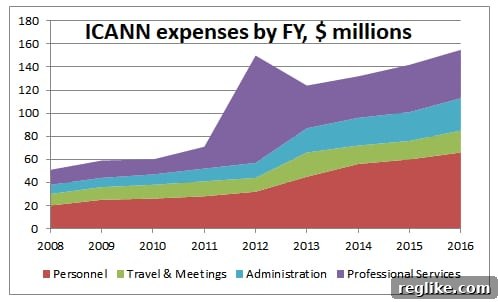
Indeed, this chart speaks volumes about the significant shifts in ICANN’s financial operations. What begins as a period of relatively slow and steady incremental increases in expenses across most categories transforms dramatically, signaling a major inflection point in the organization’s history and operational demands.
The Tipping Point: The New gTLD Program’s Profound Impact
A superficial glance at the expense chart immediately highlights a monumental shift around Fiscal Year 2013. This surge, observed across virtually all expense categories, is unequivocally linked to the launch and subsequent operational phases of ICANN’s ambitious New Generic Top-Level Domains (gTLD) Program. Initiated in 2012, this program aimed to significantly expand the internet’s namespace by introducing hundreds, potentially thousands, of new domain extensions beyond the traditional .com, .org, and country-code TLDs.
The New gTLD Program was an unprecedented undertaking in the history of the internet. It required immense resources across multiple fronts: developing complex policy frameworks, establishing robust technical infrastructure for application processing and delegation, managing a massive influx of applications (including resolving contention sets), conducting extensive legal reviews, and engaging in broad global outreach. This program, while transformative for the internet, placed immense pressure on ICANN’s operational capacity and financial resources, leading to the substantial bump in expenses evident in the 2013 fiscal year and beyond.
Deep Dive into Key Expense Categories
While the New gTLD Program provided the initial jolt, the sustained elevation and continued growth in specific expense categories post-2013 reveal deeper structural changes within ICANN. Let’s examine these in detail:
Personnel Costs: A Steady and Significant Ascent
The growth in personnel expenses is perhaps the most telling indicator of ICANN’s expanding operational footprint. Prior to the New gTLD Program, ICANN maintained a relatively stable, albeit growing, team. The program necessitated a dramatic increase in headcount to manage the complexity and sheer volume of work involved. This included hiring specialists in legal, technical, policy development, project management, and customer service roles.
However, what is particularly striking is that personnel and administration costs continued their upward march even after the initial surge of new TLD work was largely completed. This sustained growth suggests several factors:
- Ongoing Policy Development: Even with new gTLDs launched, ICANN’s policy work is continuous. New policies are required for existing gTLDs, subsequent rounds of new gTLDs, and broader internet governance issues.
- Compliance and Accountability: As ICANN matured and transitioned away from direct U.S. government oversight (the IANA Stewardship Transition), its internal governance, compliance, and accountability frameworks became more robust, often requiring additional staff.
- Global Presence: ICANN operates globally, with offices and staff in multiple regions (e.g., Los Angeles, Brussels, Istanbul, Singapore, Montevideo). Maintaining a global presence for outreach, engagement, and support contributes significantly to personnel and administrative overhead.
- Operational Overhead: Beyond program-specific staff, there’s an increasing need for support functions—HR, finance, IT, communications, and security—to manage a larger, more complex global organization.
- Talent Retention: Attracting and retaining specialized talent in a competitive global market often involves competitive compensation packages, which naturally drives up personnel costs.
The continuous rise in personnel costs warrants close scrutiny, as it represents a significant, long-term commitment of resources. Stakeholders frequently ask whether this growth translates into equivalent improvements in efficiency, output, or service delivery for the internet community.
Professional Services: Enduring High Demand
Professional services represent fees paid to external consultants, legal firms, technical experts, auditors, and other specialized agencies. As the chart indicates, these costs saw a massive spike during the peak of the New gTLD Program, which is understandable. Managing hundreds of applications, resolving disputes, developing specialized technical platforms, and navigating complex international legal landscapes required extensive external expertise.
While professional services costs did drop after the initial onslaught of new TLD work, they have continued to remain at levels approximately double what they were before the new TLD applications. This sustained elevation can be attributed to several factors:
- Post-Delegation Legal Work: Even after gTLDs are launched, legal challenges, contractual disputes, and ongoing compliance issues with new gTLD operators require continuous legal and professional support.
- Complex Policy Initiatives: Modern internet governance issues, such as those related to privacy (e.g., GDPR’s impact on WHOIS), security, and subsequent rounds of new gTLDs, are inherently complex and often necessitate external expert input.
- Technical Audits and Security: Maintaining the security and stability of the DNS, especially with an expanded namespace, requires ongoing technical audits, vulnerability assessments, and engagement with cybersecurity experts.
- Project-Specific Consultancies: ICANN frequently undertakes specialized projects, from technical upgrades to strategic reviews, which often rely on external consultants for their expertise and impartial assessments.
The persistence of high professional services costs, even after the initial rush, suggests that ICANN’s operational environment has become permanently more complex, requiring a higher baseline level of external specialized support.
Administration Costs: Supporting a Growing Infrastructure
Administrative expenses encompass a wide array of operational overheads, including office leases, utilities, IT infrastructure, software licenses, general supplies, and various support services. Like personnel costs, these have shown a consistent upward trajectory, particularly after 2013.
The expansion in administrative costs is directly correlated with the growth in headcount and the need to support a larger, more distributed organization. More employees require more office space, more IT resources, more administrative support systems, and more general operational expenditures. As ICANN’s global footprint expanded, so too did the costs associated with maintaining multiple regional hubs, each with its own administrative requirements. Upgrading IT systems to handle increased data, ensuring robust cybersecurity for its own operations, and maintaining a modern, compliant workplace across different jurisdictions all contribute to this category.
Travel Expenses: A Significant and Enduring Outlay
Travel has consistently been a major expense for ICANN, reaching approximately $19 million in the last fiscal year reviewed. For an organization operating under a multi-stakeholder model, global travel is often deemed essential, but its scale warrants examination.
The necessity for extensive travel stems from ICANN’s core operating principles:
- Global Public Meetings: ICANN holds three major public meetings annually in different regions of the world. These meetings are crucial for policy development, community engagement, and consensus building, requiring substantial travel for staff, board members, and often financially supported community members.
- Outreach and Engagement: To ensure broad participation and understanding of its work, ICANN engages in numerous regional forums, workshops, and bilateral meetings with governments, industry bodies, and civil society groups worldwide.
- Board and Committee Meetings: Beyond the public meetings, various board committees and working groups hold face-to-face meetings throughout the year to deliberate on specific policy issues or organizational matters.
- Staff Travel: Staff travel is essential for project management, technical deployments, regional support, and professional development.
While global engagement is central to ICANN’s identity, the sheer magnitude of the travel budget prompts questions regarding optimization. In an increasingly digital world, especially post-pandemic, the potential for leveraging virtual tools more extensively to reduce travel burden and costs becomes a recurring topic of discussion within the community.
Implications for the Domain Industry and Future Outlook
The sustained escalation of ICANN’s expenses across various categories carries significant implications for the domain name industry and internet governance at large. Ultimately, these costs are borne by the industry through various fees, which can translate into higher registration costs for end-users. This raises fundamental questions about ICANN’s operational efficiency, financial accountability, and whether the multi-stakeholder model is being managed in the most cost-effective manner.
The trends visible in the expense chart suggest that ICANN has transitioned from a relatively smaller, leaner organization into a larger, more complex global entity. While some growth was inevitable and necessary to manage the expanded DNS namespace and the complexities of global internet governance, the sustained high levels and continuous upward trajectory demand rigorous oversight.
The internet community, including registries, registrars, and domain registrants, has a vested interest in ICANN operating effectively and efficiently. This requires ongoing scrutiny of its budget, transparent reporting, and a proactive approach to identifying areas for optimization without compromising its crucial mission of maintaining a stable, secure, and unified global internet.
In a forthcoming analysis, we will synthesize these observations to explore what factors might have contributed to these trends and, more importantly, what actionable steps could be considered to ensure ICANN’s financial sustainability and continued relevance in the evolving landscape of internet governance.