
Unlocking Value: A Deep Dive into Premium Domain Performance for Registries and Registrars
In the expansive and ever-evolving digital landscape, a compelling domain name transcends mere digital real estate; it is a cornerstone of brand identity, a crucial gateway for online presence, and a significant asset in the modern economy. Amidst a sea of standard domain registrations, premium domains distinguish themselves by their inherent memorability, market relevance, and often, their direct commercial value. For the key players in the domain name industry—registries who operate top-level domains, and registrars who sell them to the public—these high-value names represent a vital revenue stream and a clear indicator of sustained demand for prime digital assets. This comprehensive article delves into the intricate dynamics of premium domain sales and renewals, extracting valuable insights from detailed industry data to illuminate their profound impact on the broader domain name ecosystem.
The advent of new generic Top-Level Domains (new gTLDs) ushered in a transformative era for the domain market, dramatically expanding the choices beyond the conventional .com, .net, and .org. However, carving out success in this crowded new space has proven challenging for many. A significant number of new gTLDs grapple with achieving widespread adoption and generating sustainable revenue. It is precisely in this context that premium domains, with their intrinsic appeal and market-driven value, emerge as indispensable catalysts for growth and profitability, offering a clear path to differentiation and financial health for operators and resellers alike.
Radix’s Half-Year Insights: A Snapshot of Premium Domain Market Health
Radix, a leading registry operator renowned for managing a diverse and popular portfolio of new gTLDs, recently published compelling data concerning its premium domain sales for the first half of 2017 (January to June). This report offers an invaluable and transparent look into the vitality and substantial potential of the premium domain market. The insights derived from this data are particularly actionable for both registries, who govern the TLDs, and registrars, who are on the front lines, facilitating domain sales to end-users.
During this pivotal six-month period, Radix recorded an impressive total of 727 premium domain transactions across its suite of nine top-level domains. This significant figure encompasses both brand-new registrations and critical renewals, underscoring continuous, robust activity within this lucrative, high-value segment. More specifically, the data revealed 469 new premium domain registrations and 258 premium domain renewals. These numbers collectively indicate a healthy cycle of acquisition and retention, signaling strong user commitment to these prized digital assets.
New Premium Registrations: A Deeper Dive into Market Demand and Value
The 469 new premium domain registrations during H1 2017 generated an estimated $640,000 in payments at the registrar level. This substantial financial figure eloquently highlights the significant revenue potential that premium domains offer to the entire value chain. It’s crucial to understand that this sum represents the estimated retail value paid by registrants; registrars typically deduct their profit margin before remitting the wholesale price to the registry. Furthermore, a key attractive feature for registries and registrars is that all these newly registered premium names are also subject to premium renewal fees, thereby establishing a predictable, recurring revenue stream for future years – a critical component for long-term financial planning and stability within the dynamic domain industry.
A closer examination of the revenue distribution across Radix’s TLD portfolio provides a clearer understanding of where the highest value is concentrated and which TLDs are performing most strongly:
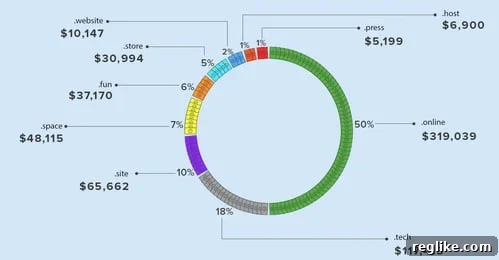
As the visual data illustrates, .online emerged as the clear leader in terms of total revenue generated from premium domains during this reporting period. This occurred despite it not having the highest number of individual premium registrations. This fascinating phenomenon is largely attributable to outlier, exceptionally high-value sales, such as the widely publicized $200,000 sale of casino.online. Such marquee transactions significantly elevate the average revenue per domain for that specific TLD, unequivocally demonstrating the potential for blockbuster deals within the premium segment. Following closely, .tech and .space also exhibited robust revenue performance, signaling their strong appeal to technology-focused businesses, startups, and creative ventures, respectively, all seeking distinctive and memorable online identities.
Premium Domain Registration Volume by Top-Level Domain:
- .Tech: 127 new premium registrations
- .Online: 124 new premium registrations
- .Space: 101 new premium registrations
- .Fun: 47 new premium registrations
- .Website: 27 new premium registrations
- .Site: 21 new premium registrations
- .Store: 14 new premium registrations
- .Press: 6 new premium registrations
- .Host: 2 new premium registrations
Interestingly, while .online dominated in terms of revenue, .tech actually led in the sheer volume of new premium domains registered. This suggests a broader base of moderately priced premium names being registered under .tech, effectively catering to a wide array of technology-driven businesses, developers, and startups looking for a relevant, concise, and professional online identity. The strong performance of .space further underscores its effectiveness in attracting creative professionals, artists, and individuals or organizations managing project-based websites, who value its open and innovative connotations.
The Price Spectrum: High-Value, Niche Volume vs. Accessible Premium
It remains a consistent observation within the global domain market that the most expensive, ultra-premium domains — those carrying exorbitant price tags — are registered with significantly less frequency. These exceptionally rare names, often consisting of single-word dictionary terms, highly coveted generic phrases, or deeply brandable keywords, command prices that understandably deter the vast majority of potential buyers. While they unquestionably represent the pinnacle of digital real estate, their target market is incredibly niche, typically attracting major multinational corporations, astute domain investors, or ultra-high-net-worth individuals seeking the ultimate brand asset for strategic purposes.
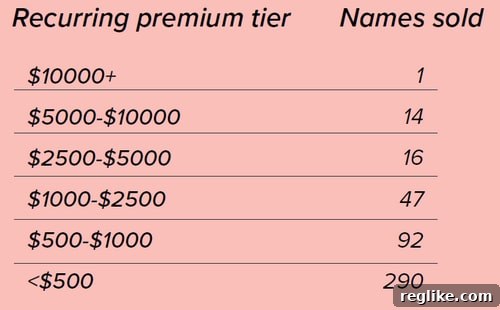
This insightful graph visually corroborates that the overwhelming majority of premium domain sales occur within the lower and mid-range price tiers. This trend emphatically underscores the critical importance of a nuanced and diverse premium pricing strategy for registries. Such a strategy must delicately balance the aspirational goal of securing high-value, blockbuster sales with the practical reality of broad market accessibility. Most businesses and individuals are willing to invest a moderate premium for a genuinely great domain that enhances their brand, but only a select few possess the budget or justification for an exorbitant, six-figure investment.
Further insight into the perceived value and market positioning of each TLD can be gleaned by examining the average yearly price paid for premium domains within each top-level domain:
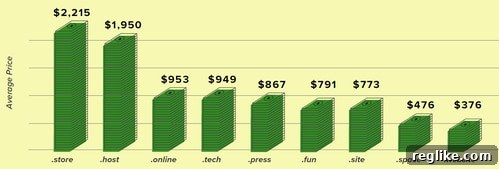
The notable variations in average prices across TLDs reflect their specific market segments, the perceived intrinsic value of their keywords, and their target audiences. For instance, TLDs like .online might command higher average prices due to their broad applicability across countless industries and the significant potential for very high-value, generic keywords. In contrast, TLDs targeting more niche markets might exhibit a lower, yet often more consistent, average price point, indicating a stable demand within their specialized user base.
Spotlight on Top Premium Domain Sales: Setting Industry Benchmarks
Highlighting individual top sales offers a tangible and exciting illustration of the market’s consistent appetite for compelling and impactful domain names. These high-profile transactions often serve as crucial benchmarks for market valuation and explicitly demonstrate the types of keywords and phrases that businesses and brands prioritize in their digital strategies. The prices listed below are estimated, particularly in instances where Radix does not possess precise information regarding the registrar’s specific markup from the wholesale price they paid to the registry:
- Room.tech: $11,467 via GMO
- Ideas.tech: $6,500 via Namecheap
- Creative.space: $6,499 via GoDaddy
- Travel.fun: $6,499 via GoDaddy
- Vitamin.site: $6,499 via PDR
- Quantum.tech: $6,499 via GoDaddy
- Holidays.online: $6,250 via Name.com
- Airline.online: $6,000 via Enom
- Mar.tech: $6,000 via Enom
- James.store: $5,274 via Alibaba
This impressive list showcases a diverse range of generic, descriptive, and highly brandable terms. From highly functional and industry-specific names like “Room” and “Airline” to more abstract yet immensely powerful concepts such as “Ideas” and “Quantum,” the variety underscores the broad appeal of premium domains. The prominent presence of multiple major domain registrars (GMO, Namecheap, GoDaddy, PDR, Name.com, Enom, and Alibaba) in facilitating these top sales unequivocally highlights their critical role in effectively marketing, selling, and executing these high-value transactions, showcasing their expertise and extensive reach in the domain marketplace.
The Critical Role of Premium Domain Renewals in Long-Term Sustainability
While the excitement generated by new registrations often captures headlines and initial attention, the enduring sustainability and long-term financial health of the premium domain market fundamentally hinge on successful renewals. A premium domain that is registered but subsequently not renewed represents not only a lost opportunity for recurring revenue but also a potential erosion of trust and perceived value for both the registry and the registrar. In this context, Radix’s data concerning renewals offers particularly encouraging news for the industry:
During the first half of 2017, a robust 67% of first-year premium domains that were due for renewal were successfully retained. This strong retention rate translates into 258 valuable premium names continuing their active registration and generating an estimated $575,000 of recurring revenue. A 67% renewal rate for premium domains is a compelling indicator of the perceived value, utility, and positive return on investment by the registrants. It strongly suggests that businesses and individuals who initially choose to invest in these premium names are generally finding tangible, ongoing value in their digital assets and are committed to maintaining their strategic online presence.
High renewal rates are absolutely vital for the long-term viability and profitability of new gTLDs. They provide a stable, predictable, and recurring income stream that registries and registrars can reliably factor into their future business models, significantly reducing their dependence on the inherently more unpredictable nature of new sales alone. This consistent revenue stream reinforces the fundamental idea that premium domains are often more than just speculative purchases; they are frequently integral, strategic components of a registrant’s brand, business strategy, and overall digital infrastructure, representing a deeper level of commitment and investment.
The Broader Debate: Premium Domains and New gTLD Acceptance in the Market
The concept of premium renewals, and indeed premium domain pricing in general, within the new gTLD landscape has been a perennial subject of considerable discussion and at times, passionate debate, across the domain name industry. On one hand, the immense appeal to both registrars and registries is self-evident and undeniable. A single high-value premium domain sale can often generate revenue equivalent to, or even surpassing, that of a thousand standard, low-cost registrations. This represents an extraordinarily powerful financial incentive, particularly pertinent for many new gTLDs that continue to strive to achieve even 10,000 total active registrations, let alone attain sustained profitability. In such scenarios, premium domains offer a viable, accelerated pathway to revenue growth and serve as tangible proof of market viability.
However, the industry is also constantly grappling with the challenge of formulating an optimal pricing strategy for these undeniably valuable assets. There is a critical, delicate balance to be struck: maximizing the lucrative revenue potential from premium names without inadvertently alienating a significant segment of potential buyers or, worse, hindering the overall acceptance, adoption, and organic growth of a given TLD. Indeed, some registries have faced considerable criticism for adopting overly aggressive or opaque pricing models, setting initial registration fees and subsequent renewal rates for premium domains that are widely perceived as exorbitant. While such an approach might successfully capture a few high-value sales in the immediate term, it carries the significant risk of inadvertently limiting the broad adoption of the TLD, fostering a pervasive perception that the registry is out of touch with prevailing market realities and customer expectations.
The author of the original article astutely alluded to this precise challenge, suggesting that “some registries are out of their minds when it comes to premium domain pricing and this is hampering their domains’ overall acceptance on the web.” This sentiment strongly resonates with numerous voices across the industry who passionately advocate for more nuanced, flexible, and market-attuned pricing strategies. Overly high prices can demonstrably stifle innovation, creating significant barriers for startups, small businesses, and individual entrepreneurs who desperately need to acquire memorable, relevant, and brand-enhancing domain names that could otherwise dramatically boost their online presence and brand equity. Furthermore, excessively high pricing can also lead to a higher percentage of desirable premium domains remaining perpetually unregistered, sitting idle and unutilized instead of actively adding value to the internet and fostering economic activity.
A truly strategic and effective approach to premium domain pricing involves a careful consideration of several interconnected and dynamic factors:
- Accurate Market Demand Assessment: Diligently gauging the authentic, current, and projected demand for specific keywords, categories, and length combinations within a particular TLD.
- Thorough Competitive Landscape Analysis: Systematically evaluating how premium prices compare to those of similar, equally desirable domains in competing TLDs, including long-established legacy domains like .com.
- Articulating a Clear Long-Term Vision: Balancing the immediate gratification of short-term revenue gains with the overarching, strategic goal of achieving widespread adoption, brand recognition, and sustainable, organic growth for the TLD over many years.
- Implementing Sophisticated Tiered Pricing Models: Devising and deploying a range of premium tiers, from moderately priced “good” names that are accessible to many, to ultra-premium “great” names for discerning buyers, thereby effectively catering to diverse budget levels and market segments.
- Innovative Promotional and Marketing Strategies: Thoughtfully utilizing limited-time offers, bundle deals, or registrar-specific promotions to strategically make certain premium names more attractive and accessible to a broader audience, stimulating initial uptake.
Ultimately, the overarching objective should be to establish premium domains as genuinely valuable and, crucially, accessible assets. This fosters a vibrant environment where businesses and innovators of all sizes can discover and acquire a perfect, impactful domain name that resonates with their brand and mission. When premium domains are priced with strategic foresight and market sensitivity, they achieve more than just generating revenue; they significantly enhance the overall value proposition of the entire TLD, attracting higher-quality websites, boosting brand perception, and contributing positively to the TLD’s search engine optimization (SEO) efficacy and long-term reputation.
Conclusion: A Thriving Niche with Strategic Imperatives for Growth
The detailed data presented by Radix for the first half of 2017 unequivocally demonstrates that the premium domain market within the new gTLD ecosystem is not only vibrant but also exceptionally lucrative. Both new registrations and subsequent renewals contribute substantially to the financial health and operational stability of registries and registrars alike. Premium domains unequivocally serve as critical revenue drivers, empowering new gTLDs to firmly establish their foothold in an increasingly competitive market and generate the essential income necessary for their ongoing operation, dedicated marketing, and sustained promotional efforts.
However, the insights gleaned from this analysis also powerfully underscore the strategic imperative for registries to meticulously and continuously refine their premium pricing models. While the undeniable allure of high-value, headline-grabbing sales is potent, the enduring, long-term success of any TLD hinges on adopting a balanced, forward-thinking approach. This approach must skillfully encourage widespread adoption and robust organic growth while simultaneously capitalizing on the unique and inherent value of premium names. By carefully segmenting their premium inventory, setting competitive and transparent prices, and actively fostering strong partnerships with their network of registrars, registries can continue to unlock the immense, untapped potential of premium domains. This strategic management is absolutely essential for ensuring a healthy, dynamic, and prosperous future for the entire domain name ecosystem. The continued thoughtful growth and expert strategic management of premium domains will undoubtedly play a pivotal and transformative role in shaping the next exciting chapter of the internet’s naming infrastructure and global digital identity.