
Unveiling the Landscape of Top-Level Domain Sales: .Com’s Reign and Emerging Opportunities
The vast digital landscape is continuously shaped by the domains that define our online presence. For domain investors and businesses alike, understanding the dynamics of the top-level domain (TLD) aftermarket is crucial. Recent data from industry giants Afternic and Sedo offers invaluable insights into which TLDs command the market, unequivocally demonstrating the enduring supremacy of .com while also spotlighting promising avenues for growth beyond this widely recognized extension.
Afternic Data: A Clear Picture of .Com Dominance
GoDaddy’s Afternic, a leading domain aftermarket platform, has become increasingly transparent with its market data, offering a window into the sales performance of various TLDs. This commitment to data sharing provides domain investors with critical intelligence to inform their strategies.
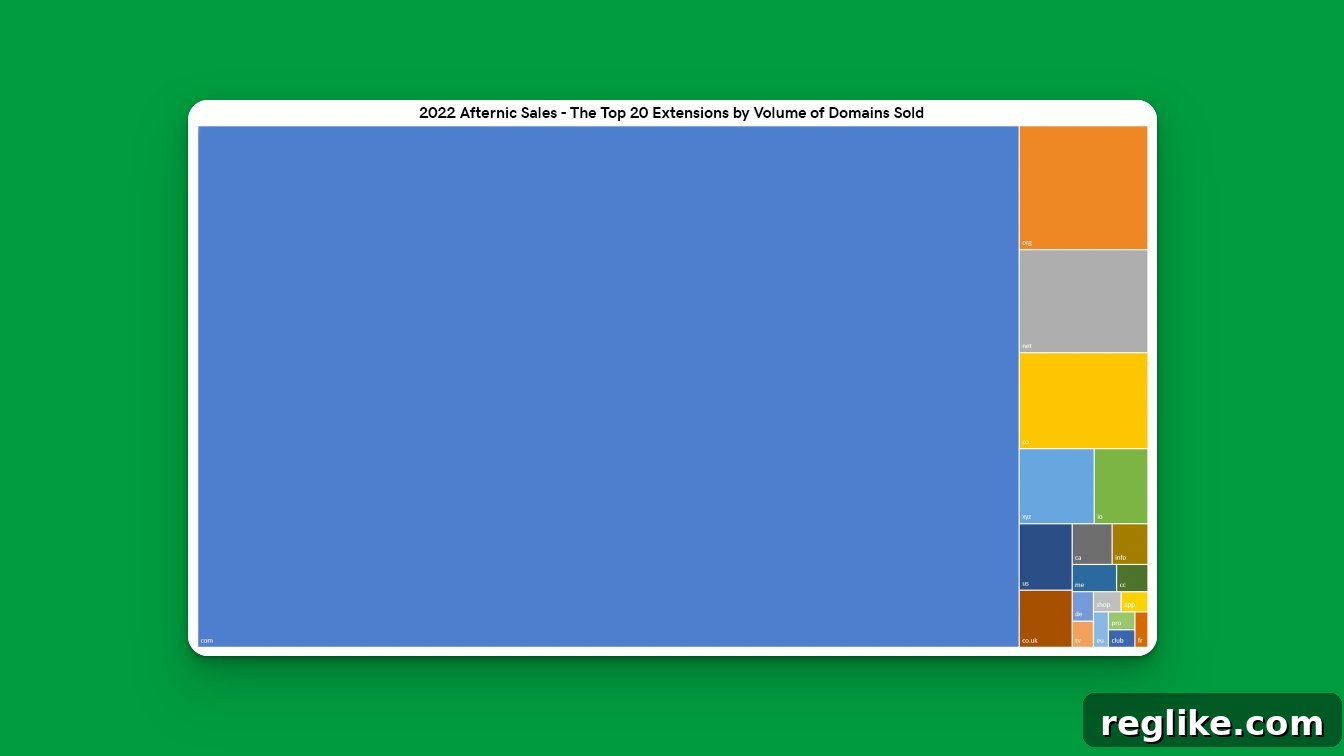
A recent chart shared by Afternic illustrating 2022 TLD sales vividly underscored the monumental lead held by .com. While the visual representation powerfully conveyed this dominance, discerning the precise market share of other TLDs required closer examination.
Afternic’s Top 10 TLDs by Rank
Following the initial graphic, Afternic provided a clear ranked list of the top-performing TLDs on its platform, offering a more granular view of the aftermarket hierarchy:
- .com
- .org
- .net
- .co
- .xyz
- .io
- .us
- .co.uk
- .ca
- .info
This list, while informative, still left open the question of scale. To better grasp the relative market share, an approximate analysis of the top six domains from the Afternic chart was conducted. It’s important to note that these figures are estimates derived from visual measurement and may vary slightly, but they effectively convey the magnitude of each TLD’s presence:
- .com – approximately 85%
- .org – approximately 3%
- .net – approximately 2.5%
- .co – approximately 2.5%
- .xyz – approximately 1%
- .io – approximately 0.8%
These approximations clearly illustrate that .com doesn’t just lead; it overwhelmingly dominates Afternic’s aftermarket sales. Its market share dwarfs that of all other TLDs combined, solidifying its status as the premier choice for businesses and individuals seeking online presence. This dominance stems from decades of established trust, brand recognition, and its perception as the default, most credible domain extension.
Sedo Data: A More International Perspective
While Afternic provides crucial insights, it represents just one facet of the global domain aftermarket. Its competitor, Sedo, renowned for its strong international presence, offers a complementary perspective, revealing a more diverse blend of buyer demographics and TLD preferences.
The Sedo/InterNetX Global Domain Report provides similar valuable data, but with the added benefit of precise figures, eliminating the need for visual estimation.
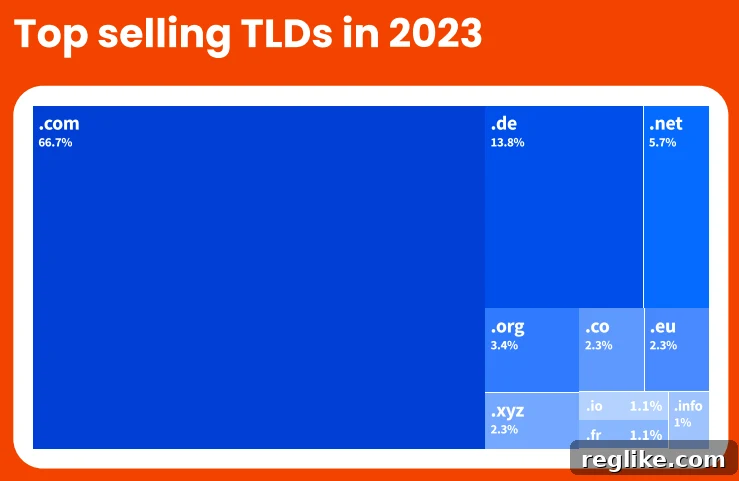
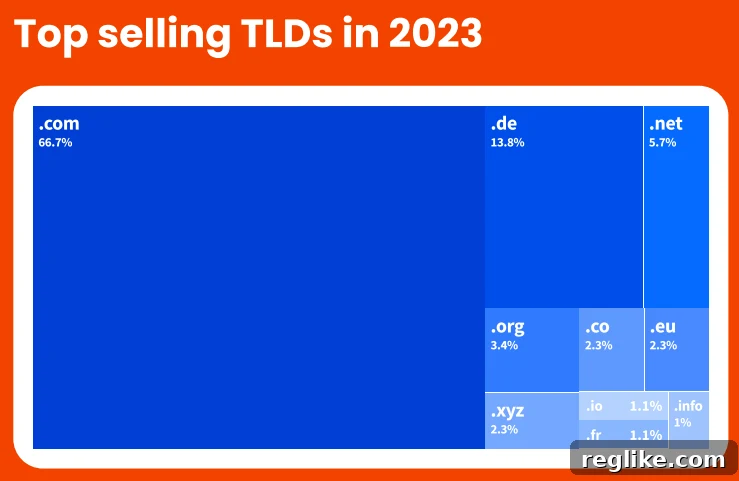
On Sedo’s platform, .com unquestionably maintains its leading position, underscoring its global appeal. However, a significant difference emerges with Germany’s country-code TLD, .de, securing a strong second place. This is largely attributable to Sedo’s origins and strong operational base in Germany, naturally attracting a substantial German-speaking customer base and reflecting the robust domestic market for .de domains.
Comparing Afternic and Sedo Insights
Despite their distinct market compositions, certain commonalities persist across both Afternic and Sedo’s top TLD rankings. Extensions such as .net, .org, .co, .xyz, and .io consistently feature in the top 10 on both platforms. This suggests a foundational recognition and demand for these particular TLDs across different geographic and platform-specific user bases.
The variations, particularly the prominence of .de on Sedo, highlight the importance of understanding specific marketplace demographics and their influence on TLD popularity. Domain investors should consider the target audience of a platform when assessing the potential value of non-.com domains.
Beyond .Com: Identifying Niche Opportunities for Domain Investors
The overwhelming dominance of .com, while a clear market reality, should not deter savvy domain investors from exploring profitable ventures in the non-.com space. In fact, many successful domain investors have built prosperous portfolios by specializing in alternative TLDs, leveraging their unique characteristics and market niches.
Strategies for Investing in Non-.Com TLDs:
- Understanding Use Cases: Each TLD often carries specific connotations or target audiences.
- .org: Universally recognized for non-profit organizations and open-source projects.
- .net: Traditionally used by network-related entities, now a general-purpose alternative.
- .io: Highly popular within the tech startup and software development community, due to its association with “input/output.”
- .co: Often seen as a concise, modern alternative to .com, favored by startups and businesses globally.
- .xyz: A highly versatile, inexpensive option often used by new ventures and experimental projects.
- Country-Code TLDs (ccTLDs) like .de, .co.uk, .ca, .us: Offer immense value for businesses targeting specific national markets, leveraging local trust and search engine optimization benefits.
- Lower Entry Barrier and Higher ROI Potential: While premium .com domains can command exorbitant prices, many valuable non-.com domains are available at significantly lower acquisition costs. This creates opportunities for higher percentage returns on investment, especially if an investor can identify an emerging trend or a specific niche where a non-.com TLD is gaining traction.
- Niche Market Specialization: Focusing on particular industries or geographic regions can unlock significant value. For example, an investor specializing in tech domains might find great success in acquiring and developing premium .io names, while another might excel in country-specific domains like .co.uk for the UK market.
- New gTLDs (Generic Top-Level Domains): The expansion of the TLD space has introduced hundreds of new options (e.g., .app, .shop, .online, .tech). While their aftermarket performance is still maturing compared to legacy TLDs, they offer opportunities for highly relevant and descriptive domain names that can attract specific audiences.
The Future of the Domain Aftermarket
The data from Afternic and Sedo collectively reinforces the undeniable fact that .com remains the heavyweight champion of the domain world. Its brand equity, universal recognition, and perceived trustworthiness are unmatched. However, to view the domain aftermarket solely through the lens of .com is to miss a wealth of strategic opportunities.
The global and diverse nature of the internet means that different TLDs resonate with different audiences and serve distinct purposes. For domain investors, understanding these nuances and leveraging comprehensive market data is paramount. Whether it’s catering to the tech community with .io, serving national markets with ccTLDs, or providing options for non-profits with .org, the aftermarket offers a rich tapestry of possibilities.
Successful domain investing in the modern era requires a balanced approach: acknowledging the might of .com while actively exploring and capitalizing on the significant and often less competitive opportunities presented by the ever-expanding universe of non-.com top-level domains. By staying informed, specializing wisely, and employing data-driven strategies, investors can effectively navigate this dynamic market and cultivate a profitable domain portfolio.