
Navigating the Shifting Tides: Has Domain Name Parking Finally Bottomed Out?
The world of domain name investing is dynamic, constantly evolving with changes in technology, search engine algorithms, and the intricate web of online advertising markets. For years, domain name parking has served as a primary monetization strategy for domainers – individuals and companies holding vast portfolios of domain names. However, the consistent profitability of this strategy has been a subject of ongoing debate and concern within the industry. Has the revenue potential for parked domains finally reached its lowest point, or is there a glimmer of hope for a significant rebound? This pressing question is central to understanding the current landscape, especially in light of recent industry surveys shedding critical light on the state of “Revenue Per Thousand” (RPM) visits.
Understanding Domain Parking and Its Core Metrics
Domain parking, at its essence, is the practice of registering a domain name without associating it with a fully developed website, comprehensive email services, or active content. Instead, the domain “parks” on a placeholder page specifically designed to display advertisements. These advertisements are often contextually relevant to the domain’s keywords, its industry, or the likely intent of its visitors. When internet users type in the parked domain directly into their browser, click on a link leading to it, or land on it through search results, they are presented with these ads. If a visitor interacts with an ad by clicking on it, the domainer earns a share of the advertising revenue, typically on a pay-per-click (PPC) model.
The most critical metric for evaluating the success and efficiency of domain parking is RPM – Revenue Per Thousand visits. This figure precisely indicates how much money a domainer earns for every 1,000 unique visitors their parked domain receives. A higher RPM signifies more effective monetization, driven by a confluence of factors such as the inherent quality of the incoming traffic, the relevance and compelling nature of the displayed advertisements, and the competitive payout rates offered by various parking providers. A robust RPM is paramount for maintaining a healthy and profitable domain portfolio, as it signals that the domains are attracting valuable traffic that effectively converts into ad clicks. Conversely, a consistently low RPM can indicate that domains are not attracting the right audience, that the advertising displayed isn’t sufficiently compelling, or that the chosen parking platform is underperforming.
Unpacking the Latest Survey Findings: A Sobering Reality and a Glimmer of Stability
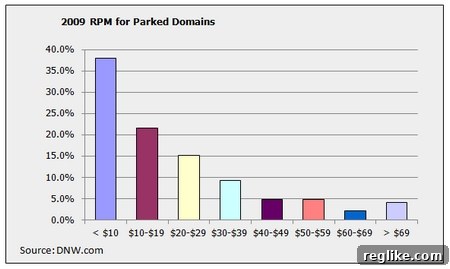
Recent industry insights paint a rather stark picture for many domainers reliant on parking income. The 5th Annual Domain Name Wire survey, a key barometer for the industry, revealed that a significant majority of domain name owners are struggling to achieve substantial returns from their parked domains. A sobering 60% of respondents reported an RPM of less than $20, meaning they earn, on average, less than two cents per visitor. Even more concerning, a staggering 40% are generating less than $10 per thousand visits. These figures starkly underscore the widespread challenges prevalent in the domain parking sector, where converting passive traffic into meaningful, sustainable revenue has become an increasingly difficult endeavor.
While these numbers may initially seem deeply discouraging, there is a nuanced perspective to consider. The silver lining, if one can indeed call it that, is that these figures are largely consistent with the previous year’s results. This consistency suggests a potential stabilization in the market. The persistent, albeit low, RPM values could indicate that domain parking revenues have indeed “bottomed out,” reaching a plateau from which further significant and widespread declines might be less likely. This doesn’t necessarily mean a rebound is imminent, but it might signal an end to a rapid downward trend.
However, the survey also delved deeper into year-over-year revenue changes, revealing a mixed bag of sentiments and experiences across the domaining community. Approximately 35% of respondents indicated that their parking revenue in the most recent year was similar to the preceding year, further reinforcing the idea of market stabilization for a segment of the industry. Yet, a larger and more concerning segment, 53%, reported a noticeable drop in their parking income during the same period. Only a small fraction, 13%, experienced an increase. This dichotomy suggests that while the overall average RPM might have reached a stable floor, individual domainers are still experiencing considerable fluctuations, with a majority seeing their revenues decline rather than grow. This trend strongly points to persistent external market pressures, heightened competition for valuable ad inventory, or perhaps the widespread adoption of ineffective monetization strategies by a large portion of the community.
The Resilience of Optimism Among Domainers: A Forward Look
Despite the challenging revenue figures and the widespread reports of declining income, domainers, as a collective, exhibit a surprising degree of mild optimism regarding the future prospects of domain parking. Looking ahead to the coming year, approximately 30% of respondents believe that parking revenue will see a rebound. This percentage is notably higher than the number who anticipate a continued decline, indicating a subtle yet significant shift towards more positive expectations within the community. The largest group, 42%, anticipates that the coming year will mirror the previous one, further supporting the idea of a stable, albeit low, earning environment rather than a continued downward spiral.
What precisely fuels this persistent optimism in the face of modest, and often dwindling, returns? Several fundamental factors could contribute to this resilient outlook. Domainers often view their portfolios as long-term assets with intrinsic value that extends beyond immediate parking income. They might be banking on an improved global economic climate leading to increased advertising spending across all digital platforms, which would naturally boost ad clicks and subsequently RPMs. Advances in ad technology, such as more sophisticated targeting algorithms and hyper-personalized ad delivery, could also promise better monetization opportunities in the near future. Furthermore, the unwavering belief in the enduring value of premium domain names – those that are highly relevant, short, memorable, and category-defining – remains a strong motivator. Even if current parking revenues are low, the potential for future development into full-fledged websites or the eventual lucrative sale of these assets can sustain a significant level of optimism. The strategic deployment of newly acquired, high-potential domains, or the ongoing optimization of existing ones, also offers tangible avenues for potential growth that keep domainers engaged, invested, and hopeful for better days.
Strategies for Maximizing Domain Parking Revenue in a Challenging Market
In an era of increasingly tight margins and intense competition, domainers can no longer afford to simply register domains and hope for the best. To thrive, or even just survive, domainers must employ sophisticated and strategic approaches to optimize their parked domain portfolios. Passive management is unlikely to yield significant profitability.
1. Curate Quality Domains Ruthlessly
The foundational principle for success in domain parking is to own high-quality, keyword-rich domains that naturally attract valuable type-in traffic or rank well in search engines for highly relevant terms. Generic, dictionary-word domains, geographic domains, or those with strong brand potential generally outperform obscure or less intuitive names. Focusing on domains that align with evergreen niches and high-value advertising verticals is crucial.
2. Select the Right Parking Provider
Not all domain parking platforms are created equal. Domainers should meticulously research and choose providers known for high payout rates, diverse and high-quality ad inventories, flexible template options, robust real-time analytics, and excellent customer support. Experimenting with different providers for various segments of a portfolio can often yield surprising and improved results, as each platform might excel in different niches or traffic types.
3. Optimize Parking Pages Proactively
Most reputable parking services offer extensive customization options for page layouts, ad formats (e.g., text, image, video), and specific keyword targeting. Domainers should actively test different configurations to see what resonates best with their particular audience and consistently generates the most clicks and highest RPMs. Ensuring the displayed ads are highly relevant to the domain’s topic and the visitor’s intent is paramount for achieving optimal conversion rates.
4. Monitor and Analyze Performance Continuously
Regular and meticulous analysis of RPM, traffic sources, and click-through rates (CTR) is absolutely essential. The sophisticated tools provided by parking companies can offer invaluable insights into what’s working and what isn’t. This data allows domainers to quickly identify underperforming domains that need attention or optimize those showing strong potential. Understanding *why* a particular domain is performing well or poorly is the key to making informed, data-driven decisions that improve overall portfolio profitability.
5. Consider Alternative Monetization Strategies
While parking offers a relatively passive income stream, it is not the only option, nor always the most lucrative. Domainers should proactively explore a spectrum of alternative monetization strategies:
- Direct Sales: Actively marketing and selling domains outright, especially premium ones, can generate significant capital far exceeding years of parking revenue.
- Leasing/Renting: Offering valuable domains for lease or rent to businesses can provide recurring, often higher, income streams than simple parking, without relinquishing ownership.
- Mini-Sites/Lead Generation: Developing small, focused, content-rich websites on valuable domains can capture targeted leads or directly sell niche products/services, offering potentially far greater returns than pure ad parking.
- Affiliate Marketing: Integrating relevant affiliate links into a basic landing page or mini-site can be another effective monetization route, especially for domains in specific commercial niches.
6. Stay Informed About Industry Trends
The digital advertising landscape is in a constant state of flux. Changes in major search engine algorithms, significant shifts in advertiser spending patterns, and the emergence of new technologies (such as artificial intelligence in ad optimization) all profoundly impact domain parking profitability. Staying abreast of these ongoing developments allows domainers to adapt their strategies proactively, ensuring they remain competitive and relevant.
The Evolving Future of Domain Parking: Adaptation is Key
The future of domain parking is inextricably intertwined with the broader evolution of online advertising and user behavior. As search engines become increasingly sophisticated in understanding user intent and as users increasingly rely on direct navigation, voice search, or app-based interactions, the nature of “type-in” traffic to parked domains may continue to change. However, as long as businesses need to reach specific, targeted audiences online, there will likely remain a foundational role for contextually relevant advertising displayed on appropriate domain names.
The integration of advanced artificial intelligence and machine learning technologies promises to further refine ad placement and targeting on parked pages, potentially boosting RPMs significantly. Future parking platforms might offer hyper-personalized content and ad experiences, making the parked pages more valuable to individual visitors and, by extension, more attractive to advertisers. Yet, the ongoing challenge for the industry will be to continuously differentiate domain parking from fully developed websites, ensuring that parked domains offer unique and compelling value propositions to both visitors and advertisers.
Conclusion: A Plateau, Not Necessarily a Perilous Descent
Revisiting our initial and central question: Has domain name parking hit bottom? Based on the observed stability of average RPMs in the most recent industry surveys, it appears that the significant and rapid declines experienced in previous years may indeed have plateaued. While a substantial portion of domainers still faces significant revenue challenges and a majority reported declines, the consistency of these aggregate figures suggests that a bottom has likely been found, rather than an ongoing freefall into deeper unprofitability. The mild optimism observed among domainers, coupled with an array of strategic opportunities for proactive optimization and diversification, indicates that domain parking, while perhaps less universally lucrative than in its heyday, remains a viable, albeit increasingly challenging, component of a comprehensive domain monetization strategy.
Success in this evolving landscape will increasingly depend on thoughtful and strategic domain acquisition, intelligent selection of parking platforms, proactive and continuous optimization of parked pages, and a flexible willingness to explore a broader spectrum of monetization avenues beyond mere ad parking. For domainers looking to benchmark their performance, research new strategies, or find the best partners in this dynamic industry, exploring reputable resources is highly recommended. For instance, ParkingJudge.com offers comprehensive reviews of domain name parking companies, helping domainers make informed choices. Furthermore, delving into the detailed findings from industry analyses and surveys can provide invaluable insights, often found by visiting dedicated sections such as DomainNameWire.com/survey.