
GoDaddy’s Q1 Revenue Growth: A Detailed Look at Performance and Market Dynamics
GoDaddy, a global leader in domain registration and web hosting services, consistently attracts significant attention with its quarterly financial reports. As a pivotal player empowering millions of small businesses to establish and expand their online presence, the company’s performance offers crucial insights into the broader digital economy and entrepreneurial landscape. In the first quarter, while the year-over-year revenue figure presented a seemingly robust picture, a more granular examination of sequential growth reveals a nuanced trend that warrants deeper analysis for investors and market observers alike.
Understanding GoDaddy’s Q1 Revenue Performance in Detail
The headline number for GoDaddy’s Q1 revenue growth initially appeared quite positive, indicating a substantial 17.5% increase compared to the same quarter in the previous year. This double-digit expansion is often hailed as a strong indicator of continued market expansion and a reinforcement of the company’s dominant position. However, sophisticated financial analysis necessitates looking beyond singular year-over-year comparisons, especially for companies operating in mature markets with diverse product portfolios and revenue streams.
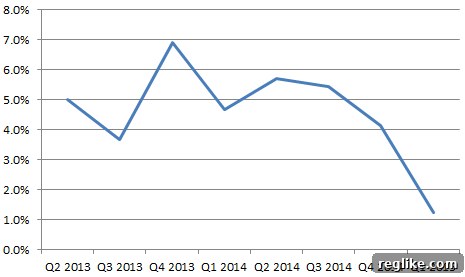
When we shift our analytical focus to the quarter-over-quarter (QoQ) growth, a distinctly different trend emerges. The sequential revenue growth from the fourth quarter of the prior year (Q4 2014) to the first quarter of the current year (Q1 2015) experienced a notable deceleration. Specifically, Q1 2015 registered only a modest 1.2% increase in revenue when benchmarked against Q4 2014. This considerably slower increment suggests a potential easing in the company’s immediate growth momentum, prompting important questions regarding prevailing market conditions, escalating competitive pressures, or internal operational shifts.
To provide further context and underscore the significance of this deceleration, let’s examine the actual dollar increase. The revenue surge from Q4 to Q1 amounted to approximately $5 million. This figure becomes particularly striking when juxtaposed with GoDaddy’s historical performance. Over the preceding two years, the lowest observed gross change in revenue on a quarter-over-quarter basis typically hovered around $10 million. The fact that the most recent sequential growth was precisely half of this historical minimum signifies a substantial slowdown in the pace of revenue accretion, raising critical considerations for both immediate performance assessment and long-term strategic formulation.
Visualizing these financial trends often provides unparalleled clarity. Financial reports frequently incorporate charts that graphically illustrate quarterly performance over extended periods. A typical chart depicting GoDaddy’s quarterly revenue, similar to the one referenced in internal documentation, would visually represent these fluctuations, distinctly highlighting periods of accelerated expansion and, more recently, the deceleration observed during Q1. Such a visual aid empowers stakeholders to swiftly grasp the trajectory of the business, facilitating the easier identification of patterns, anomalies, and potential turning points in revenue generation.
Navigating the Nuances of Subscription-Based Businesses: Beyond Headline Revenue
It is absolutely vital to recognize that revenue, while undeniably a fundamental financial metric, is not always the sole or most comprehensive indicator of financial health for a subscription-based business model like GoDaddy’s. The company’s core offerings – encompassing domain name registration, sophisticated web hosting solutions, professional email services, and a wide array of online business tools – are predominantly sold via a recurring subscription framework. This structure implies that customers remit fees periodically (e.g., monthly, annually, or through multi-year contracts), and the revenue associated with these services is systematically recognized over the subscription term, rather than being recorded entirely upfront at the point of initial sale.
This method of revenue recognition, which adheres strictly to prevailing accounting standards, introduces a natural lag between the moment a customer commits to a service (often termed “bookings” or “billings”) and when the corresponding revenue is fully reported on the income statement. For instance, if a customer prepays for a one-year advanced hosting plan, the entire payment is initially recorded as “deferred revenue” on the balance sheet. This deferred revenue is then systematically recognized as actual revenue in equal monthly installments over the subsequent twelve-month period. This accounting practice effectively smooths out reported revenue figures but can, at times, inadvertently mask immediate business momentum, or conversely, a slowdown in critical areas such as new customer acquisition or renewals.
Consequently, to genuinely comprehend the underlying performance and trajectory of GoDaddy, financial analysts and investors typically scrutinize a comprehensive suite of other performance metrics in conjunction with reported revenue. These crucial indicators often include: net customer additions, average revenue per user (ARPU), customer churn rates, total bookings (representing the aggregate value of new contracts and renewals secured within a specific period), and customer lifetime value (CLTV). For example, a reported slowdown in revenue might be more accurately attributed to fewer new subscriptions secured in the preceding quarter, even if existing long-term subscriptions continue to generate recognized revenue through the amortization of deferred revenue.
Key Factors Influencing GoDaddy’s Dynamic Growth Trajectory
GoDaddy’s revenue growth is subject to a multitude of influencing factors, both positive accelerators and potential headwinds. A thorough understanding of these forces is essential for accurately interpreting the Q1 results and for formulating informed projections regarding future financial performance:
Market Maturity and Intense Competition
The global market for domain registration and web hosting services is characterized by its high level of competition and, in certain segments, a significant degree of maturity. While there is a continuous influx of demand from new businesses establishing an online presence, the organic growth rate for foundational services may naturally moderate as the market approaches saturation points. GoDaddy navigates an intensely competitive landscape, facing formidable rivals such as Namecheap, Bluehost, HostGator, Squarespace, and Wix. Each competitor actively vies for market share, employing diverse pricing strategies, distinct feature sets, and targeting specific demographic niches. This fierce competition can exert downward pressure on pricing, necessitate increased marketing expenditures, and ultimately impact overall profitability and the pace of revenue expansion.
Strategic Product Diversification and Upselling Initiatives
GoDaddy has strategically evolved beyond its foundational domain and hosting offerings, developing a comprehensive suite of tools specifically designed to empower small businesses in the digital realm. This expanded ecosystem includes intuitive website builders, robust e-commerce platforms, advanced online marketing tools (such as SEO services, email marketing campaigns, and social media management), and essential security products (like SSL certificates and website backup solutions). The company’s ability to effectively cross-sell and upsell these higher-value, complementary services to its vast existing customer base is a critical engine driving ARPU enhancement and overall revenue growth. A slowdown in Q1 might hypothetically suggest a temporary dip in the efficacy of these upselling initiatives or perhaps a slightly lower adoption rate for newer, more advanced services.
Aggressive International Expansion Efforts
A cornerstone of GoDaddy’s long-term growth strategy centers on expanding its global footprint. Tapping into nascent and emerging markets where internet penetration is still on an upward trajectory, and where small businesses are increasingly transitioning online, presents colossal opportunities for growth. However, international expansion inherently involves its own set of challenges, including the need to meticulously adapt to diverse local market conditions, navigate complex regulatory environments, manage currency fluctuations, and contend with varying competitive landscapes. The speed and success of international market penetration can thus directly influence the company’s aggregate revenue growth.
Global Economic Environment and Small Business Resilience
GoDaddy’s financial fortunes are intrinsically linked to the overall health and vitality of small businesses worldwide. During periods marked by economic uncertainty or widespread downturns, small businesses might postpone the launch of new websites, scale back their online marketing investments, or opt for more budget-conscious digital solutions. Conversely, a flourishing economic environment typically stimulates entrepreneurial activity and concurrently boosts the demand for comprehensive online services. Macroeconomic trends, therefore, wield a direct and significant impact on GoDaddy’s customer acquisition rates and the average spending per customer.
Beyond Revenue: Essential Metrics for GoDaddy’s Long-Term Health
Given the intricate nature of GoDaddy’s business model, an exclusive focus on quarterly revenue growth alone can often present an incomplete or misleading picture. A truly comprehensive assessment necessitates scrutinizing several other critical performance indicators:
- Bookings: This metric represents the total value of all new contracts and renewals secured within a specific reporting period. For subscription-based businesses, bookings are frequently regarded as a robust leading indicator of future recognized revenue. If bookings maintain a strong upward trajectory despite a temporarily slower pace of revenue recognition, it strongly suggests a healthy and robust pipeline of future income.
- Customer Growth and ARPU (Average Revenue Per User): The total number of paying customers and the average monetary amount they spend are foundational metrics. Sustained growth in the customer count, synergized with an increasing ARPU (driven by successful upselling of additional services), unequivocally indicates a robust and scalable business model. A slowdown in reported revenue could potentially originate from either a reduced influx of new customers or a decrease in the average spending per existing customer.
- Churn Rate: This crucial metric quantifies the percentage of customers who cancel their subscriptions over a specified period. Elevated churn rates can significantly erode growth, making proactive customer retention strategies as critically important as new customer acquisition efforts. GoDaddy’s sustained ability to maintain a low churn rate is absolutely vital for preserving the integrity and stability of its recurring revenue base.
- Customer Lifetime Value (CLTV): CLTV provides an estimation of the total revenue a company can reasonably expect to generate from a single customer account throughout the entire duration of their business relationship. A high CLTV, particularly when benchmarked against customer acquisition costs (CAC), signifies a highly profitable and sustainable business model, even if short-term revenue growth experiences occasional fluctuations.
- Free Cash Flow (FCF): While revenue recognition can be a complex accounting exercise, free cash flow (derived from operating cash flow minus capital expenditures) offers a clearer and more tangible representation of the actual cash generated by the business. For a subscription-driven company, consistently strong free cash flow is a definitive indicator of financial health and provides the necessary capital to invest confidently in future growth initiatives and strategic opportunities.
Implications and Forward-Looking Outlook
The observed deceleration in GoDaddy’s quarter-over-quarter revenue growth in Q1, while not necessarily an unequivocal red flag, serves as an important prompt for introspection and strategic re-evaluation. It encourages the company to meticulously reassess its current growth strategies, potentially focusing on invigorating new customer acquisition efforts, optimizing the effectiveness of its upsell programs, or strategically exploring untapped market segments and geographical regions.
For discerning investors, this financial data underscores the critical importance of analyzing GoDaddy’s performance through a multifaceted and comprehensive lens. A healthy year-over-year growth rate (17.5%), combined with ongoing strategic initiatives in product diversification and aggressive international expansion, still points towards a company with substantial long-term growth potential. Nevertheless, vigilant monitoring of sequential trends and key operational metrics such as bookings, ARPU, and churn will be absolutely crucial in ascertaining whether the Q1 slowdown was an isolated, seasonal fluctuation or an early indicator of more enduring challenges within the market.
GoDaddy continues to maintain a formidable and dominant position within its core markets, propelled by its globally recognized brand, an extensive and evolving product suite, and an expansive, loyal customer base. The company’s sustained ability to innovate, adeptly adapt to dynamic market demands, and effectively monetize its comprehensive ecosystem of online tools will be paramount in sustaining its impressive growth trajectory and solidifying its unequivocal leadership in the ever-evolving landscape of online presence solutions for small businesses across the globe.