
Navigating the New Digital Frontier: Reassessing Brand Protection Costs in the Era of New TLDs
The digital landscape is in perpetual motion, constantly evolving and presenting new opportunities alongside novel challenges. Among the most significant shifts in recent years has been the introduction of hundreds of new generic Top-Level Domains (gTLDs). This expansion, spearheaded by the Internet Corporation for Assigned Names and Numbers (ICANN), aimed to diversify the internet’s naming system, offering businesses and individuals more precise, relevant, and creative domain name options beyond traditional ones like .com or .org. However, this vast expansion also ignited considerable debate and concern, particularly within the brand protection community. The core issue revolved around the anticipated increase in brand protection costs, fueled by fears of widespread cybersquatting, trademark infringement, and the necessity for extensive defensive registrations across these new digital territories.
The Dawn of New TLDs and Anticipated Challenges
The vision behind the new gTLD program was ambitious: to foster innovation, competition, and consumer choice within the domain name space. Imagine domains like .app, .shop, .tech, .london, or even .brand – each offering unique branding opportunities and clearer online identities. While the potential benefits for businesses seeking specialized online addresses were clear, the brand protection sector immediately recognized a significant potential downside. For trademark holders, every new TLD represented a new potential battleground where their intellectual property could be exploited. The sheer scale of the rollout, with hundreds of new extensions being delegated, suggested a daunting task for brands striving to maintain their digital integrity.
Unpacking the Vision Behind Domain Expansion
The rationale for expanding the domain name system was multifaceted. It aimed to alleviate the scarcity of desirable domain names under legacy TLDs, allow for geo-specific or industry-specific branding, and empower communities and companies with their own dedicated online spaces. This proliferation of choice was seen as a modernization of the internet’s addressing system, moving beyond a limited set of options to a more diverse and representative global network. For many, it represented a chance to create more meaningful and memorable online identities.
The Foreboding Shadow: Early Concerns from Brand Owners
From the perspective of brand owners and intellectual property professionals, the excitement surrounding new TLDs was heavily tempered by apprehension. The primary fear was an inevitable surge in brand abuse. With hundreds of new extensions, the possibility of third parties registering domain names incorporating well-known trademarks (e.g., brandname.newTLD, brandname-official.newTLD) became a very real and alarming prospect. This concern wasn’t unfounded; historical precedents with previous domain expansions had shown how quickly bad actors could capitalize on new opportunities to engage in cybersquatting, phishing, and trademark infringement. The immediate implication for brands was the perceived need for extensive defensive registrations – securing their trademarks across a wide array of new TLDs – a strategy that promised to be incredibly costly and complex.
The Trademark Lobby’s Stance: A Prophecy of Escalating Costs
In the lead-up to the new gTLD rollout, the trademark lobby, comprising legal firms, brand protection agencies, and corporate intellectual property departments, voiced profound concerns. Their warnings were stark, painting a picture of a digital “wild west” where brands would be constantly under siege. They anticipated a significant escalation in brand protection budgets, with a substantial portion dedicated to defensive registrations, monitoring, and enforcement actions.
Projecting a “Nightmare Scenario”
The narrative often described was a “nightmare scenario” where brands would be forced to register their primary trademarks in every relevant new gTLD to prevent cybersquatting and other forms of abuse. This pre-emptive strategy, though financially burdensome, was seen as a necessary evil to safeguard brand reputation, customer trust, and revenue streams. The cost projections were staggering, suggesting that companies might need to spend millions simply to maintain their existing level of brand protection in this expanded domain space. The lobbying efforts were intense, urging ICANN to implement robust safeguards to protect trademark holders.
Financial Implications of Widespread Defensive Registrations
The financial outlay associated with widespread defensive registrations extends beyond just the initial registration fees. It includes ongoing renewal costs, administrative overhead for managing a vastly expanded domain portfolio, and the potential legal costs associated with recovering domain names that were missed or registered by infringers. Brand owners were genuinely worried about the drain on resources that this new landscape could impose, potentially diverting funds from innovation or core business activities simply to protect their existing brand equity.
Mitigation Measures: ICANN’s Framework for Brand Safeguarding
Recognizing these legitimate concerns, ICANN implemented several mechanisms designed to mitigate trademark abuse and assist brand owners in protecting their intellectual property within the new gTLD program. These measures aimed to provide a balance between fostering innovation and safeguarding established rights.
The Role of the Trademark Clearinghouse (TMCH)
A cornerstone of ICANN’s brand protection strategy was the establishment of the Trademark Clearinghouse (TMCH). The TMCH acts as a centralized database for verified trademarks. Brands can record their trademarks with the TMCH, which then offers two key benefits: a “Sunrise Period” and a “Claims Service.” During the Sunrise Period, trademark holders who have registered their marks with the TMCH are given an exclusive opportunity to register corresponding domain names in newly launched gTLDs before they become available to the general public. This allows brands to secure critical domains proactively. The Claims Service, on the other hand, provides notifications. If a third party attempts to register a domain name that matches a trademark recorded in the TMCH after the Sunrise Period, both the brand owner and the potential registrant receive a notification, alerting the brand owner to the potential infringement and informing the registrant of the existing trademark rights.
The Uniform Rapid Suspension (URS) System: A Quick Recourse
In addition to the TMCH, ICANN introduced the Uniform Rapid Suspension (URS) system. The URS is a faster, cheaper, and lower-cost alternative to the Uniform Domain-Name Dispute-Resolution Policy (UDRP) for clear-cut cases of trademark infringement. It allows trademark owners to quickly suspend abusive domain names without necessarily having to go through a full-blown transfer process. This mechanism provides a crucial tool for swift action against obvious cybersquatting or phishing attempts, offering a more immediate remedy than traditional legal avenues.
The Reality Unveiled: A Striking Discrepancy
Despite the dire predictions and significant investments in developing brand protection mechanisms, a surprising reality emerged in the initial phases of the new gTLD rollout. Data collected, particularly evident from discussions at events like ICANN 50, revealed a phenomenon that defied initial expectations: the level of defensive trademark registrations in new TLDs was significantly lower than anticipated by the trademark lobby.
Lower-Than-Expected Defensive Registrations
The trademark lobby had braced for a tidal wave of defensive registrations, expecting brands to defensively register their marks across a vast number of new TLDs. While new gTLD applicants also anticipated a higher volume of registrations from brand owners, even their more conservative estimates often exceeded the actual numbers. This discrepancy quickly became a focal point of discussion, prompting questions about the effectiveness of existing protection mechanisms, the evolving strategies of brand owners, and the overall market dynamics of the new domain space.
Visualizing the Data: A Clearer Picture
The reality of the situation is perhaps best understood through a clear visual representation of the data. For many brand protection specialists and stakeholders within the ICANN community, the numbers presented a compelling counter-narrative to the initial fears. The graph below illustrates this stark contrast between the anticipated surge in protection costs and registrations, and the actual, more modest uptake.
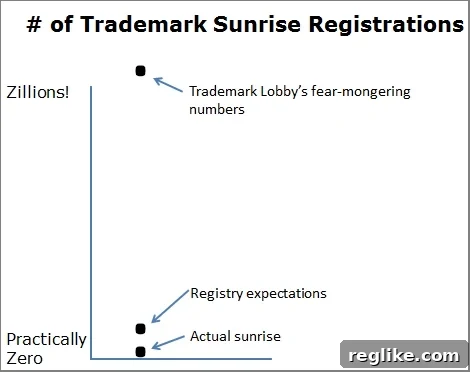
This chart vividly captures the unexpected trend, showing that the “nightmare” of exorbitant protection costs through mass defensive registrations did not materialize to the extent predicted. The implications of this data are profound, challenging pre-conceived notions and reshaping future strategies for brand protection.
Why the Gap? Unpacking the Reasons Behind the Low Numbers
The observed gap between predicted and actual defensive registrations prompts a critical analysis of the factors at play. Several interconnected reasons likely contributed to this unexpected outcome, ranging from the effectiveness of ICANN’s protection mechanisms to the evolving strategies of brand owners and the broader market dynamics of new TLDs.
Effectiveness of Brand Protection Mechanisms
One significant factor contributing to lower defensive registrations could be the unexpected efficacy of the TMCH and URS systems. While not perfect, these mechanisms provided brand owners with tools to proactively protect their marks and swiftly address clear infringements without resorting to costly blanket registrations. The existence of these streamlined dispute resolution processes might have instilled a greater sense of security, reducing the perceived urgency for mass defensive actions.
Strategic Prioritization by Brand Owners
Brand owners have become increasingly sophisticated in their digital asset management. Instead of a blanket defensive strategy, many opted for a more targeted and risk-averse approach. They likely conducted thorough risk assessments, prioritizing registrations only in new TLDs that posed a direct threat to their core business or brand reputation, or those that offered genuine strategic value. This selective approach, driven by a desire for cost-efficiency, meant avoiding registrations in less relevant or niche TLDs where the likelihood of abuse was deemed low or the business impact minimal.
Market Adoption Dynamics of New TLDs
The market adoption of many new gTLDs has been slower and more uneven than initially predicted. While some TLDs like .app or .dev have seen significant uptake, others have struggled to gain widespread traction. This slower adoption rate inherently reduced the perceived threat level for many brand owners. If a new TLD isn’t popular or widely used, the risk of it being exploited for trademark infringement diminishes, thereby reducing the impetus for defensive registrations.
The Evolving Landscape of Digital Brand Strategy
Finally, the overall landscape of digital brand protection has matured. Brands are increasingly leveraging advanced monitoring tools, social media protection strategies, and comprehensive online enforcement programs that extend beyond just domain name registrations. This holistic approach means that domain name protection, while crucial, is just one component of a broader strategy, allowing for more nuanced decisions regarding defensive registrations.
Implications for Future Brand Protection Strategies
The insights gleaned from the first round of new gTLD expansion carry significant implications for how brand owners and intellectual property professionals approach brand protection in the future. The data suggests a need for adaptability and a shift away from reactive, fear-driven strategies towards more proactive and data-informed decision-making.
Data-Driven Decisions Over Blanket Defense
The era of indiscriminate, blanket defensive registrations appears to be drawing to a close. Future strategies will increasingly rely on data analytics, threat intelligence, and a deep understanding of market relevance for each new TLD. Brands will prioritize registrations based on actual risk profiles, business value, and target audience engagement within specific new domain extensions, rather than simply trying to cover all bases.
Redefining “Cost-Effective” Brand Protection
The lower-than-expected costs have prompted a re-evaluation of what constitutes “cost-effective” brand protection. It’s no longer about spending the most, but about spending wisely. This involves a strategic blend of leveraging mechanisms like TMCH and URS, targeted defensive registrations, continuous monitoring, and swift enforcement action, all within a carefully managed budget.
Preparing for the Next Wave of TLD Expansion
Critically, the results of this round of brand protection efforts will undoubtedly inform the planning and execution of any subsequent TLD expansion rounds. The trademark lobby, ICANN, and brand owners will all draw upon this experience. Predictions for future costs and necessary protective measures will likely be more grounded in empirical data rather than solely on worst-case scenarios. This collective learning process holds the promise of a more efficient and harmonized approach to managing intellectual property in an ever-expanding digital domain space.
Conclusion: Adapting to a New Paradigm of Brand Security
The journey through the initial phase of new TLD implementation has provided invaluable lessons for the brand protection community. While initial fears of an overwhelming financial burden due to defensive registrations were widely expressed, the reality has proven to be more nuanced. The lower-than-expected uptake of defensive registrations highlights the combined effectiveness of ICANN’s protection mechanisms and the strategic evolution of brand owners’ intellectual property management. This outcome is a testament to the fact that exaggeration of costs, while perhaps well-intentioned to ensure robust safeguards, can sometimes obscure the actual landscape. Moving forward, the focus for brand protection in the digital realm must be on intelligent, data-driven strategies, leveraging available tools, and making informed decisions that prioritize both brand integrity and fiscal responsibility. The insights gained from this round will undoubtedly serve as a critical benchmark, shaping policies and strategies for the inevitable next expansion of the internet’s domain name system, fostering a more secure and predictable environment for brands worldwide.