
Unpacking the New Domain Landscape: The Enduring Shadow of .COM
The internet’s domain name system has undergone a significant transformation with the introduction of hundreds of new generic Top-Level Domains (gTLDs). These new extensions, ranging from industry-specific options like .tech and .bike to more general descriptors like .online and .xyz, promised to revolutionize how individuals and businesses establish their digital identities. However, early observations and recent data reveal a fascinating paradox: despite the proliferation of these new choices, the venerable .COM remains an overwhelmingly dominant force, often shadowing the registrations within these burgeoning new TLDs.
This article delves into an intriguing pattern emerging from the new TLD registrations, dissecting the reasons behind it, and exploring its broader implications for online presence, branding, and future domain strategies. What started as a personal observation has now been validated by extensive data, painting a clearer picture of the evolving, yet stubbornly traditional, domain name ecosystem.
The Curious Case of SLDtld.com: An Observation Confirmed
Early this year, as the release of new top-level domain names gained momentum, a peculiar trend caught my attention while reviewing various new TLD registrations: a significant majority of the second-level domains (SLDs) being registered under these new extensions were also readily available in their .com equivalent. Specifically, the combination of the SLD and the new TLD often formed a variant that was available as SLDtld.com. For instance, if someone registered “Something.Guru,” it was highly probable that “SomethingGuru.com” was also available.
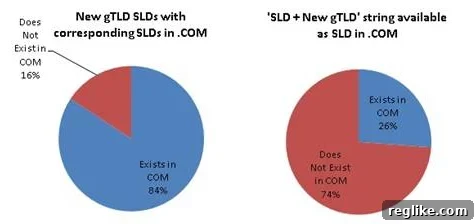
This initial, anecdotal observation has now been robustly confirmed by Verisign, the authoritative registry for .com and .net domains. Verisign recently published comprehensive data supporting this phenomenon, drawing from a much larger dataset than any individual could observe. Their findings indicate that a remarkable 74% of all new TLD registrations are, in fact, available as their concatenated SLDtld.com counterpart. This statistic not only validates the initial observation but also underscores the profound influence .com continues to exert, even in a landscape purportedly designed to offer alternatives.
Deconstructing the Trend: Why Does This Pattern Emerge?
Understanding why such a high percentage of new TLD registrations have an available .com equivalent is crucial for anyone navigating the modern domain landscape. Several factors contribute to this phenomenon, touching upon user perception, branding strategies, and the very nature of these new extensions.
TLDs as Categories, Not Extensions
One primary reason for this trend is how many users and registrars perceive the new TLDs. Rather than viewing the TLD as an integral, continuous part of the domain name string, it is often treated more as a descriptive category or a contextual label for the second-level domain. Consider “MyBusiness.Tech” or “LocalCafe.Berlin.” In these instances, “.tech” and “.berlin” provide additional context, specifying the industry or geographic location, rather than forming a single, flowing word with the SLD. When these are strung together as “MyBusinessTech.com” or “LocalCafeBerlin.com,” they often become lengthy, somewhat awkward, and less intuitive as a primary web address.
Furthermore, many new TLDs are designed to read “backward” or function as qualifiers, which makes their concatenation with the SLD and then .com even less sensical. Examples include .best, .top, .cheap, .expert, and .solution. For instance, “SEO.Expert” clearly indicates a website about SEO experts. However, “SEOExpert.com” just sounds like a regular .com domain without the specific categorical nuance. This inherent design of many new TLDs naturally leads to the availability of their continuous string .com versions, as they don’t logically flow as a single entity.
Strategic Brand Protection and Defensive Registrations
Another significant driver of this high availability percentage stems from corporate branding and trademark protection strategies. Large brands, in an effort to safeguard their intellectual property and maintain comprehensive control over their digital presence, frequently engage in defensive registrations. This involves registering their brand name across a multitude of new TLDs, even those that have little to no direct relevance to their core products or services.
For example, a financial services company like TD Ameritrade might register “TDAmeritrade.bike” to prevent others from potentially misusing their brand or engaging in cybersquatting. However, it’s highly unlikely they would then register “TDAmeritradeBike.com” because the latter combines two disparate concepts into a single, less meaningful .com address. While the strategy of registering a brand across numerous irrelevant TLDs is understandable from a defensive standpoint, its practical utility can be questioned. If a user were susceptible to being duped by “TDAmeritrade.bike,” it’s plausible they might also fall for “TDAmeritradeBike.com” or a variation like “Ameritrade.bike,” if such domains were available or exploited by malicious actors. The sheer volume of new TLDs makes comprehensive defensive registration an expensive and often inefficient endeavor, further contributing to the availability of these concatenated .com versions.
The Enduring Power of .COM: A Legacy of Trust and Recognition
Beyond these specific reasons, the pervasive availability of SLDtld.com stems from the overarching dominance and unique position of .COM in the internet’s history. For decades, .com has been the default, the gold standard, and the most trusted domain extension globally. It carries an inherent authority and memorability that newer TLDs are still striving to achieve.
Users instinctively type “.com” when guessing a website address. Businesses, even those opting for a niche new TLD, often maintain a .com presence as their primary brand anchor, redirecting traffic from other domains. This ingrained habit and trust mean that purely conceptual concatenations of SLD + new TLD + .com rarely gain organic traction or are proactively sought out by potential registrants, leaving them open for availability.
The Uncharted 16%: Where .COM Doesn’t Reign Supreme
While the 74% figure highlights the shadow of .COM, Verisign’s data also uncovers a fascinating counter-trend: a significant 16% of second-level domains registered in new top-level domain names are *not* registered in .com. This minority offers a glimpse into a different facet of the domain landscape, where registrants are intentionally diverging from the .com norm. Exploring the reasons behind these non-.com registrations provides valuable insights into niche markets, innovative branding, and the evolving role of domain names.
Exploring the Reasons for Non-.COM Registrations
What motivates a registrant to choose a new TLD without securing its .com equivalent? Several factors could be at play:
Niche Appeal and Market Specialization
Many new gTLDs cater to specific industries, interests, or geographic locations. For businesses and individuals operating within these highly specialized niches, the specific new TLD can offer a more precise and memorable brand identity than a generic .com. For instance, a cutting-edge software startup might find “Innovate.Tech” to be more impactful and relevant than “InnovateTech.com.” A local bakery might prioritize “Delicious.Bakery” over a lengthier or less specific .com address.
In these cases, the new TLD itself becomes a powerful part of the brand message, directly communicating the nature of the business or content. The audience for such specialized domains might also be more tech-savvy or accustomed to exploring beyond traditional .com URLs, making the .com variant less critical for discovery or trust.
Uniqueness and Brand Innovation
For some startups and brands, the goal is to break free from conventional naming structures and establish a truly unique digital presence. If “MyBrand.com” is already taken or is simply too generic, “MyBrand.Shop” or “MyBrand.Online” might offer a fresh alternative that aligns better with their innovative spirit. In such scenarios, the .com equivalent might not even be considered, or it might be intentionally bypassed to emphasize the distinct identity offered by the new gTLD.
This approach often appeals to younger companies or individuals who are not bound by the legacy perceptions of .com and are keen to leverage the novelty and specificity of newer extensions for a modern brand image.
Cost, Availability, and Strategic Choice
The availability of premium .com domains can be a significant hurdle. Desired short, memorable .com names are often expensive, held by domain investors, or already in use. For budget-conscious startups or individuals, registering a relevant new TLD might be a more feasible and cost-effective option, especially if the corresponding .com is either unavailable or prohibitively expensive.
Moreover, some registrants might deliberately choose not to secure the .com variant if they believe their target audience will primarily discover them through direct searches for the specific new TLD, social media, or other marketing channels where the .com default is less relevant. This strategic choice reflects a calculated decision that the benefits of the niche TLD outweigh the traditional advantage of a .com, perhaps focusing resources on the new TLD’s brand building rather than defensive .com registrations.
Implications for Digital Identity and Online Strategy
The data from Verisign offers profound implications for anyone contemplating their online presence, from individual bloggers to multinational corporations. The enduring strength of .com, alongside the emerging, albeit shadowed, landscape of new gTLDs, creates a complex environment for digital strategy.
The Enduring Power of .COM
.COM remains the undeniable king of the internet. Its ubiquity means that for most general-purpose websites, it is still the preferred choice for memorability, trust, and ease of access. Businesses neglecting their .com presence, even when using a new gTLD, risk losing traffic to competitors or causing confusion among users who instinctively append “.com” to a brand name. This means that for many, securing the .com remains a foundational element of their digital strategy, often serving as the primary redirect target or the most recognized brand address.
The Future of New gTLDs
While new gTLDs haven’t fully supplanted .com, they are carving out important niches. They offer unprecedented opportunities for specific branding, localization, and industry-focused identity. For those in specialized fields, a relevant new TLD can convey expertise and community belonging more effectively than a generic .com. However, their success often hinges on strong marketing and clear communication to guide users to these new addresses.
For brands considering a new gTLD, a balanced approach is often best: secure the most relevant .com first (if possible and affordable), and then strategically add new TLDs that genuinely enhance brand messaging or protect against specific threats. The goal should be to create a cohesive digital ecosystem, where different domain extensions serve distinct, yet complementary, purposes.
Conclusion
The domain name landscape is in a constant state of evolution, yet some fundamental truths persist. The introduction of new top-level domains has expanded choices and offered exciting possibilities for online identity, but the deep-rooted trust and dominance of .COM continue to shape registration patterns. Verisign’s data strikingly illustrates this, revealing that the vast majority of new TLD registrations exist alongside an available .com counterpart. This phenomenon is a testament to how users perceive domain names, the strategic actions of brands, and the inherent legacy of the internet’s original extension.
As the digital world continues to expand, understanding these dynamics is paramount. While new gTLDs offer valuable specificity and branding opportunities for niche markets and innovative entities, the strategic importance of .COM for broad recognition and trust remains unchallenged. A thoughtful domain strategy today requires navigating both the traditional power of .COM and the specific potential of new TLDs, creating a robust and recognizable online presence that caters to both historical user habits and future digital trends.