
Afternic Unveils Self-Brokering: A Deep Dive into the Initial Release and Its Implications for Domain Investors
In a significant development for the domain aftermarket, Afternic, a leading platform for domain name sales and a subsidiary of GoDaddy, has officially rolled out a highly anticipated self-brokering feature. This new functionality empowers domain name investors to directly manage negotiations for their listed domains, shifting from the traditional model where Afternic’s dedicated brokers handle the sales process. While this represents a monumental step towards greater control for sellers, the initial version of the self-brokering system is, by design, a minimum viable product (MVP), introducing both exciting opportunities and some notable limitations that warrant a closer look.
For years, domain investors have relied on Afternic’s robust brokerage services to facilitate transactions, leveraging their expertise, established buyer networks, and negotiation skills. The introduction of self-brokering marks a pivotal moment, offering a hybrid approach that allows investors to choose their preferred sales method. This could revolutionize how some high-volume or highly strategic domain investors manage their portfolios, offering direct engagement with potential buyers and potentially faster deal closures, albeit with a learning curve.
Understanding the Minimum Viable Product (MVP) Approach
The term “minimum viable product” is crucial to understanding Afternic’s current offering. An MVP is a version of a new product or feature that has just enough functionalities to satisfy early adopters and provide feedback for future product development. This strategic launch allows Afternic to gather real-world data and iterate on the feature, ensuring subsequent versions are more robust and user-friendly. For domain investors, this means the current self-brokering system, while functional, is an initial iteration and not yet a comprehensive solution for all sales scenarios. Early adopters will be instrumental in shaping its evolution.
This phased rollout is a common practice in software development, particularly for complex platforms like Afternic. It enables developers to identify pain points, prioritize enhancements, and build a feature that truly meets the needs of its diverse user base without over-engineering the first version. Therefore, investors considering this new option should approach it with an understanding of its foundational nature and anticipate future improvements.
Eligibility Requirements: Who Can Self-Broker?
Access to Afternic’s self-brokering feature is not universal at launch; it comes with a specific prerequisite designed to target a particular segment of the domain investor community. To opt into self-brokering, sellers must possess an active Premium Domain Discount Club membership. This membership, priced at $240 per year, offers various benefits, including reduced commission rates on domain sales. GoDaddy has indicated that approximately 100,000 users are eligible based on their existing membership status, suggesting a substantial pool of potential self-brokers who might be keen to explore this new avenue.
The membership requirement means that the feature is initially aimed at serious or professional domain investors who are already committed to the Afternic ecosystem and likely have larger portfolios or a higher volume of sales. This strategic gating ensures that early feedback comes from experienced users who can provide valuable insights into the system’s practical application and areas for improvement.
Activating the Self-Brokering Option
For eligible users, enabling the self-brokering feature is straightforward. Within the Afternic dashboard, navigating to Settings > Account will present the option to turn on self-brokering. This seamless integration into the existing user interface ensures that those who meet the criteria can easily activate the feature and begin managing their sales leads directly. The user experience is designed to be intuitive, allowing investors to quickly transition between their current settings and the new self-brokering functionalities.
Critical Limitations: Lander Compatibility and “Make Offer” Functionality
One of the most significant constraints of the current self-brokering system lies in its compatibility with Afternic’s landing pages. Currently, the feature exclusively supports “make offer” inquiries originating through the Custom Lander, a legacy system inherited from the Dan.com acquisition. Crucially, it does not function with the more modern Price Request lander. This distinction is vital for sellers to understand, as it directly impacts which of their listed domains can utilize self-brokering.
Sellers wishing to use the self-brokering system must ensure that their domains are configured with the Custom Lander, and more importantly, that the “make offer” option is explicitly enabled on that lander. Without this specific configuration, potential sales leads will not be routed through the self-brokering system, thereby limiting its applicability to a subset of an investor’s portfolio. This limitation underscores the MVP nature of the release, suggesting that broader lander compatibility is likely on the roadmap for future updates.
Impact on Lead Generation and Buyer Experience
The reliance on the Custom Lander and its “make offer” structure introduces several considerations regarding the buyer’s journey and potential conversion rates. When a prospective buyer initiates an offer through the Custom Lander, they are first prompted to log into their GoDaddy account. This mandatory login step is a potential point of “friction” that could deter some buyers, especially those who do not have an existing GoDaddy account or prefer a more anonymous browsing and inquiry process. Any additional steps in a buyer’s journey can lead to a drop-off in engagement.
Following the login, buyers are presented with a series of screening questions. These questions are designed to ascertain the buyer’s genuine interest in acquiring the domain, distinguishing serious prospects from casual browsers or those simply confused about the process. While this pre-qualification mechanism can be beneficial for sellers by filtering out irrelevant inquiries, there’s a critical gap in the current system: the answers to these screening questions are not currently shared with the sellers.
This lack of shared information is a notable limitation. For effective negotiation and understanding of buyer intent, knowing why a buyer is interested or what their specific needs are can be invaluable. Without this context, sellers are left to negotiate with less information, potentially hindering their ability to close a deal or understand the buyer’s motivation. This aspect highlights an area ripe for enhancement in subsequent versions of the self-brokering tool.
Managing Self-Brokered Leads: The Seller’s Perspective
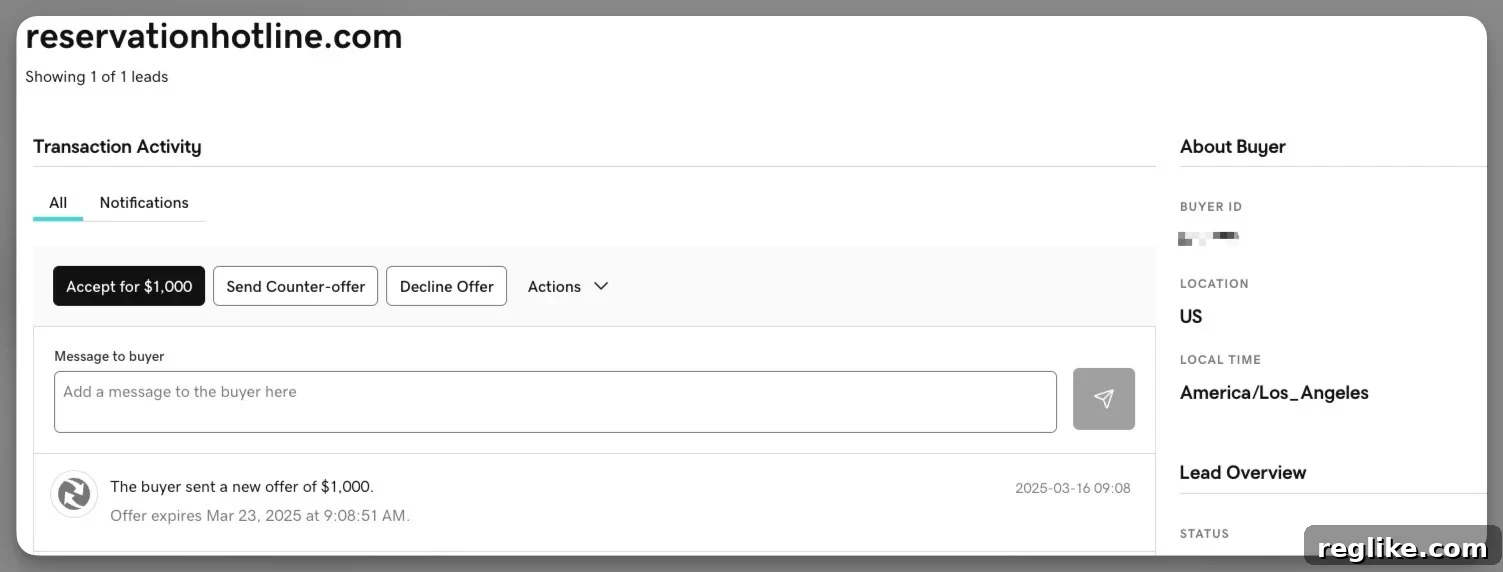
Once an offer is successfully submitted through the Custom Lander and passes the initial screening, it becomes visible to the seller within the Afternic account manager. These leads are conveniently located under Sales > Self Brokered Leads. This dedicated section provides sellers with a centralized hub to monitor and manage all direct offers. The information provided to sellers for each lead includes the offer price and basic geographical location data for the buyer.
The availability of basic location data can be moderately useful for sellers, offering a general sense of the buyer’s origin, which might sometimes play a role in understanding their needs or potential use cases for the domain. However, more granular data or insights into buyer intent (such as the screening question answers) would undoubtedly enhance the seller’s negotiation position and overall understanding of the lead.
Negotiation and Broker Forwarding Options
Upon reviewing a self-brokered lead, sellers are presented with two distinct paths:
- Negotiate Directly: Sellers can engage in direct communication and negotiation with the buyer through the Afternic system. This empowers investors to control the conversation, set their own terms, and potentially expedite the sales process without intermediary involvement. The platform likely provides tools for counter-offers, messaging, and deal progression.
- Forward to an Afternic Broker: If a seller prefers not to handle the negotiation directly, feels overwhelmed, or believes a professional broker can achieve a better outcome, they have the option to forward the lead to an Afternic broker. This flexibility ensures that sellers are not locked into the self-brokering process and can leverage Afternic’s established brokerage services when needed. This is particularly useful for complex deals or when time constraints prevent direct engagement.
This dual option offers significant flexibility, allowing investors to experiment with self-brokering while retaining the safety net of professional brokerage. It acknowledges that not every investor will want to handle every negotiation directly, and not every domain sale is equally straightforward.
Initial Impressions and Future Outlook
The introduction of Afternic’s self-brokering feature is undoubtedly a positive step forward, offering domain investors unprecedented control over their sales processes and potentially new insights into buyer interactions. The prospect of directly engaging with buyers, understanding their motivations firsthand, and streamlining negotiations is genuinely exciting. However, the current iteration’s limitations, particularly the mandatory GoDaddy login for buyers and the exclusive reliance on the Custom Lander with its “make offer” function, introduce significant friction points.
For many domain investors, myself included, the concern is that these friction points could potentially reduce conversion rates. Requiring a buyer to log into an account just to make an offer adds an extra hurdle that might deter casual or less committed prospects. The lack of screening question answers for sellers also deprives them of valuable intelligence that could aid in negotiation. Therefore, while the potential for new insights is high, a cautious approach to widespread adoption seems prudent at this early stage.
The strategic move to launch this as an MVP suggests that Afternic is committed to evolving the feature. Anticipated enhancements might include broader lander compatibility, a more streamlined buyer experience (perhaps without a mandatory login for initial offers), and improved information flow to sellers. These improvements would significantly bolster the feature’s utility and appeal, making it a more viable option for a wider range of domain sales and investors.
What’s Next for Self-Brokerage?
Further insights into the future of Afternic’s self-brokerage initiative are expected soon. Alan Shiflett, the Senior Director of Domain Investor Product at GoDaddy, is scheduled to appear on an upcoming podcast. During this discussion, Mr. Shiflett will likely delve deeper into the strategic rationale behind launching the feature with its current set of functionalities. More importantly, he is expected to elaborate on the comprehensive roadmap for self-brokerage, offering a glimpse into planned enhancements and the long-term vision for this exciting development.
Domain investors and industry watchers will be keenly awaiting this update, as it will provide crucial context for how Afternic plans to address current limitations and expand the capabilities of self-brokering. This ongoing evolution promises to empower domain investors with increasingly sophisticated tools, fostering a more dynamic and seller-centric domain aftermarket.