
Verisign’s Groundbreaking Patent: Revolutionizing Dynamic Domain Pricing and Registration Management
A recently granted patent to Verisign marks a significant milestone in the domain name industry, introducing sophisticated mechanisms for dynamic domain pricing, adaptive registration requirements, and enhanced allocation strategies. This forward-thinking patent has the potential to reshape how domain names are bought, sold, and managed, addressing long-standing challenges related to market efficiency, security, and fairness.
The U.S. Patent and Trademark Office has officially awarded patent number 11,244,368 (PDF available for review) to Verisign (NASDAQ: VRSN). Titled “Adaptive control of domain name registrations via dynamically variable registration requirements,” this patent covers a comprehensive suite of advancements designed to bring unprecedented agility and intelligence to the domain name ecosystem. This broad patent encompasses four critical areas of domain pricing, allocation, and registration management, promising a more responsive and secure future for internet infrastructure.
Transforming Domain Name Allocation: Four Core Innovations
Verisign’s patent introduces a multi-faceted approach to domain name management, moving beyond static systems to embrace dynamic, data-driven methodologies. The four key pillars of this patent — dynamic domain pricing, adaptive registration requirements, optimized expired domain management, and strategic registrant whitelisting — collectively aim to enhance market efficiency, combat abuse, and ensure a more equitable distribution of valuable digital assets.
1. Dynamic Domain Pricing: Responding to Market Demand in Real-Time
The concept of premium domain names, where certain desirable strings command higher prices, is not new. Verisign itself pioneered this approach with the .tv top-level domain many years ago, and it became a standard practice with the launch of new generic top-level domains (gTLDs) almost a decade ago. However, the existing infrastructure for managing and updating these premium prices has largely remained antiquated and inefficient.
Historically, the process of relaying premium pricing information to domain registrars has been remarkably archaic. Many registries still rely on manual methods, such as sending extensive spreadsheets to registrars, detailing which domains are considered premium and their respective price points. This labor-intensive process makes it incredibly challenging for registries to quickly adjust prices in response to rapidly evolving market trends or sudden surges in demand for specific keywords. For instance, if a term like “NFT” or “Metaverse” suddenly gains immense popularity, registries face significant delays in updating their pricing structures to reflect this newfound value.
While some modern registry platforms have introduced systems that allow for faster price updates through centralized management interfaces, these often still require manual intervention to identify trends and implement changes. Verisign’s new patent fundamentally redefines this process. It describes an intelligent system capable of dynamically setting domain prices based on a continuous stream of real-time data and demand signals.
This sophisticated system can analyze various indicators to determine the level of demand or interest for specific domain strings. These indicators may include:
- The frequency of requests to register or resolve domain names containing particular keywords.
- Significant changes or spikes in these request frequencies.
- Historical registration patterns of domain names incorporating the string.
- Trending topics or search terms identified across various platforms, including social media, news outlets, and search engines.
- Data related to non-existent domains (NXD data), which can indicate demand for currently unregistered domains based on their traffic levels.
Imagine a scenario where a keyword like “ETH” suddenly experiences a massive surge in online searches, news coverage, and social media mentions due to market events. Under Verisign’s patented system, the pricing for domain names containing “ETH” could automatically adjust to a premium level in real-time. This dynamic adjustment ensures that domain prices accurately reflect current market value, allowing registries to maximize revenue while also potentially deterring speculative registrations driven solely by short-term trends.
2. Adaptive Registration Requirements: Bolstering Security and Preventing Abuse
Beyond pricing, Verisign’s patent extends its adaptive control to the very requirements for domain registration, offering powerful new tools to combat abusive registrations such as phishing, cybersquatting, and brand impersonation. This aspect of the patent aims to create a more secure and trustworthy domain name space by introducing flexible verification mechanisms.
The system outlined in the patent can dynamically establish and adjust registration requirements based on the characteristics of the domain name being sought and potential risks associated with its registration. For example:
- Accreditation for Sensitive Domains: For domain names likely to be used for charitable or non-profit purposes (e.g., “RedCross.tld”), the system could automatically require the requesting entity to prove its status as a registered 501(c) organization or equivalent. This helps prevent fraudulent entities from misrepresenting themselves.
- Identity Authentication: Basic identity authentication requirements could be enhanced. The system could demand concrete proof of the requesting entity’s stated individual or organizational identity, such as pertinent legal documentation, digital identity certificates, or multi-factor authentication, particularly for high-value or sensitive domains.
- Proof of Related Ownership: To thwart “typosquatting” or registrations exploiting common misspellings of established brands, the registry system could require proof of ownership of the primary domain before allowing the registration of similar or commonly-mistyped variations. For instance, if an entity attempts to register “wwwexample.tld,” they might be asked to verify ownership of “example.tld.” This proactive measure significantly reduces opportunities for brand infringement and user confusion.
Furthermore, the patent highlights the system’s ability to protect vulnerable end-users from malicious actors. By dynamically adjusting registration requirements for domain names exhibiting certain risk assessments—such as those with high or spiking DNS lookup rates (often indicative of a trending topic or a recently expired domain)—the system can deter malicious middlemen. These actors often seek to register such domains at below-market prices to set up phishing websites or other deceptive online presences, especially during crisis events like natural disasters.
Consider a humanitarian crisis, such as an earthquake in Haiti. In such a scenario, malicious actors frequently attempt to register domains like “HaitiRelief.tld” or “EarthquakeAid.tld” to create fake donation sites. Verisign’s patent allows the registry to immediately increase the offer price for such domains, making them prohibitively expensive for price-sensitive phishers. Alternatively, the system could enforce stringent eligibility requirements, demanding verification of non-profit status or official disaster relief organization credentials before allowing registration. This significantly elevates the barrier for entry for bad actors, protecting the public from scams during vulnerable times.
3. Optimized Expired Domain Management: A Smarter Approach to Reallocation
Verisign has a history of innovating in the realm of expired domains, having filed multiple patents related to their allocation and lifecycle. The newly issued patent builds upon this foundation, introducing sophisticated mechanisms for adjusting both pricing and registration requirements for domains that have expired.
One particularly interesting aspect addresses how the price of an expired domain can change based on the identity of the prospective registrant. This has significant implications for existing domain name practices. Many new top-level domains offer attractive promotional pricing for initial registrations, with much higher renewal fees. This model often leads to domains being allowed to expire and then re-registered at the lower “new registration” price by the same or different entities, essentially circumventing renewal costs for less demanded domains.
The patent introduces a refined approach using eligibility criteria that can include:
- Whitelists: A list of entities deemed eligible to register an expired domain at a specific offer price. This whitelist could, for example, exclude previous registrants of that domain to prevent re-registration at a lower introductory rate.
- Blacklists: Conversely, a blacklist could identify entities ineligible to register the domain at a certain price, potentially targeting those with a history of abusive practices or the domain’s most recent registrant if the aim is to encourage new ownership.
Furthermore, the registry could dynamically adjust pricing for expired domains based on their potential demand, indicated by metrics such as high historical traffic or DNS queries. The system could also implement a tiered pricing model, where an initial expired domain price is set, which then changes over time—perhaps decreasing if the domain remains unregistered for a specified period, or increasing if demand signals emerge. These adaptive strategies aim to ensure that expired domains are reallocated more efficiently and fairly, reflecting their true market value and discouraging speculative exploitation.
4. Strategic Registrant (or Registrar) Whitelisting: Controlled Access and Fair Allocation
This section of the patent addresses sensitive issues related to domain availability and the fairness of registration processes, drawing parallels to past controversies in the domain industry. A notable example is Network Solutions’ practice in 2008 of reserving domain names that users searched for on their platform. If a user searched for “example.com,” Network Solutions would preemptively register it, blocking the customer from registering it with another registrar while still allowing them to complete the registration through Network Solutions.
Verisign’s patent describes a system that enables the limitation of registrations to specific entities, but with a focus on creating more controlled and potentially fairer allocation scenarios. This could manifest in several ways:
- First Searcher Priority: The system could temporarily restrict a domain’s registration to the entity that first searched for it. If a user searches for “example.tld” and is presented with a price, they might have a limited window (e.g., 24 hours) to register it before the price changes or other individuals become eligible. This could prevent “front-running” by registrars or other entities.
- Timed Eligibility and Phased Rollouts: The patent also allows for limiting registrations to specific groups of entities for a defined period, after which the domain opens up to a broader audience. This concept is highly relevant to various launch scenarios within the domain industry. For instance, it mirrors “sunrise periods” for new TLDs, where trademark holders are given exclusive early access. It could also apply to the expansion of namespaces, such as when .co.uk registrants were offered priority for .uk domains, or when .com.au registrants were given priority for corresponding .au registrations.
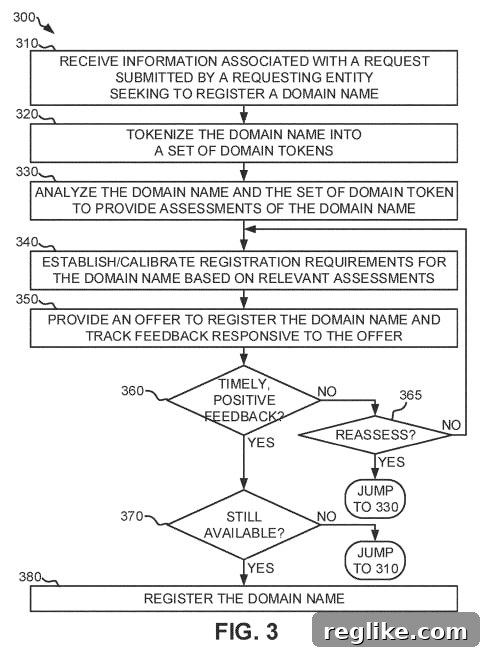
The patent excerpt below illustrates the adaptive nature of this system:
If, at stage 360, the registration controller determines that feedback received is not positive, for example, the requesting entity cancels the registration request, rejects the registration offer, fails to accept or satisfy all relevant registration requirements during the offer period, then process 300 can proceed to stage 365. At stage 365, the registration controller can determine whether or not to reassess the domain name, for example, by evaluating whether or not the domain name’s current assessments and/or registration requirements remain valid (e.g., not yet expired based on associated time-to-live). If, at stage 365, the registration controller elects to not reassess the domain name, then process 300 can jump to stage 340, at which the registration controller can calibrate or adjust the domain name’s registration requirements to account for any relevant feedback or lack thereof, if warranted, or simply maintain the domain name’s registration requirements. For example, subsequent to determining that the domain name failed to receive positive feedback within the domain name’s offer period, the registration controller can calibrate or adjust the domain name’s registration requirements by lowering the domain name’s offer price, extending the offer period, adding one or more TLDs for which the offer price applies, adding entities to the whitelist of entities eligible for the offer price, removing entities from the blacklist of entities ineligible for the offer price, lowering or removing entity eligibility requirements, and the like. However, if at stage 365 the registration controller elects to reassess the domain name, for example, because the domain name’s current assessments and/or registration requirements are no longer valid (e.g., expired based on the registration requirements’ associated time-to-live), then process 300 can jump to stage 330 to reassess the domain name.
In essence, this passage describes a feedback loop where if a domain offer isn’t accepted, the system can automatically adjust parameters like price, offer duration, eligible TLDs, or even modify whitelist/blacklist entries to increase the chances of a successful registration. This ensures that the allocation process remains dynamic and responsive, adapting until the domain finds a suitable registrant.
The Future Implications of Verisign’s Sweeping Patent
Companies strategically apply for patents not only for services they currently provide but also for innovations they might introduce in the future, or even to preempt competitors. This particular patent from Verisign, initially applied for in 2016 and granted today, stands out as one of the most comprehensive and impactful patents the company has secured in recent memory.
Its broad scope, covering dynamic pricing, adaptive registration requirements, sophisticated expired domain management, and controlled allocation, suggests a significant strategic vision. This patent could pave the way for a more intelligent, secure, and responsive domain name system, moving away from static, reactive models to a truly adaptive ecosystem. For domain registries, it offers tools to maximize revenue and combat abuse more effectively. For registrants, it could lead to fairer pricing based on true market demand and enhanced security measures, though it also signals a potential increase in complexity for some registration processes.
Understanding the intricacies of this patent is crucial for anyone involved in the domain name industry, as it provides a valuable glimpse into how Verisign, a pivotal player in internet infrastructure, envisions the future of domain name management and control.