
The Convergence of Artificial Intelligence and Domain Name Disputes: A Glimpse into the Future of UDRP

In an increasingly digital world, the intersection of technology and law continues to evolve at an unprecedented pace. One of the most fascinating developments is the growing capability of Artificial Intelligence (AI) to engage with complex legal reasoning, offering predictions and insights that once were the sole domain of seasoned legal professionals. A recent Uniform Domain Name Dispute Resolution Policy (UDRP) case involving the domain name young.com has cast a spotlight on this very phenomenon, demonstrating AI’s surprising aptitude for dissecting intricate legal arguments and forecasting outcomes. This article delves into the specifics of this pivotal case, explores the AI’s analysis, and contemplates the broader implications for domain name disputes and the legal industry at large.
A Landmark UDRP Decision: The young.com Case
The World Intellectual Property Organization (WIPO) recently published a significant decision concerning the domain name young.com. A three-person panel unanimously ruled in favor of the domain registrant, delivering a sharp rebuke to the Complainant, Young Pharmaceuticals, Inc., for filing the case in bad faith. The UDRP, established by ICANN, provides an administrative process for resolving disputes over domain name registrations, primarily focusing on cases of cybersquatting where domain names are registered with the sole intent to profit from another’s trademark.
The panel’s critique of the Complainant was particularly pointed, highlighting several unsubstantiated assertions. They stated that “to assert that it is not possible to conceive any legitimate use of the disputed domain name is simply nonsense,” underscoring the common dictionary nature of the term “young.” Furthermore, the panel observed that “the Panel could list several submissions and assertions made by the Complainant which are not borne out by any reasonable interpretation of the evidence that the Complainant had to hand when the Complainant filed the Complaint.” This strong language from WIPO emphasizes the rigorous burden of proof placed on complainants in UDRP proceedings and the severe consequences of bringing a dispute without sufficient grounds.
The Complainant, Young Pharmaceuticals, Inc., was represented by Cantor Colburn LLP, while the domain name owner was skillfully defended by John Berryhill, a renowned UDRP attorney. Berryhill’s track record of success in complex domain disputes is well-established, making his involvement in this case particularly noteworthy.
The Human Element: The Expertise of a UDRP Veteran
John Berryhill is widely recognized as one of the most prolific and successful UDRP lawyers globally. His deep understanding of trademark law, domain name policy, and the nuances of UDRP precedents has led to numerous victories for his clients. He specializes in crafting detailed and persuasive responses that often dismantle complainants’ arguments, especially in cases involving generic or dictionary word domains where proving “bad faith” registration and use is challenging.
However, as AI capabilities advance, a pertinent question arises: are the days of such highly specialized human legal drafting numbered? Or, more optimistically, how will AI augment the work of attorneys and panelists in these specialized fields? The young.com case offers a fascinating test case, providing a unique opportunity to explore the potential synergy between human legal expertise and artificial intelligence.
AI Enters the Fray: Claude’s Pre-Hearing Analysis
In a compelling experiment, the owner of young.com submitted both the Complaint and John Berryhill’s meticulously crafted Response to Claude, an advanced AI model. The AI was tasked with predicting the outcome of the case and identifying potential weaknesses in the Complainant’s arguments. Its responses offer a remarkable insight into AI’s current capacity for legal reasoning.
Here’s Claude’s initial prediction regarding the likely outcome:
Based on the information provided in the Complaint and Response, I believe it is more likely that the Complainant, Young Pharmaceuticals Inc., will lose this UDRP case against the Respondent for the domain name young.com. Here are the key reasons:
- The Respondent has demonstrated that “young” is a common dictionary word and popular surname with a wide range of potential legitimate uses unrelated to the Complainant’s trademark. This weakens the Complainant’s claim that the Respondent targeted its mark. In UDRP, legitimate interest often hinges on whether the domain is a generic term that can be used independently of a specific trademark.
- The Respondent provided evidence that he acquired the domain name for its inherent value as a short, common word, not primarily to sell it to the Complainant or its competitors. The domain was owned by an unrelated third party for nearly 30 years prior, indicating a history predating the Complainant’s specific trademark claims.
- The Respondent is in the business of investing in valuable generic domain names, which is not in itself illegitimate. The Complainant did not show a pattern of the Respondent abusively registering trademarked domains, a crucial element for proving a pattern of bad faith.
- The broker’s outreach to the Complainant occurred months after the Respondent acquired the domain and was part of a mass solicitation to many potential buyers, not just the Complainant. This undercuts the claim of “targeting,” as general solicitations for a valuable generic domain are distinct from attempts to sell a domain specifically to a trademark owner.
- The Complainant is one of many trademark owners using the common word “young” and has not shown the Respondent’s aim was to profit off the Complainant’s mark specifically, as opposed to the word’s inherent value. The mere existence of a trademark does not automatically grant rights over a common word.
- The domain has not been used to target the Complainant’s business and the Respondent was unaware of the Complainant when acquiring the domain. The absence of active use infringing on the Complainant’s mark further weakens the “bad faith use” component of a UDRP complaint.
While each case is unique, based on prior UDRP precedents involving common word domains, the strengths of the Response, and certain shortcomings in the Complaint, I believe the Complainant has not met its burden to prove the Respondent registered and used the domain in bad faith to target the Complainant’s rights. The Panel will likely find the Respondent has a legitimate interest in this inherently valuable name and deny the Complaint. However, the Panel’s ultimate decision could depend on how it weighs all the facts and arguments presented.
Claude’s analysis is strikingly accurate and aligns remarkably well with the final WIPO panel decision. It correctly identified the core UDRP principles at play: the “common dictionary word” defense, the lack of specific targeting or bad faith intent, the long-standing legitimate ownership, and the distinction between general domain investment and cybersquatting. This capability suggests that AI could indeed serve as a powerful preliminary assessment tool for both complainants and respondents, helping them gauge the strength of their cases before investing significant resources.
Deconstructing the Complaint: AI Identifies Weaknesses
Further demonstrating its analytical prowess, the domain owner also asked Claude to pinpoint “weak or unreasonable points” within the Complainant’s submission. The AI’s response again highlights its ability to critically evaluate legal arguments and identify strategic vulnerabilities:
Here are a few potential weaknesses or unreasonable points I notice in the Complainant’s arguments:
- They rely heavily on their registered trademark for YOUNG, but the registration appears to be from 2007, long after your 1994 domain registration. Their alleged common law rights dating back to 1982 may be more difficult for them to conclusively prove, especially against a domain name established much earlier. The temporal disconnect between domain registration and trademark rights is a critical factor in UDRP disputes.
- The domain name young.com is a common dictionary word, not a distinctive coined trademark. Prior UDRP decisions have consistently held that registering domain names incorporating dictionary words is not necessarily done in bad faith. More evidence beyond just the trademark similarity may be needed to show bad faith, as merely registering a common word does not imply targeting a specific trademark.
- They argue you have no legitimate interest because the domain is not actively used, just parked with an “under construction” message. But UDRP panels have held that non-use of a domain alone is not necessarily illegitimate – the Complainant may need clearer evidence of your intent to profit off their mark rather than just holding a generic word. This concept, often termed “passive holding,” is only considered bad faith under very specific, narrow circumstances.
- The high offer to sell the domain that they cite came from an unknown domain broker – it’s not clear this offer definitively came from you or someone acting on your behalf. More proof may be needed to attribute those statements to you, as an independent broker’s actions cannot automatically be imputed to the domain owner without clear authorization.
- The claim that your email address is associated with a huge pattern of domain registrations could potentially be misleading – the raw number alone doesn’t necessarily show they are infringing or cybersquatting domains. More analysis of those domains may be needed to demonstrate a pattern of abusive registration, rather than simply indicating a legitimate domain investing business.
- They don’t provide strong evidence of your affirmative intent to target their specific brand, as opposed to just registering a common word domain that happens to match their later-adopted mark. Targeting their goodwill is a key element of the bad faith claim; mere coincidence is insufficient.
- Waiting 30 years since your registration to initiate this complaint could undermine their arguments that your registration and use has been causing them ongoing harm during that period. While UDRP does not have a formal statute of limitations, excessive delay (laches) can, in some cases, weaken the Complainant’s assertion of ongoing harm or urgency.
Of course, these potential weaknesses would need to be developed with arguments and evidence, and considered in the overall context of both parties’ submissions. But looking at the complaint carefully to spot any holes, overstatements or unsubstantiated allegations can help you prepare an effective defense. Let me know if you have any other questions!
Berryhill confirmed that many of these points were indeed central to his winning strategy. While Claude had the benefit of reviewing Berryhill’s response, its ability to articulate these critical weaknesses with such clarity is still remarkable. It identified key legal principles such as the importance of registration dates, the nature of generic domain names, the nuances of “passive holding” vs. bad faith use, and the necessity of proving direct targeting rather than mere coincidence. This detailed breakdown showcases AI’s potential not just for predicting outcomes, but also for assisting in the strategic formulation of legal defenses.
The Future Landscape: AI as a Legal Assistant in UDRP and Beyond
The young.com case provides compelling evidence that AI is no longer a distant futuristic concept for the legal profession; it is an increasingly present and valuable tool. While AI models like Claude cannot replace the nuanced judgment, ethical considerations, and client-specific counsel provided by human attorneys or the authoritative decisions rendered by UDRP panelists, they can significantly enhance various stages of the legal process.
For attorneys, AI could become an invaluable research assistant, sifting through vast amounts of UDRP precedents, identifying relevant cases, and even drafting preliminary arguments or counter-arguments. It could help pinpoint weaknesses in opposing counsel’s arguments or highlight the strongest points in one’s own case, as demonstrated in the young.com example. This could free up legal professionals to focus on higher-level strategic thinking, client communication, and courtroom advocacy.
For UDRP panelists, AI could serve as a “clerk on steroids,” generating initial drafts of decisions, summarizing complex submissions, and cross-referencing facts against established policy. This could streamline the decision-making process, ensuring consistency and efficiency, while allowing panelists to concentrate on the final adjudication and intricate legal reasoning that still requires human intellect.
Beyond UDRP, the implications for legal technology are vast. AI-powered tools are already transforming legal research, document review, contract analysis, and even predictive analytics in broader litigation. This trend suggests a future where AI acts as a sophisticated co-pilot, empowering legal professionals with data-driven insights and automating repetitive tasks, thereby making legal services more efficient, accessible, and potentially more affordable.
Conclusion: Augmenting, Not Replacing, Human Expertise
The young.com UDRP case and Claude’s insightful analysis offer a compelling preview of AI’s burgeoning role in the legal domain. It underscores AI’s impressive capability to process complex legal information, identify key issues, and even predict outcomes with considerable accuracy. However, this development does not signal the end of human lawyers or panelists. Instead, it heralds an era of augmentation, where artificial intelligence tools will empower legal professionals, helping them to be more effective, efficient, and strategic.
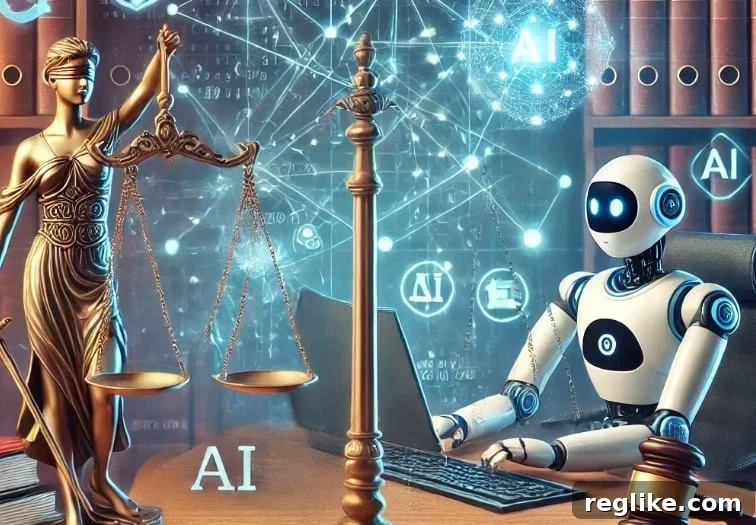
Just as AI assisted with the visual representation for this article, it is increasingly poised to assist in the intricate world of domain name disputes and the broader legal landscape. The future of UDRP, and indeed of law, will likely be a collaborative one, where the precision and processing power of AI synergize with the invaluable judgment, ethical reasoning, and empathetic understanding of human legal experts.