
Unveiling True TLD Success: Why .Directory Leads in Google Indexed Pages
The vast landscape of the internet is constantly evolving, and at its core lies the domain name system – the fundamental addressing mechanism that guides users to digital destinations. With the introduction of hundreds of new generic Top-Level Domains (gTLDs) in recent years, the digital frontier has expanded dramatically, offering businesses and individuals unprecedented opportunities for branding and online presence. However, assessing the genuine success and utility of these new TLDs goes far beyond simple registration numbers, which can often be misleading. While many often focus on which new domain extension has accumulated the most registrations, a deeper, more insightful metric can reveal the true vibrancy and content-generation power of these new digital territories.
This article embarks on an alternative exploration of TLD success, shifting the focus from mere registration counts – which might be inflated by defensive registrations or undeveloped domains – to the tangible output of active websites: the number of unique pages indexed by Google. By examining how much actual content these new TLDs are generating and making discoverable through search engines, we gain a clearer picture of their organic growth and contribution to the web. We’re not debating whether .xyz or .club holds the crown for the highest registration numbers; instead, we’re delving into a more granular, content-centric measure that reflects real-world usage and search engine visibility.
Beyond Registrations: A New Metric for TLD Success
In the dynamic world of search engine optimization (SEO), visibility is paramount. A domain name, no matter how clever or well-registered, holds little value if its content isn’t discoverable by search engines like Google. This is precisely why the metric of “indexed pages” offers a compelling and often overlooked perspective on TLD success. An indexed page signifies active content that Google has found, crawled, and deemed worthy of inclusion in its vast search index. It’s a direct indicator of content creation and, by extension, active website development under a specific TLD.
To shed light on this crucial aspect, Matt Bentley, a seasoned expert from the early days of Sedo and now at the helm of the advanced SEO service CanIRank, meticulously compiled data on the unique URLs indexed by Google across various new TLDs. His analysis provides a fresh lens through which to evaluate the performance and inherent content-generating potential of these relatively nascent domain extensions. The findings offer compelling insights, particularly into which TLDs are not just being registered, but are actively contributing rich, indexable content to the global web. This data underscores that while registration counts might show initial interest, indexed pages reveal sustained activity and the true depth of engagement.
Decoding the Indexed Page Leaderboard
When examining the sheer volume of indexed pages, the results present an intriguing hierarchy that challenges conventional wisdom based solely on registration figures. The initial snapshot of Matt Bentley’s data clearly illustrates a surprising frontrunner in this content-centric race:
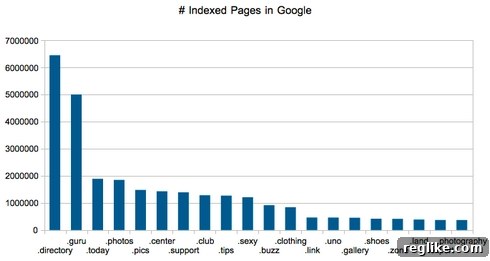
This chart is a powerful visual representation of total indexed pages, not merely unique domain names. What immediately stands out is the dominance of .directory. While some might find this unexpected, a deeper understanding of the nature of “directory” websites makes this outcome entirely logical. Directory sites are, by their very definition, designed to house a multitude of listings, categories, profiles, and associated information – each typically constituting a unique page. Whether it’s a business directory, a local service listing, or a specialized niche compilation, these platforms inherently generate a vast number of individual URLs, making them natural powerhouses for indexed content.
Consider the structure of a typical directory: a main page, category pages, sub-category pages, individual listing pages, profile pages for businesses or people, review pages, and so forth. Each of these elements contributes to the overall page count, often accumulating hundreds or even thousands of pages for a moderately sized directory website. This inherent content architecture gives .directory a significant advantage in the indexed page metric, truly reflecting the active development and utility of domains under this extension.
The Content Volume Advantage: .Photos, .Pics vs. .Photography
Another fascinating insight from the indexed page data is the ranking of .photos and .pics above .photography, despite the latter often having a higher number of total registrations. This discrepancy highlights a fundamental difference in content generation potential. While a .photography domain might be used by an individual photographer to showcase their portfolio, typically comprising a limited number of “about me,” “portfolio,” and “contact” pages, domains like .photos and .pics lend themselves to platforms that host a multitude of individual images.
Think of it this way: a single photographer typically has a finite number of portfolio pieces. In contrast, a photo-sharing site, a stock image repository, or even a personal blog primarily focused on sharing numerous pictures would naturally generate a significantly higher volume of unique pages – one for each photograph, album, or gallery. The subject matter itself – individual photos (pics) – is far more numerous and conducive to vast page generation than the content of a typical photographer’s website. This illustrates that the *type* of content a TLD is naturally suited for plays a critical role in its indexed page count, offering a valuable lesson in choosing the right TLD for a content-heavy project.
The Impact of Content Concentrators
It’s also important to note that the indexed page counts for some domain names can be significantly influenced, and sometimes even dominated, by a handful of exceptionally large and active sites. For instance, the data reveals that a single behemoth like Fotos.directory can occupy positions 6 through 25 in the Google search results for a `site:.directory` query. This phenomenon is not uncommon in the digital landscape, where highly successful content platforms can disproportionately contribute to a TLD’s overall indexed page count.
While this might suggest a lack of widespread adoption across many small sites, it simultaneously indicates that the TLD is attractive and functional for major content publishers. It signifies that the extension can support large-scale content operations, providing a robust platform for extensive indexing. This concentration of content, while skewing the average, also demonstrates the TLD’s capacity to host significant web properties that drive substantial search visibility.
Limitations and Broader Context of Success Metrics
Naturally, no single metric can perfectly capture the multifaceted concept of “success” for new TLDs. While indexed pages offer a vital window into content creation and search engine visibility, it’s essential to acknowledge its limitations. This method doesn’t differentiate between high-quality, authoritative content and low-quality, “thin” pages or even spam. Index bloat, where a site generates many pages with minimal unique value, could theoretically inflate numbers without corresponding true utility. However, for a general overview, it remains a powerful indicator of active development and search engine engagement.
Moreover, it’s crucial to contextualize these findings within the broader domain landscape. Comparing the indexed page counts of new TLDs, which have only been available for a relatively short period, to established legacy TLDs like .com or .org – which have been accumulating content for decades – would be an unfair and misleading comparison. The sheer volume of pages under older TLDs would render any comparison a “rounding error.” Therefore, this analysis focuses specifically on the peer group of new gTLDs, where the playing field is more level, allowing for meaningful insights into their relative performance and growth trajectory.
Unpacking TLD Usage Patterns: Forwarding vs. Active Content
Beyond simply counting indexed pages, Matt Bentley’s research also delved into *how* these indexed domain names are actually being utilized. This aspect provides another layer of critical understanding regarding the adoption and functional deployment of new TLDs. The data reveals distinct patterns in how registrants choose to use their new domain assets:
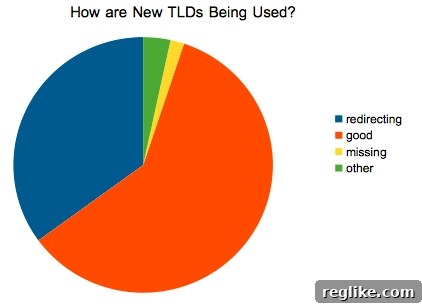
One of the most striking findings from this usage analysis is the significant amount of “forwarding” taking place. Approximately 35% of all indexed URLs for new TLDs are configured to redirect visitors to another site. This practice can serve various purposes: it might be a strategic move for branding, directing users from a new TLD to an existing primary website; it could represent a defensive registration, where a company registers its brand across multiple TLDs to prevent cybersquatting; or it could be a placeholder for future development. While forwarding ensures that the domain name is “active” in a technical sense, it doesn’t represent unique content residing directly on that TLD. Interestingly, a notable observation was the use of several .link domains specifically for URL shorteners. These shortener services, by their nature, create unique, indexed redirection links, contributing to the overall forwarded page count, even if they don’t host traditional web content.
In contrast to forwarding, a healthier indicator of active content development and direct utility is when a domain “resolves to the matching website,” meaning it hosts its own unique content. The data shows that 60% of indexed new TLD URLs fall into this category. This percentage represents domains that are actively hosting websites, blogs, e-commerce stores, portfolios, or other forms of original content directly under their respective new TLDs. This figure is crucial for understanding the organic growth and genuine contribution of new TLDs to the overall content ecosystem of the internet. These are the domains that are building new digital homes, creating fresh content, and directly engaging with users.
From an SEO perspective, domains that resolve to their own unique website are generally more valuable. They represent original content that Google can crawl, understand, and rank based on its relevance and quality. While forwarded domains can pass some SEO value (depending on the type of redirect), actively resolving sites with unique, valuable content are the lifeblood of search engine visibility and ultimately, the true measure of a TLD’s capacity to host thriving online communities and businesses.
Conclusion: The Evolving Landscape of TLD Success
In conclusion, the journey to understand the success of new Top-Level Domains is complex and multifaceted, requiring a look beyond conventional metrics. While registration numbers provide a superficial glance at interest, the number of indexed pages offers a much deeper, content-centric view of active utilization and search engine visibility. Through the insightful data compiled by Matt Bentley and CanIRank, we’ve seen that by at least one significant measure – the volume of unique pages indexed by Google – the .directory TLD stands out as a clear leader.
This success is not accidental; it’s intrinsically linked to the inherent nature of directory websites, which are designed to generate and house vast amounts of structured content. Similarly, the performance of .photos and .pics over .photography highlights the importance of a TLD’s suitability for content-rich applications, where the volume of individual items (like photographs) far outweighs that of individual entities (like photographers). Furthermore, the analysis of TLD usage patterns underscores the dynamic ways in which these new extensions are being deployed, with a significant portion dedicated to forwarding, yet a strong majority actively resolving to unique content.
As the internet continues its rapid evolution, so too will the methods we use to measure its various components. The shift towards content-centric metrics like indexed pages provides a more nuanced and accurate picture of how new TLDs are truly integrated into the digital ecosystem, driving visibility, and creating value. For businesses and individuals looking to establish a robust online presence, understanding these metrics is paramount. It emphasizes that the true power of a domain name, regardless of its extension, ultimately lies in the quality and quantity of the content it hosts, making it discoverable and valuable to users and search engines alike.