
Navigating the Digital Minefield: Unmasking the “Search Registration” Email Scam
In the vast and ever-expanding digital landscape, the promise of online visibility is a powerful magnet for businesses and individuals alike. Unfortunately, this very desire for presence and connectivity often makes us targets for deceptive practices. Among the multitude of unsolicited emails flooding inboxes today, a particularly insidious type known as the “Search Registration” scam has seen a notable resurgence. This sophisticated phishing attempt preys on a lack of technical understanding regarding domain names, search engines, and website operations, often leaving recipients confused, anxious, and sometimes, financially exploited.
The digital realm is rife with scams, constantly evolving to exploit new vulnerabilities and leverage increasingly convincing tactics. Just as we’ve witnessed the rebirth of various domain-related frauds, such as the infamous domain name appraisal scam, this “Search Registration” variant has resurfaced, meticulously crafted to mimic official correspondence. Many individuals, including myself, have recently received these emails, underscoring their widespread distribution and the need for heightened awareness.
The subject lines of these emails are often designed to evoke urgency and a false sense of official communication. A common format reads something like this:
Domain Notification: FIRSTNAME LASTNAME This is your Final Notice of Domain Notification – YOURDOMAIN.COM
This carefully worded subject line combines personal information (often pulled from public WHOIS records) with a direct reference to your domain and a stark warning of a “Final Notice.” This immediately triggers a recipient’s concern, making them more likely to open the email and engage with its deceptive content.
Deconstructing the Deception: How the “Search Registration” Scam Works
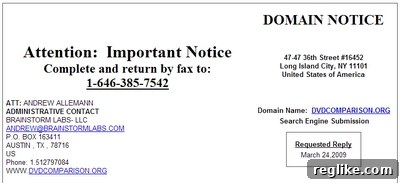
At first glance, the email notification bears a striking resemblance to a legitimate expiring domain notice. The layout, the tone, and the inclusion of your domain name all contribute to an air of authenticity. However, it’s crucial to understand that this is not the old “Domain Registry of America” style scam, which tried to trick you into renewing your domain name through an unauthorized, overpriced third-party service. Instead, this particular iteration focuses on a different, yet equally misleading, proposition.
The core of this scam lies in its ambiguous language regarding “search engine registration.” The notification strongly implies that you need to renew or complete your “search engine registration,” which the scam artists want you to interpret as the process of submitting your website to major search engines like Google, Bing, and others. The language is deliberately vague, conflating the critical importance of your domain name with the distinct process of search engine indexing and optimization.
Of course, all the accompanying language is designed to instill a sense of panic, strongly suggesting that a failure to respond could lead to the expiration of your domain, rendering your website inaccessible and your online presence erased. This is a blatant falsehood. Your domain name registration is entirely separate from your website’s indexing by search engines. Domain names are registered with accredited registrars (e.g., GoDaddy, Namecheap), and their renewals are managed directly through those registrars. Search engine indexing, on the other hand, is generally a free and largely automated process, supplemented by legitimate SEO efforts, not by paying a “registration fee” to an unsolicited third party.
While the notice often includes small-print disclaimers stating that “this is an offer and not an invoice,” history consistently shows that these caveats are frequently overlooked. Busy small business accounting departments, or individuals unfamiliar with digital terminology, often perceive such documents as legitimate bills or urgent requirements, leading them to authorize payment without proper scrutiny. The psychological pressure of a “final notice” combined with the threat of losing online visibility can override rational judgment, making these disclaimers ineffective.
Another tell-tale sign of illegitimacy can be found in the contact details provided. For example, some versions of these notices list an “address” for Long Island City, NY. While Long Island City is a prominent and well-known neighborhood, it is a part of the borough of Queens in New York City, not an independent city itself. Such inaccuracies, while seemingly minor, hint at a lack of professionalism and authenticity, serving as crucial red flags for discerning recipients.
Anatomy of a Solicitation: What the Scam Email Says
Let’s examine the typical text found within these deceptive notifications to understand their tactics better:
I: REVIEW SOLICITATION
Attn: FIRSTNAME LASTNAME
As a courtesy reminder, we are sending you this notification for your business Domain name search engine registration. This letter is to inform you that it’s time to send in your registration and save.Failure to complete your Domain name search engine registration by the expiration date may result in cancellation of this offer making it difficult for your customers to locate you on the web.
Privatization allows the consumer a choice when registering. Search engine subscription includes domain name search engine submission. You are under no obligation to pay the amounts stated below unless you accept this offer. Do not discard, this notice is not an invoice it is a courtesy reminder to register your domain name search engine listing so your customers can locate you on the web.
This Notice for: WWW.YOURDOMAIN.COM will expire on March 24, 2009 Act today!
Breaking down this text reveals several manipulative techniques:
- “REVIEW SOLICITATION”: This header sounds official but is intentionally vague, preparing the reader for a “review” of something important.
- “courtesy reminder… for your business Domain name search engine registration”: Immediately combines “domain name” with “search engine registration,” creating confusion. It implies a critical action is due.
- “Failure to complete… may result in cancellation of this offer making it difficult for your customers to locate you on the web”: This is the core threat. It creates urgency and fear of losing customers and online visibility, without explicitly saying your domain will expire. The “cancellation of this offer” is meaningless if the offer itself is illegitimate.
- “Privatization allows the consumer a choice when registering. Search engine subscription includes domain name search engine submission.”: This convoluted language attempts to sound like a legitimate choice related to privacy or specialized services, further muddying the waters. “Search engine subscription” is not a standard, necessary service for basic indexing.
- “You are under no obligation to pay… unless you accept this offer. Do not discard, this notice is not an invoice it is a courtesy reminder…”: This is the “disclaimer” section. It’s often buried or phrased in a way that doesn’t fully counteract the threatening language above it. The instruction “Do not discard” subtly reinforces its perceived importance.
- “This Notice for: WWW.YOURDOMAIN.COM will expire on March 24, 2009 Act today!”: The mention of an expiration date (often a past date in older examples, but current in newer ones) heightens the sense of impending loss and urgency, pushing for immediate action. The call to “Act today!” is a classic scam tactic.
Why These Scams Persist: Targeting the Unwary
These “search registration” scams, much like yellow pages solicitations that have plagued businesses for decades, continue to thrive because they target specific vulnerabilities. Small business owners, entrepreneurs, and even established companies with busy administrative staff are prime candidates. Many lack a deep understanding of the technical distinctions between domain registration, web hosting, and search engine optimization (SEO).
The scam capitalizes on a legitimate concern: being found online. Businesses inherently want their websites to be visible. When an email arrives, appearing official and threatening to jeopardize that visibility, it taps into genuine anxieties. Furthermore, in many organizations, emails related to website domains or services are often forwarded to administrative personnel who might not have the technical background to differentiate a legitimate notice from a scam. They are simply tasked with ensuring bills are paid and services are maintained, making them susceptible to these misleading solicitations.
Understanding Genuine Online Presence: Domain Names vs. Search Engines
To effectively protect yourself, it’s vital to grasp the fundamentals of your online presence:
- Domain Names: Your domain name (e.g., yourdomain.com) is your website’s address on the internet. It is registered for a specific period (typically 1-10 years) through an accredited domain registrar. You receive renewal notices directly from your chosen registrar, and these notices will clearly state that they are for your domain name renewal, not “search engine registration.” ICANN (Internet Corporation for Assigned Names and Numbers) governs domain name policy, and legitimate registrars adhere to strict guidelines.
- Web Hosting: This is the service that stores your website’s files and makes them accessible on the internet. Your hosting provider sends separate invoices and notices related to your hosting services.
- Search Engine Optimization (SEO) & Submission: This is the process of improving your website’s visibility on search engine results pages. Submitting your site to search engines (which primarily means submitting a sitemap to Google Search Console and Bing Webmaster Tools) is generally free and a one-time, simple process. Legitimate SEO is an ongoing strategy involving content creation, technical optimization, link building, and more – it is not a “registration fee” you pay to an unknown entity.
These three components are distinct services. A legitimate threat to one does not automatically imply a threat to another, and certainly not in the conflated manner presented by these scams.
Identifying Red Flags and Safeguarding Your Digital Presence
Vigilance and a healthy dose of skepticism are your best defenses against these and similar online scams. Here are key red flags to look for and actions to take:
- Sense of Urgency and Threats: Emails demanding immediate action, using phrases like “Final Notice,” “Act Today,” or threatening service cancellation should always be treated with extreme caution.
- Vague Sender Information: Carefully check the “From” email address. Does it match your actual domain registrar (e.g., GoDaddy, Namecheap) or web hosting provider? Often, these scam emails come from generic or unusual domains.
- Misleading Terminology: Be wary of terms like “search engine registration” or “domain name search engine listing” as paid services. Legitimate search engine interaction is free or part of broader, professional SEO services.
- Requests for Immediate Payment: Genuine service providers usually send clear invoices, not “offers” that demand payment to avoid catastrophic consequences.
- Incorrect Details: While scammers often get domain names right (from public WHOIS data), they sometimes get personal names wrong, or include geographical inaccuracies (like the Long Island City example).
- Grammar and Spelling Errors: Many scam emails contain subtle (or not so subtle) grammatical mistakes or awkward phrasing, which are clear indicators of non-professional communication.
- Do Not Click Links: Never click on links within suspicious emails. These can lead to phishing sites designed to steal your information or download malware.
- Verify Independently: If you receive an email claiming a service needs renewal, *independently* navigate to your actual domain registrar’s website or hosting provider’s portal. Log in securely and check your service status there. You can also contact their official support channels using contact information found on their official websites (not from the suspicious email).
- Educate Your Team: Ensure anyone handling administrative tasks or finances understands these common scam tactics.
- Report and Block: Mark suspicious emails as spam or phishing and block the sender. This helps email providers filter similar messages in the future.
Broader Context: Related Digital Deceptions
The “Search Registration” scam is just one piece of a larger puzzle of online trickery aimed at domain owners and businesses. Other common scams include:
- Fake Domain Renewal Notices: These often mimic official registrar emails, urging you to renew your domain through a scammer’s inflated service. Always verify directly with your legitimate registrar.
- Domain Appraisal Scams: Similar to the one mentioned earlier, these offer to “appraise” your domain for a fee, often promising unrealistic valuations to entice payment, without providing any real value.
- Unsolicited SEO/Web Design Offers: Emails promising guaranteed top rankings on Google for a low price, or offering cheap web design services that never materialize, are rampant. Legitimate SEO is complex and takes time; instant, cheap guarantees are highly suspicious.
- Phishing Attempts: General emails designed to trick you into revealing sensitive information (passwords, credit card details) by impersonating banks, payment processors, or other trusted entities.
Conclusion: Stay Informed, Stay Secure
In the digital age, being online is essential, but it comes with the responsibility of exercising constant vigilance. The “Search Registration” email scam is a prime example of how malicious actors exploit common anxieties and technical misunderstandings to illicit payments. By understanding the distinction between domain names, web hosting, and search engine functionality, and by recognizing the tell-tale signs of deceptive communication, you can arm yourself against these pervasive threats.
Always question unsolicited emails, verify information through independent channels, and never feel pressured into immediate action by threatening language. Your digital security and peace of mind depend on your informed caution. Stay proactive, stay aware, and protect your online presence from those who seek to exploit it.