
The Shifting Landscape of Google Search: An Ad-Dominated Reality
In the evolving world of digital information, Google remains the undisputed gateway to the internet for billions. Yet, a growing observation among users and webmasters alike points to a significant transformation in its search engine results pages (SERPs): the increasing prominence of paid advertisements, often at the expense of organic content, particularly in the critical “above the fold” area. This shift raises questions about user experience, the effectiveness of traditional SEO, and Google’s own advice to website owners regarding content quality and visibility.
The Prominence of Paid Advertising “Above the Fold”
For years, Google has championed the importance of providing valuable, high-quality content above the fold – the portion of a webpage visible without scrolling – as a cornerstone of good website design and user experience. This advice has been a guiding principle for webmasters striving for better search rankings. Ironically, Google’s own search results page often presents a stark contrast to this very principle. A recent search for a common, highly commercial term like “domain name” vividly illustrates this growing trend, revealing an SERP heavily saturated with advertisements right at the top, pushing genuine organic results further down the page.
Consider a typical search scenario. When I recently typed “domain name” into Google, without any specific modifiers or being logged into an account that might personalize results, the immediate display was striking. The entire section visible without any scrolling whatsoever was dominated by advertising. Specifically, four distinct ad units occupied the prime real estate, leaving virtually no room for the organic content that users traditionally trust as unbiased and authoritative information.
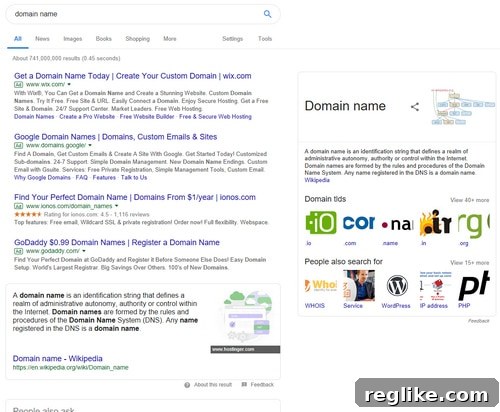
This visual evidence underscores a critical point: for many high-commercial-intent keywords, the initial user experience on Google is no longer one of discovery but rather one of immediate exposure to sponsored content. In this particular instance, the sole piece of organic content appearing above the fold was a brief snippet from Wikipedia, which, while authoritative, serves primarily an informational rather than a transactional purpose. The sheer volume of paid listings confirms a highly competitive market where various domain registrars and related service providers are willing to pay a premium to capture user attention instantly. This aggressive bidding behavior is a testament to the direct commercial value associated with such search terms, making it a lucrative battleground for advertisers.
Deconstructing the “Domain Name” Search: A Case Study in Commercial Intent
The term “domain name” serves as an excellent case study for understanding the dynamics of Google’s ad-heavy SERPs. It represents a search query with exceptionally high commercial intent. Users searching for a “domain name” are often in the early stages of establishing an online presence, launching a business, or rebranding an existing one. This makes them highly valuable prospects for domain registrars, web hosting companies, and related service providers.
For businesses operating in this space, advertising on Google’s search results pages is a direct pathway to potential customers. The return on investment (ROI) for such ads can be significant, as a click on an ad for “domain name” can lead directly to a registration page, converting a search query into a sale. This direct correlation between ad spend and potential revenue fuels the intense competition we observe, leading to high bids and multiple ad slots for these lucrative keywords. Companies understand that securing a top ad position guarantees visibility, potentially funneling a significant portion of the search traffic directly to their offerings, bypassing organic results entirely.
What’s particularly noteworthy is the presence of Google Domains itself among the advertisers for the term “domain name.” This illustrates a fascinating dynamic: Google, the search engine provider, is also a direct competitor in the domain registration market. While it’s a common practice for Google to promote its own services, seeing its paid ad alongside competitors further highlights the commercialization of its search platform. It effectively means that even a behemoth like Google finds it necessary to pay to play in its own advertising ecosystem to secure prime visibility for its services.
The Erosion of Organic Visibility and User Trust
The increasing number of ads above the fold inevitably leads to a significant erosion of organic visibility. For small businesses, startups, or even established companies relying on strong SEO to attract traffic, this presents a substantial challenge. If the first several results users see are paid ads, the likelihood of them scrolling down to find organic listings diminishes, particularly for less committed searchers. This forces companies to either compete in the expensive realm of Pay-Per-Click (PPC) advertising or invest even more heavily in SEO strategies that aim for top organic positions, which are now metaphorically “further down the page.”
Moreover, there’s an ongoing debate about user trust. While many users are savvy enough to distinguish between sponsored content and organic search results, there’s often a subconscious preference for the latter, perceived as more credible and less biased. When the initial screen is dominated by ads, it can subtly shift user perception of the search engine itself – from a neutral arbiter of information to a platform primarily driven by commercial interests. This can lead to a sense of frustration or a feeling that genuinely valuable content is harder to find, impacting the overall search experience.
This situation also raises critical questions for SEO strategists and content creators. Is traditional organic SEO becoming less effective for highly commercial keywords? While content quality, backlinks, and technical SEO remain vital for long-term online presence, the immediate battle for eyeballs above the fold is increasingly being won by those with larger advertising budgets. This necessitates a more integrated approach to digital marketing, where SEO works in conjunction with PPC, content marketing, and brand building to ensure comprehensive visibility.
The Organic Contenders: Analyzing the Top 9 for “Domain Name”
Despite the ad saturation, Google’s search algorithms still evaluate and rank websites for organic relevance. Examining the current top 9 organic results for “domain name” offers valuable insights into which entities Google continues to deem authoritative and relevant for this highly competitive query (based on a non-logged-in search at the time of observation):
- Name.com
- Domain.com
- Wikipedia
- Network Solutions
- Google Domains
- BlueHost
- Verisign
- Namecheap
- GoDaddy
It’s immediately apparent that this list is dominated by well-established players in the domain and hosting industry. Let’s delve into why these specific entities likely hold these coveted organic positions:
- Wikipedia (No. 3): Its high ranking is almost a given for many informational terms. Wikipedia provides comprehensive, unbiased, and highly authoritative content on “domain names,” making it an invaluable resource for understanding the concept. Its non-commercial nature often positions it high for foundational knowledge, even when ads surround it.
- Name.com, Domain.com, Namecheap, GoDaddy (Nos. 1, 2, 8, 9): These are some of the largest and most recognized domain registrars globally. Their high rankings are a result of decades of brand building, massive website authority, extensive backlink profiles, and deeply relevant content that directly addresses user intent for domain registration. They have optimized their sites for a vast array of related keywords and often provide robust educational resources alongside their commercial offerings.
- Network Solutions (No. 4): A legacy player in the domain registration industry, Network Solutions has been around since the early days of the internet. Its long history contributes to significant domain authority and brand recognition, making it a trusted entity in Google’s eyes.
- Google Domains (No. 5): Appearing both in paid ads and organically, Google Domains benefits from the immense authority of its parent company. While it’s a newer entrant compared to some, its seamless integration with other Google services and Google’s inherent trust factors contribute to its strong organic showing.
- BlueHost (No. 6): Primarily known as a web hosting provider, BlueHost often bundles domain registration with its hosting packages. Its high ranking indicates Google’s understanding that users searching for “domain name” might also be interested in related services like web hosting, making BlueHost’s integrated offerings highly relevant.
- Verisign (No. 7): Verisign plays a fundamental role in the internet’s infrastructure, operating the registry for .com and .net domain names. Its authority stems from this foundational technical role, making it an undisputed source of information and services related to domain name management, even if it’s not a direct registrar in the same way as GoDaddy.
This organic list underscores the enduring importance of brand reputation, historical authority, and comprehensive, relevant content. Even as the paid landscape grows, these fundamental SEO principles continue to reward sites that truly serve user needs and demonstrate long-term trustworthiness.
Google’s Evolving Business Model: Balancing Revenue and User Experience
At its core, Google’s business model is largely fueled by advertising revenue. The company’s impressive profitability is a direct result of its ability to connect advertisers with users at the moment of intent. This commercial imperative naturally pushes Google to maximize ad placements, particularly for high-value search terms where advertisers are willing to pay significant sums. The evolution of the SERP, from minimal ads to a heavily ad-laden top section, reflects this fundamental economic driver.
However, Google has always faced the delicate task of balancing profitability with user experience. Too many ads, or ads that are irrelevant, can degrade the search experience, potentially driving users to alternative search engines or directly to known websites. The current state of the SERP for “domain name” suggests that Google is pushing the boundaries of this balance, prioritizing ad revenue for commercially lucrative terms. This strategy risks alienating users who expect an objective gateway to information, rather than an immediate commercial storefront.
Historically, Google’s search results were renowned for their clean interface and predominantly organic listings. Over the years, we’ve witnessed a gradual increase in ad units, new ad formats, and a blurring of the lines between paid and organic content. This incremental change might be less jarring than a sudden overhaul, allowing users to adapt slowly. Nevertheless, the trend is clear: the digital marketing landscape, as shaped by Google, is increasingly becoming a pay-to-play environment, especially for businesses vying for immediate customer acquisition.
Navigating the Future of Search: Strategies for Users and Businesses
In this new era of Google search, both users and businesses need to adapt their strategies. For users, it means becoming more discerning. Learning to identify sponsored content, scrolling past the initial ad blocks, and potentially exploring alternative search engines or direct navigation to trusted websites might become more commonplace. Critical evaluation of search results is no longer just for complex queries but for almost any commercial term.
For businesses, the implications are profound. A robust digital strategy can no longer rely solely on organic SEO. While SEO remains crucial for long-term brand building, authority, and attracting users for less commercial, informational queries, a multi-faceted approach is essential for competitive terms. This includes:
- Integrated Marketing: Combining strong SEO efforts with strategic Pay-Per-Click (PPC) campaigns to ensure visibility across both organic and paid channels.
- Brand Building: Cultivating a strong brand identity and direct website traffic that reduces reliance on search engines as the primary acquisition channel.
- Content Authority: Continuing to invest in high-quality, in-depth content that establishes thought leadership and authority, making a website valuable even if its immediate SERP visibility is challenged.
- User Experience (UX): Ensuring that once users arrive on a site, whether from an ad or an organic link, they encounter an intuitive, fast, and satisfying experience that encourages engagement and conversion.
Ultimately, while the immediate landscape of Google search results for terms like “domain name” paints a picture of ad dominance, the underlying principles of providing genuine value, building trust, and adapting to technological shifts remain paramount. Businesses that understand this evolving dynamic and strategically combine various digital marketing tactics will be best positioned to thrive in the complex, ad-saturated world of modern search.
Conclusion: A New Era for Google Search Results
The transformation of Google’s search engine results pages, particularly the heavy concentration of paid advertisements above the fold for commercially driven terms like “domain name,” marks a new era in digital search. This evolution highlights a critical balance Google strives to maintain between its revenue generation goals and its commitment to providing a useful, relevant search experience for its users. While ads are an integral part of its business model, their increasing omnipresence fundamentally alters how users interact with search results and how businesses must approach their online visibility strategies.
For webmasters, the takeaway is clear: achieving top organic rankings alone may no longer guarantee the immediate visibility it once did. The battle for eyeballs above the fold is often won by the highest bidder. This necessitates a more sophisticated and diversified digital marketing approach that embraces both organic SEO and paid advertising, alongside robust content creation and strong brand building efforts.
For the average internet user, this shift demands a more critical eye and a greater understanding of the distinction between sponsored and organic content. Navigating the modern web now requires an awareness of these commercial forces shaping the very first impression delivered by the world’s most popular search engine. As Google continues to evolve, so too must our strategies for finding and being found online.