
Unmasking the .Com Domain Monopoly: Why Consumers Pay Over a Half Billion Dollars Extra Annually
In the vast and rapidly expanding digital landscape, the humble .com domain name serves as the undisputed cornerstone for countless businesses, personal brands, and online ventures worldwide. It’s the globally recognized address that signifies trust, professionalism, and accessibility. Yet, beneath this seemingly straightforward system lies a significant financial burden on consumers and businesses alike: a system where internet users collectively pay over a half billion dollars more than necessary each year to register and renew their vital .com domains. This substantial overcharge stems from a unique regulatory framework and a market structure that deviates sharply from competitive norms.
At the heart of this issue is Verisign (NASDAQ: VRSN), the sole and exclusive operator of the .com domain registry. Currently, Verisign is engaged in critical negotiations with the U.S. Department of Commerce regarding the renewal of its Cooperative Agreement. This pivotal agreement, which governs Verisign’s operation of the world’s most popular domain name system, is set to expire on November 30 of this year. This approaching deadline places significant power in the hands of the Department of Commerce, which holds the exclusive discretion to extend, modify, or even potentially terminate the terms of this vital contract, directly impacting the future cost of .com domains globally.
The Cooperative Agreement is far more than a routine procedural document; it is the fundamental mechanism through which the Department of Commerce effectively implements and enforces price controls on both the registration and renewal fees for all .com domains. While Verisign maintains a separate contract with the Internet Corporation for Assigned Names and Numbers (ICANN) to manage the domain’s technical aspects, the Cooperative Agreement possesses the paramount authority to mandate specific price controls that either supersede or profoundly influence the terms established within the ICANN agreement. In the past, ICANN had granted Verisign the latitude to incrementally increase .com prices. However, it was the direct intervention of the Department of Commerce that subsequently froze the amount Verisign charges registrars at a fixed rate of $7.85 per domain per year, a decision with profound financial implications for every online entity globally.
Adding another layer of complexity to this entrenched arrangement is Verisign’s “presumptive right of renewal” for the .com contract with ICANN. This extraordinary right was secured after a period of intense negotiations following a lawsuit, effectively granting Verisign an almost perpetual hold on managing the .com registry. Barring any egregious operational failures or a decisive antitrust ruling that could fundamentally alter the market, Verisign is poised to continue running .com indefinitely. This unique market position largely eliminates the possibility of competitive bidding for the .com contract, making any exercise in determining what the cost of .com would be under open market conditions seem somewhat academic. However, understanding this hypothetical competitive cost is paramount for both the Department of Commerce and the National Telecommunications and Information Administration (NTIA) as they deliberate on the future of the Cooperative Agreement and its broader impact on the global digital economy and consumer welfare.
Verisign’s Unrivaled Business Model: A Digital Tollgate on the Information Superhighway
Verisign’s business model is fundamentally defined by its exclusive, government-sanctioned contract to operate the most critical piece of internet infrastructure: the .com domain. While the company also manages other top-level domains such as .net and a select few others, its colossal revenue and unparalleled profitability are overwhelmingly derived from its singular control over .com. This creates a de facto monopoly, granting Verisign the ability to generate exceptionally high profit margins, which many critics accurately liken to an unavoidable tax levied on individuals and businesses across the globe who rely on the internet for their existence and operations.
To truly grasp the scale of Verisign’s financial success and market dominance, one must closely examine its profit margins. In 2017, for example, Verisign reported an astounding gross margin of 83.4% and an operating margin of 60.7%. These figures are not merely impressive; they are truly staggering when compared to benchmarks across a diverse range of industries. According to comprehensive data compiled by CSIMarket, the combined gross margin for companies listed on the S&P 500 typically hovers around the mid-40% range, with operating margins often falling into the mid-teens. Even within the communication services sector, which can exhibit comparatively higher gross margins nearing 80%, operating margins rarely climb beyond the teens, making Verisign’s figures exceptionally unique.
What these remarkable numbers unequivocally underscore is that Verisign essentially operates as a highly efficient “money-printing machine.” The operational costs associated with running the .com registry, while substantial in absolute terms due to the scale and complexity, are remarkably low on a per-domain basis due to immense economies of scale. Once the robust infrastructure is established, developed, and maintained, virtually every additional domain registration or renewal translates almost directly into pure profit, after a minimal 25-cent fee is paid to ICANN. This highly efficient, high-margin structure means that Verisign faces minimal competitive pressure on pricing or operational efficiency, allowing it to maintain an extraordinary level of profitability that is virtually unheard of in truly competitive markets anywhere in the world.
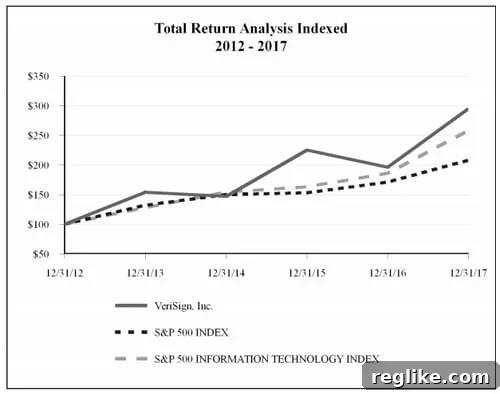
It is precisely this predictability, combined with exceptional profitability and a virtual guarantee of recurring revenue, that makes Verisign an enduring favorite among investors. Even in periods where the broader S&P 500 and the dynamic tech sector have experienced unprecedented valuation growth, Verisign has consistently managed to outpace these benchmarks, demonstrating remarkable resilience and consistent performance. Its stock performance reflects a company with an incredibly stable, recurring revenue stream, fortified by incredibly high barriers to entry, and minimal exposure to typical market volatilities. This makes it an attractive “safe haven” for capital seeking consistent and reliable returns in an often unpredictable market. The accompanying chart, drawn from the company’s 2017 annual report, visually demonstrates this superior stock performance, vividly highlighting the deep financial advantage Verisign continues to enjoy within its unique market position.
Defining a Fair Price: What a Competitive Market Would Offer for .Com Domains
The absence of competitive bidding for the critical .com registry contract inevitably raises a fundamental and pressing question: what would a fair and equitable price for managing this essential internet resource truly be? It is almost unequivocally certain that any competent competitor, if given the opportunity to bid for the contract, would submit an offer significantly lower than the current $7.85 Verisign charges per domain. The immense scale, global reach, and paramount importance of .com undoubtedly present unique operational challenges, including the need to ensure robust security, unwavering stability, and exceptionally high availability for billions of daily DNS queries. However, these challenges are often substantially mitigated, and in many cases even offset, by the unparalleled economies of scale that inherently come with managing a domain of .com’s sheer magnitude.
To effectively illustrate what a truly competitive price might look like in a free market, we can draw valuable insights from recent precedents in other domain registry operations. For instance, in a fiercely competitive bid to manage the registry for India’s Country Code Top-Level Domain (ccTLD), .in, the submitted bids were startlingly low when compared to the existing .com rate. According to an in-depth report by MoneyControl, Neustar, a highly reputable and extensively experienced registry operator with a proven track record, submitted an impressively low bid of just 70 cents per domain. Its primary rival in this tender, Afilias, another recognized industry leader in domain management, offered to run the .in registry for $1.65 per domain. These figures stand in stark and immediate contrast to the nearly eight-dollar price tag currently imposed for each .com domain.
It is crucial to emphasize that these companies—Neustar and Afilias—are not inexperienced newcomers to the domain industry; they are well-established and highly competent registry operators possessing extensive expertise in managing critical internet infrastructure. Neustar, for example, is responsible for operating important and widely used domains like .us, .biz, and .co, among many others, demonstrating its capability to handle significant operational loads. Afilias similarly manages prominent global domains such as .info and .au, in addition to overseeing the registries for hundreds of other top-level domains. Their competitive bids for .in unequivocally demonstrate that high-quality, secure, and reliably managed registry services can be provided at a mere fraction of the current .com cost, even for domains that command significant user bases and necessitate rigorous operational demands.
While acknowledging that .com possesses a truly unique global footprint and unparalleled transaction volume when compared to a ccTLD like .in, it is equally crucial to recognize and emphasize the substantial benefits derived from its massive scale. The significant fixed costs associated with developing, implementing, and meticulously maintaining cutting-edge registry software, sophisticated security protocols, and resilient global DNS infrastructure are amortized across an enormous base of registered domains. This wide distribution of fixed costs inherently leads to exceptionally low marginal costs for each additional domain. This critical economic principle means that while the initial investment might be higher for .com due to its complexity and global reach, the actual cost per domain should logically decrease dramatically as the number of managed domains increases, benefiting immensely from these unparalleled economies of scale.
Now, let’s consider the tangible and significant financial impact of this above-market, non-competitive contract with Verisign on consumers and businesses globally. If we adopt a generous and well-justified estimate that a fair and truly competitive bid to manage the .com registry, thoroughly accounting for its immense scale, inherent complexity, and stringent security requirements, would realistically be around $3.50 per name, the implications are profound. With approximately 137 million .com domains currently registered worldwide, this substantial price delta of $4.35 (calculated as $7.85 – $3.50) per domain translates into an astronomical sum. Consumers and businesses across the globe are collectively paying about $600 million in extra, entirely unnecessary fees per year. This is not merely a one-time charge but an ongoing, annual burden that accumulates significantly over time. Moreover, this amount is poised to grow even larger if Verisign is granted the right to increase prices in future iterations of the agreement, further exacerbating the financial strain on internet users.
This persistent half-billion-dollar annual surcharge represents a truly significant and regressive “tax” on the entire global digital economy. It is a cost that exists primarily because the foundational .com contract is not, and historically has not been, subjected to the rigors and efficiencies of open market competition. It is an artifact of a monopolistic market structure that is shielded and perpetuated by a regulatory agreement, rather than a price dictated by the natural forces of supply and demand in a truly free and competitive market. This situation directly impacts a vast array of entities: from aspiring startups trying to establish an online presence, to small businesses endeavoring to expand their digital reach, and even large multinational enterprises who must meticulously factor these inflated costs into their extensive digital strategies. It is, in essence, a direct and continuous transfer of wealth from internet users to a single corporation, facilitated directly by the current lack of competitive pressure and robust regulatory oversight.
The Department of Commerce’s Critical Role in Consumer Protection and Fostering a Fair Digital Landscape
Given the inherent market inefficiencies and the profound lack of competition surrounding the operation and pricing of the .com domain, the responsibility to diligently safeguard consumer interests falls squarely and uniquely upon the U.S. Department of Commerce. Through the pivotal Cooperative Agreement, the Department of Commerce is unequivocally the sole governmental entity empowered to control, regulate, and influence the price of .com domain names. This unique and powerful regulatory authority is an indispensable tool for ensuring that the foundational infrastructure of the internet remains truly accessible, affordable, and equitable for everyone, from individual bloggers to multinational corporations.
As the November 30 expiration date rapidly approaches, the ongoing negotiations between Verisign and the Department of Commerce represent a truly crucial juncture with far-reaching consequences. The Department has several distinct options, each carrying significant ramifications for the global internet community. It could choose to renew the agreement largely as-is, which would likely perpetuate the current price structure and its associated consumer burden. Alternatively, and in what many argue would be a clear demonstration of serving the public good, it could decisively leverage its authority to mandate a substantial reduction in the current price cap, thereby bringing the cost of .com domains closer to what a genuinely competitive market would bear. Furthermore, the Department could introduce new terms that foster greater transparency, accountability, or even establish a clear pathway towards more competitive arrangements in the long term, without necessarily disrupting Verisign’s presumptive right of renewal. The overarching goal should be to strike a delicate and effective balance between ensuring the continued stability and robust security of the critical .com registry and vigorously protecting internet users from the detrimental effects of monopolistic pricing.
It is, therefore, imperative that the Department of Commerce fully and assertively exercises this vital power. The internet has fundamentally evolved from a niche academic technology into an indispensable global utility, foundational to modern communication, commerce, and societal interaction. The .com domain, in particular, is not merely a commercial identifier; it is arguably the most critical piece of public infrastructure that underpins global communication, digital commerce, and pervasive innovation. Allowing prices to remain artificially inflated by an uncompetitive monopoly fundamentally undermines the core principle of an open, accessible, and affordable internet for all. By ensuring fair, transparent, and reasonable pricing for .com domains, the Department of Commerce has a unique opportunity to make a tangible and profound difference, saving consumers and businesses hundreds of millions of dollars annually, and fostering a more vibrant, equitable, and ultimately more affordable digital ecosystem for the entire world.