
Elevating Your Digital Defenses: The Superiority of Hardware Security Keys
In an era defined by relentless digital threats, safeguarding our online accounts has never been more critical. The increasing sophistication of cyberattacks, coupled with the ever-present risk of human error, underscores the urgent need for robust security measures. While the digital landscape constantly evolves, one truth remains steadfast: strong authentication is the bedrock of online safety. Many of us have become accustomed to using Two-Factor Authentication (2FA) or Multi-Factor Authentication (MFA) as an added layer of defense beyond a simple password. However, not all 2FA methods are created equal, and understanding these distinctions can mean the difference between secure accounts and vulnerable ones.
Consider the widely reported incident involving the email security of a high-profile political figure. While the precise details and ultimate impact remain subjects of debate, it served as a stark, public reminder: even seemingly minor security oversights can lead to monumental consequences, from reputational damage to significant data breaches. This incident, among countless others, should resonate as a universal wake-up call for individuals and organizations alike – digital security is not merely a technical checkbox, but a continuous and evolving responsibility.
My own journey to strengthen digital defenses was propelled by similar concerns and a direct warning from my own Gmail account late last year:

Such alerts are not just notifications; they are explicit calls to action. They highlight the relentless efforts of malicious actors to gain unauthorized access to our digital lives. Consequently, enabling two-factor authentication has become my primary and most vital precaution for protecting all my critical accounts, including vital services like domain registrars, banking portals, and social media profiles. It’s a foundational step that everyone with an online presence should adopt.
Traditional 2FA: Convenience and Compromises
The landscape of two-factor authentication has evolved significantly. For many years, the most common forms of secondary authentication have been either a one-time password (OTP) sent via text message to a registered mobile number or a time-based one-time password (TOTP) generated by an authenticator application, such as Google Authenticator or Authy. While these methods represent a considerable improvement over password-only security, they are not without their inherent vulnerabilities.
SMS-Based Two-Factor Authentication: A Fragile Foundation
SMS-based 2FA, where a unique code is sent to your phone via text message, gained popularity due to its simplicity and ubiquitous nature. Users would enter their password, receive a code on their phone, and then input that code to gain access. However, this method has proven to be susceptible to a variety of sophisticated attacks:
- SIM Swapping: Attackers can trick mobile carriers into transferring your phone number to a SIM card they control. Once they control your number, they can intercept all SMS messages, including your 2FA codes, effectively bypassing this security layer.
- SMS Interception: While less common for the average user, advanced attackers can exploit vulnerabilities in telecommunication networks (like SS7 protocol flaws) to intercept text messages without the need for SIM swapping.
- Phishing Expeditions: Malicious websites designed to mimic legitimate login pages can not only capture your primary username and password but also prompt you for the SMS-delivered 2FA code. If you enter it on the fake site, the attacker can quickly use it to log into your real account before the code expires.
These vulnerabilities make SMS a less secure option, particularly for high-value accounts, and security experts increasingly recommend migrating away from it as a primary 2FA method.
Authenticator Apps: A Step Up, Yet Still Imperfect
Authenticator apps, which generate time-sensitive codes directly on your device, offer a more secure alternative to SMS. Because the codes are generated locally and not transmitted over a network, they are immune to SIM swapping and SMS interception. However, they still face challenges:
- Phishing Susceptibility: Just like with SMS codes, a sophisticated phishing site can still trick you into entering your authenticator app code. The phishing site can then relay this code in real-time to the legitimate service, granting the attacker access. The app itself has no way of knowing if the website you’re interacting with is authentic.
- Device Loss/Theft: If your device containing the authenticator app is lost or stolen, an attacker gaining access to the device could potentially also gain access to your 2FA codes, provided they can unlock the device.
- Backup and Recovery: Managing backups for authenticator apps can be cumbersome. If you lose your device without a proper backup or recovery plan, you could be locked out of your accounts.
While certainly better than SMS, the underlying principle of typing a code, even if locally generated, introduces an exploitable vulnerability for determined attackers employing advanced phishing tactics.
Embracing Hardware Security Keys: The Gold Standard in Authentication
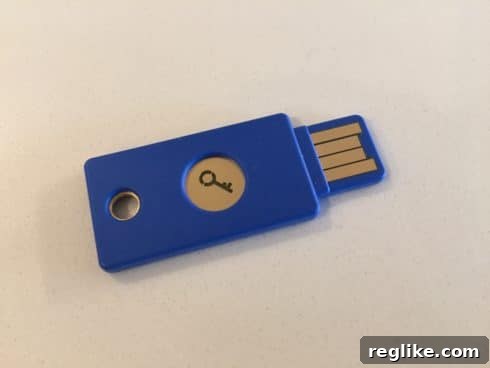
It’s within this context of evolving threats and the limitations of traditional 2FA that hardware security keys, often referred to as U2F (Universal 2nd Factor) keys, emerge as a truly robust and revolutionary solution. Devices like the pictured U2F security key from Yubi (Yubico’s YubiKey is a prominent example) are small, affordable (I paid approximately $18 for mine), and profoundly enhance your digital security posture.
These hardware tokens leverage the FIDO U2F protocol, an open standard developed by the FIDO Alliance. Unlike SMS or authenticator apps, U2F keys employ cryptographic challenge-response mechanisms that fundamentally change how secondary authentication works. Here’s why they are considered a superior form of two-factor authentication:
Unparalleled Phishing Resistance
The primary and most significant advantage of U2F security keys is their inherent resistance to phishing. This is achieved because the security key does not simply provide a code; instead, it cryptographically verifies the authenticity of the website you are trying to log into. When prompted for your secondary factor:
- Your web browser communicates with the security key and the website.
- The security key performs a cryptographic check to ensure that the domain it’s interacting with is the legitimate service it was registered to.
- Only if the domain is authentic will the key “sign” the authentication request, completing the login.
This means that even if you are tricked into visiting a sophisticated phishing site that perfectly mimics your bank’s login page, your U2F security key will refuse to authenticate. It will only respond to the *actual* domain of your bank, making it virtually impossible for an attacker to steal your credentials via a fake website. You can’t accidentally type a code onto a malicious site if the key itself won’t talk to it.
Simplicity and User Experience
Beyond security, U2F keys offer a remarkably streamlined user experience. Once registered to your account, the authentication process is often as simple as touching a spot on the key when prompted by your browser. There are no codes to remember, no codes to type, and no apps to open. This eliminates common pain points like mistyping codes or struggling to sync time on authenticator apps, making logins faster and less prone to user error.
Resilience Against Malware and SIM Swapping
Because the private cryptographic key never leaves the physical security key, it is highly resistant to malware attacks. Even if your computer is compromised with keyloggers or other malicious software, the attacker cannot extract the cryptographic secrets needed to authenticate to your accounts. Furthermore, as the authentication relies on a physical device rather than a mobile number, U2F keys provide complete immunity to SIM swapping attacks, a major vulnerability for SMS-based 2FA.
Integration and Adoption: A Growing Standard
The adoption of U2F and the broader FIDO standards (which include FIDO2 and WebAuthn) is steadily growing across the digital landscape. Major technology companies and service providers recognize the superior security offered by hardware keys:
- Tech Giants: Services like Google, Dropbox, GitHub, Facebook, Twitter, and even some enterprise cloud providers now widely accept U2F keys for enhanced account security.
- Browser Support: Modern web browsers such as Google Chrome, Mozilla Firefox, Microsoft Edge, Brave, and Apple Safari offer native support for U2F and WebAuthn, ensuring a seamless user experience across most platforms.
- Domain Registrars: While support among domain registrars was initially limited, it is a crucial area for growth. The security of your domain name is paramount, as control over it can lead to control over your entire online presence. The underlying technology for U2F is designed to be relatively straightforward for service providers to implement, so we can anticipate broader adoption in this critical sector. It’s imperative that services handling the very foundation of your online identity embrace these advanced security measures.
Implementing Hardware Security Keys: Best Practices
Integrating a hardware security key into your digital security strategy is a straightforward process:
- Purchase a Key: Invest in a FIDO U2F or FIDO2-compliant security key from a reputable manufacturer like Yubico, Google (Titan Security Key), or Feitian.
- Register Your Key: Navigate to the security settings of your supported online accounts (Google, GitHub, etc.) and follow the instructions to register your security key. This typically involves inserting the key into a USB port (or tapping it to an NFC reader) and touching it when prompted.
- Always Have a Backup: This is perhaps the most critical piece of advice. What happens if you lose your primary security key? To avoid being locked out, always purchase and register at least two security keys for your most important accounts. Store the backup key in a secure, separate location (e.g., a home safe or a trusted friend’s house).
- Review Recovery Options: Understand the recovery options provided by each service in case you lose both your primary and backup keys. While ideally you rely solely on your U2F keys for daily login, some services may still allow for SMS or authenticator app recovery in emergencies. Evaluate the risks associated with these less secure recovery methods.
The Future is Passwordless: FIDO2 and WebAuthn
The FIDO U2F standard has evolved into FIDO2, which, combined with the W3C’s WebAuthn standard, lays the groundwork for passwordless authentication. This next generation of security keys and authentication protocols aims to move beyond passwords entirely, using biometrics (fingerprint, facial recognition) or PINs combined with a security key (physical or platform-integrated) to provide even more seamless and secure access to online accounts. This shift promises to dramatically reduce the attack surface for cybercriminals and simplify the user experience further.
Conclusion: A Non-Negotiable Step for Modern Security
In conclusion, while traditional two-factor authentication methods like SMS OTPs and authenticator apps offer a basic layer of protection, they are increasingly vulnerable to sophisticated phishing and account takeover attempts. Hardware security keys, built on the robust FIDO U2F and WebAuthn standards, represent the current pinnacle of authentication security.
They offer unparalleled phishing resistance, enhanced protection against malware and SIM swapping, and provide a significantly improved user experience. Their affordability and growing adoption across major online services make them an accessible and essential tool for anyone serious about safeguarding their digital identity and sensitive information. Taking the step to integrate a security key into your routine is not just an upgrade; it’s a non-negotiable stride towards a more secure and resilient online presence in today’s threat-filled digital world.