
The Evolution of Google Search: More Data and Direct Answers on Google.com
In the dynamic world of search engines, Google is continuously evolving its approach to delivering information. A significant shift has been underway for years, moving beyond merely providing links to presenting answers directly within the search results page itself. This strategic pivot aims to enhance user experience by offering immediate gratification for common queries, fundamentally altering how users interact with search and, consequently, how content publishers need to adapt their SEO and content strategies.
For specific types of searches, Google has long provided immediate, on-page answers. Whether you’re planning a trip and need to check flight times, performing quick currency or measurement conversions, seeking a definition, or simply wondering about the local weather, Google often displays the most relevant result right at the top of the Search Engine Results Page (SERP). This prominent placement, often within a “featured snippet” or “knowledge panel,” eliminates the need for users to click through to an external website.
Consider a simple query like “weather in Austin.” Instead of a list of weather forecast websites, Google presents a concise, real-time weather summary directly:
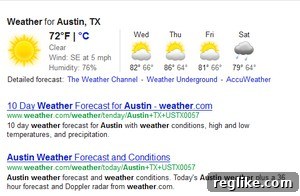
This immediate access to answers signifies a profound change. When the information a user seeks is readily available on Google.com, the incentive to navigate to a third-party site in the search results diminishes significantly. This trend, often referred to as “zero-click searches,” is not just a convenience for users; it’s a critical challenge and opportunity for content creators.
Google’s Vision: Expanding the Knowledge Graph
The current direct answer functionality is merely a precursor to Google’s broader ambitions. According to a report in the Wall Street Journal, Google has long planned to dramatically scale up this type of content display. This expansion is deeply rooted in Google’s “Knowledge Graph,” a vast database of facts and information about people, places, and things and their interconnections.
Under the shift, people who search for “Lake Tahoe” will see key “attributes” that the search engine knows about the lake, such as its location, altitude, average temperature or salt content. In contrast, those who search for “Lake Tahoe” today would get only links to the lake’s visitor bureau website, its dedicated page on Wikipedia.com, and a link to a relevant map.
For a more complex question such as, “What are the 10 largest lakes in California?” Google might provide the answer instead of just links to other sites.
This vision moves beyond simple factual snippets to providing comprehensive profiles for entities and direct answers to more complex, yet still factual, questions. The goal is clear: Google aims to be the ultimate information hub, providing immediate, authoritative answers for a growing range of queries. This isn’t Google venturing into original content creation in the traditional sense, like its past experimental platform Knol; rather, it’s about intelligently curating and presenting existing factual data in a user-friendly format.
The Rise of Zero-Click Searches and Its Impact on Publishers
The increasing prevalence of direct answers and featured snippets has given rise to the phenomenon of “zero-click searches,” where a user’s query is resolved directly on the SERP without any clicks to external websites. This trend poses a significant challenge for many web publishers, particularly those whose business models rely heavily on traffic generated from answering simple, factual questions or providing readily available data.
Websites specializing in definitions, conversion tools, quick facts, weather forecasts, or general knowledge might see a decline in organic traffic as Google becomes more adept at delivering these answers directly. If a user gets the answer to “What is the capital of France?” without leaving Google, the website that traditionally provided that answer misses out on a potential visit.
Who is Most Affected?
- Niche Fact Sites: Dictionaries, encyclopedias (beyond Wikipedia), trivia sites.
- Tool-Based Sites: Unit converters, calculators, time zone converters.
- Information Aggregators: Sites that compile simple lists or data points.
- Local Businesses: While Google provides direct answers for local search (maps, hours, phone), the challenge is ensuring your business is the one featured and drives a call or visit.
Adapting SEO and Content Strategies in the Direct Answer Era
While Google’s push for direct answers might seem daunting, it also forces content creators to innovate and redefine what constitutes valuable content. The key is to adapt by focusing on areas where Google cannot (or chooses not to) provide a complete, direct answer. This involves moving beyond mere factual dissemination to offering deeper insights, context, unique perspectives, and engaging experiences.
1. Embrace Depth, Context, and Uniqueness
Instead of just providing the answer, provide the “why” and the “how.” If Google answers “What are the 10 largest lakes in California?”, a publisher’s role could be to delve into the history of each lake, ecological impact, recreational activities, nearby attractions, conservation efforts, or personal travel experiences. Focus on long-form content that explores a topic comprehensively, offering value that goes beyond a concise snippet.
2. Optimize for Featured Snippets (Selectively)
Paradoxically, being the source of a featured snippet can still drive significant brand visibility and, sometimes, clicks. If your content is chosen for a snippet, it positions you as an authority. To optimize for this:
- Structure your content with clear headings (H2, H3).
- Provide concise, direct answers to common questions in a paragraph immediately following the question.
- Use lists, tables, and numbered steps for structured data.
- Implement Schema Markup (structured data) to help Google understand your content’s context.
However, carefully evaluate if securing a snippet for a particular query truly benefits your overall traffic goals, especially if the answer is so simple that users won’t need to click further.
3. Focus on Experience and Engagement
Beyond information, Google cannot provide experiences. This means investing in interactive content, multimedia (videos, podcasts, webinars), unique data visualizations, and community forums. Content that encourages engagement, discussion, or offers a tool that users actively interact with (e.g., a complex calculator or planner) will always have a place.
4. Build Brand Authority and Trust
Even if Google provides a direct answer, users often seek validation or deeper information from trusted sources. Cultivate your brand as an authoritative voice in your niche. This involves consistent quality content, strong internal linking, robust external backlinks, and a strong social presence. A user might get a quick answer from Google but then actively seek out your site for detailed analysis or expert opinion.
5. Target Niche and Long-Tail Keywords
While Google is excellent at answering broad, simple queries, it’s less likely to provide direct answers for highly specific, long-tail questions that reflect unique user intent or require nuanced understanding. Focus your SEO efforts on these less-competitive, more specialized queries where users are actively looking for detailed solutions or discussions that only a dedicated website can provide.
6. Local SEO for Businesses
For local businesses, direct answers in local search (e.g., Google My Business listings with hours, reviews, maps, phone numbers) are not a threat but an essential part of driving traffic. Optimizing your Google My Business profile and ensuring NAP (Name, Address, Phone) consistency across the web is crucial to appear prominently in these direct answer formats.
Conclusion: The Evolving Landscape of Information Retrieval
Google’s ongoing evolution towards providing more direct answers on its platform is a clear indication of its commitment to enhancing user convenience and information accessibility. While this trend presents undeniable challenges for content publishers who rely on organic search traffic, it also serves as a powerful catalyst for innovation. Websites that adapt by offering deeper insights, unique perspectives, interactive experiences, and focusing on niche, complex queries will continue to thrive.
The future of SEO and content marketing lies not just in getting found, but in providing unparalleled value that goes beyond what a direct answer box can offer. It demands a strategic shift from simply being a source of information to becoming a trusted resource that educates, engages, and inspires. The landscape of information retrieval is constantly changing, and adaptability remains the cornerstone of success for digital publishers.