
Paving the Way for a Truly Global Internet: VeriSign’s Patent for Internationalized Domain Names
 The internet, a boundless ocean of information and connectivity, began predominantly in English, relying on the ASCII character set for its foundational Domain Name System (DNS). However, as the digital world expanded to encompass billions of users speaking diverse languages and utilizing various scripts, the limitations of ASCII became increasingly apparent. The dream of a truly global internet, where users could navigate using their native languages and characters, hinged on the development of Internationalized Domain Names (IDNs). In a significant move that underscored its pioneering role in internet infrastructure, the U.S. Patent and Trademark Office granted U.S. patent number 7,774,432 to VeriSign for its innovative methods of registering and utilizing multilingual domain names. This patent marked a crucial milestone, establishing a standardized framework for the integration of non-ASCII characters into the global domain name system.
The journey to this patent was a testament to the complex and evolving nature of internet governance and technology. The application for patent 7,774,432 was notably a continuation of a provisional application filed as early as 2000, followed by a subsequent application in 2001 that was later abandoned. The specific application that culminated in this grant was filed in 2007, highlighting a multi-year effort by VeriSign to refine and secure its intellectual property in this critical area. This protracted process reflects the intricate technical and administrative challenges associated with enabling domain names in scripts such as Arabic, Chinese, Cyrillic, Devanagari, and many others, all while maintaining the stability and interoperability of the underlying DNS architecture.
At its core, the patent addresses the fundamental technical hurdles involved in making IDNs a reality. The abstract for the patent succinctly outlines the scope of this groundbreaking invention, providing insight into the intricate processes developed by VeriSign:
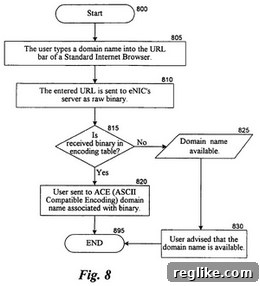
A method, system, and computer-readable medium are described for registering and using multilingual domain names that include characters outside the ASCII character subset supported by the DNS system. Such multilingual domain names can in some situations be registered by first being converted into appropriate ASCII-Compatible Encodings (ACEs) that represent the corresponding multilingual domain names and that use only characters within the ASCII character subset. In addition, a variety of binary variants may be generated at registration for each multilingual domain name and then used as equivalents for the multilingual domain name, such as by storing the variants in the registry as alternative domain names or by otherwise reserving the binary variants. When requests to resolve such a registered multilingual domain name into a corresponding IP address or URL are received, the stored binary variants and/or ACE information can then be used to respond in an appropriate manner.
This abstract details two critical components that form the backbone of IDN functionality: ASCII-Compatible Encodings (ACEs) and the management of “binary variants.” The introduction of ACEs, most famously implemented through Punycode, serves as the essential technical bridge. Since the Domain Name System was originally designed to process only a limited set of ASCII characters (alphanumeric characters, hyphens), non-ASCII characters cannot be directly integrated. ACEs provide a mechanism to convert these complex multilingual strings into an ASCII-only format, typically prefixed with “xn--“, allowing them to be processed by the existing DNS infrastructure. This ingenious solution ensures that while users see and type domain names in their native script, the underlying system can still resolve them efficiently and reliably. For example, a domain name like “例子.com” might be converted to “xn--fsqu00a.com” for DNS resolution, effectively maintaining compatibility without altering the core DNS protocols.
Beyond the fundamental conversion to ACE, VeriSign’s patent also delves into the crucial concept of “binary variants.” This aspect of the invention addresses a significant challenge inherent in multilingual domains: the potential for visual similarities between characters from different scripts, or even within the same script, that could lead to confusion, cybersquatting, or phishing attempts. For instance, an ‘a’ from the Latin alphabet might look identical or very similar to a character from Cyrillic or Greek scripts. The patent describes a proactive approach where, during the registration of an IDN, a range of “binary variants” are automatically generated. These variants represent different possible interpretations or visually similar alternatives of the primary multilingual domain name. By generating and reserving these variants, either by storing them as alternative domain names in the registry or by simply reserving them, the system aims to prevent malicious actors from registering look-alike domains. This foresight dramatically enhances the security and integrity of the IDN space, protecting both registrants and internet users from potential abuses.
The methods outlined in the patent ensure that when a request is made to resolve an IDN into its corresponding IP address or URL, the system can leverage the stored ACE information and/or the binary variants to provide an accurate and appropriate response. This sophisticated process supports the seamless user experience of typing a domain name in one’s native script and being directed to the correct website, all while the technical complexities are handled behind the scenes. VeriSign’s role as a prominent registry operator for critical top-level domains like .com and .net gives this patent immense significance. It enabled them to implement robust, standardized mechanisms for IDN registration and resolution at a global scale, thereby facilitating the internet’s expansion into non-English speaking regions.
The granting of this patent was not just a win for VeriSign; it represented a significant leap forward for the entire internet community. It laid down a structured and patented approach for tackling the complex issues surrounding multilingual domain names, encouraging broader adoption and standardization. By providing clear methods for managing IDNs, including their conversion and the proactive handling of potential variants, the patent helped to build trust and stability in this nascent area of domain name management. It has been instrumental in the internet’s transformation from a predominantly English-centric network into a truly global, inclusive platform accessible to people worldwide, regardless of their linguistic background.
In essence, VeriSign’s U.S. patent number 7,774,432 on the registration and usage of multilingual domain names provided critical intellectual property and methodological guidance during a pivotal era of internet expansion. Its contributions to the understanding and implementation of ASCII-Compatible Encodings and the intelligent management of binary variants have profoundly shaped how IDNs are handled globally. This innovation has undeniably played a key role in empowering billions of users to access and interact with the internet in their native languages, furthering digital inclusion and making the World Wide Web genuinely world-spanning. You can view the patent here (pdf) for a deeper technical dive into its specifications.