
The Nuance of Domain Names: Why Your Target Audience Might Just Break the Rules
For decades, domain name investors and online business strategists alike have championed a golden rule: domain names must be easy to spell. The conventional wisdom dictates avoiding cute spellings, tricky words, or anything that might lead to user frustration or missed traffic. This advice holds true in countless scenarios, aiming for broad appeal and effortless recall. However, like many rules, this one comes with compelling exceptions, particularly when you possess a profound understanding of your specific target audience. This article delves into a fascinating case study that challenges the ‘easy-to-spell’ mantra, revealing how a deep connection with your niche can redefine what makes a domain truly effective.
The Conventional Wisdom: Simplicity is King
The emphasis on an easily spellable domain name stems from several core principles of online usability and marketing. A straightforward domain name is:
- Memorable: Users can recall it easily, aiding direct navigation and word-of-mouth referrals.
- Typo-Resistant: Less complex spellings reduce the likelihood of mistyping, ensuring users land on the intended site.
- Search Engine Friendly: While direct spelling isn’t a primary SEO factor, a clear domain enhances user experience signals.
- Brandable: Simple, clear names often contribute to a stronger, more accessible brand identity.
Domain investors, including myself, frequently discuss the pitfalls of complicated names. Imagine trying to explain a domain over the phone that includes a number instead of a word, or a common homophone with an unusual spelling. “Is that ‘for’ as in F-O-R or F-O-U-R?” Such ambiguities create friction and potential customer loss. This is why advice often leans towards direct, common words that leave no room for misinterpretation.
Challenging the Orthodoxy: The Boutique Adventurer’s Unique Perspective
While simplicity usually reigns supreme, an enlightening conversation during a recent podcast interview offered a fresh perspective. Amanda O’Brien, the insightful publisher behind the high-end travel blog TheBoutiqueAdventurer.com, shared an approach that subtly, yet powerfully, defies this conventional wisdom.
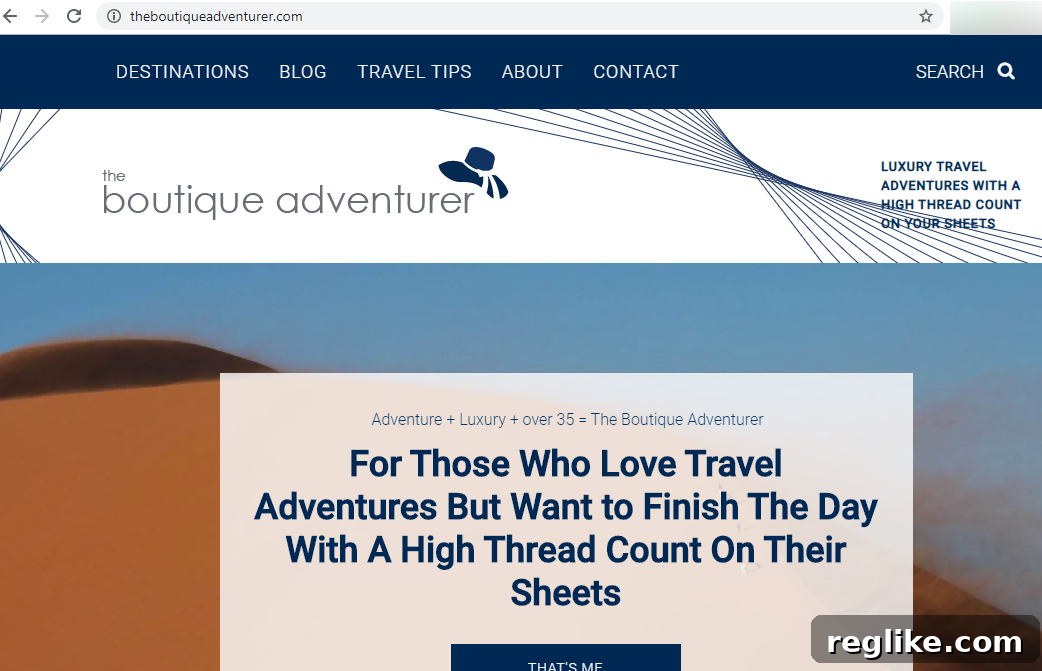
The word “boutique” itself is notorious for being frequently misspelled. It’s a French loanword that doesn’t follow typical English phonetic patterns, often leading to confusion. Given this common challenge, I asked Amanda if she ever encountered problems with her domain name due to the difficulty in spelling “boutique.” Her response was a masterclass in target audience understanding:
“I guess it comes down to who your target audience is,” she explained. “What I’ve always been aiming for are people that stay in boutique hotels, that they know what that means.”
This statement encapsulates the core of her strategy. In O’Brien’s specific case, her ideal audience isn’t the general public. It comprises seasoned travelers who are intimately familiar with the concept and terminology of ’boutique’ experiences. These individuals not only understand what a boutique hotel signifies but also possess the literacy and cultural familiarity to spell the word correctly without a second thought.
The Power of a Hyper-Niche Target Audience
Amanda O’Brien’s strategy with TheBoutiqueAdventurer.com brilliantly illustrates that a domain name can serve as an effective filter, attracting precisely the right kind of visitor while subtly deterring others who might not be a good fit. This concept goes beyond mere branding; it’s a strategic embrace of exclusivity that resonates deeply with a high-end niche.
Who is the “Boutique Adventurer” Audience?
To understand why this works, consider the characteristics of her target demographic:
- Affluent Travelers: Individuals with disposable income seeking unique, high-quality, and often luxurious travel experiences.
- Cultured and Knowledgeable: They are likely well-traveled, appreciate finer details, and are familiar with international terms and trends in hospitality.
- Specific Preferences: They actively seek out “boutique” properties, meaning smaller, often independently owned hotels with distinct character, personalized service, and unique aesthetics, as opposed to large chain hotels.
- Discerning Consumers: They value authenticity and a curated experience over mass-market offerings.
For this audience, the word “boutique” isn’t a linguistic hurdle; it’s a keyword, a descriptor, and an immediate indicator that they’ve found their tribe. It signals a certain level of sophistication and a promise of content that aligns with their specific interests. The domain name, therefore, doesn’t just identify the website; it communicates its value proposition and exclusivity from the very first impression.
SEO in a Niche World: Attracting the Right Traffic
While general SEO strategies often aim for broad keywords to maximize traffic, niche targeting like Amanda’s focuses on attracting highly qualified leads. For TheBoutiqueAdventurer.com, the SEO implications are distinct:
- Long-Tail Keyword Alignment: Users searching for “boutique travel,” “luxury adventure tours,” “unique small hotels,” or “curated travel experiences” are precisely the audience Amanda wants. These users are highly likely to spell “boutique” correctly because it’s central to their search intent.
- Reduced Competition: Competing for generic travel terms like “travel blog” is incredibly difficult. By embracing a niche term, TheBoutiqueAdventurer.com can rank more effectively for specific, less competitive phrases, leading to higher visibility among its ideal audience.
- Higher Conversion Rates: Traffic arriving from highly specific search queries or direct navigation of a niche domain is inherently more qualified. These visitors are not just browsing; they are actively seeking content that matches the website’s offerings, leading to increased engagement, longer dwell times, and ultimately, better conversion rates for affiliate links, bookings, or other calls to action.
- Brand Authority: A domain name that clearly communicates its niche builds immediate brand authority within that specific segment. It positions the website as an expert resource for “boutique adventures,” fostering trust and loyalty among its discerning readership.
In this context, the perceived difficulty of “boutique” becomes an asset. It acts as a self-selecting mechanism, ensuring that the vast majority of visitors who arrive are already pre-qualified and interested in the specific content offered.
When to Break the Rules (and When Not To)
Amanda O’Brien’s success highlights a crucial lesson: the rules of domain naming are not immutable laws, but guidelines to be understood and, where appropriate, intelligently adapted. However, it’s vital to recognize that this strategy is an exception, not the norm. So, when is it appropriate to consider a less conventional domain name, and when should you stick to simplicity?
Consider Breaking the Rules If:
- Your Target Audience is Highly Specific and Knowledgeable: As seen with TheBoutiqueAdventurer.com, if your audience has a deep understanding of niche terminology.
- The “Difficult” Word is Central to Your Brand Identity: If the word clearly defines your unique selling proposition and resonates strongly with your specific niche.
- You Have a Strong Marketing Strategy: You can compensate for any initial spelling challenges through targeted marketing, brand building, and strong SEO for niche keywords.
- Your Business is Not Aiming for Mass Market Appeal: If exclusivity is a part of your brand, a filtering domain can be beneficial.
Stick to Simple Spellings If:
- You Are Targeting a Broad Audience: For products or services intended for the general public, ease of recall and spelling is paramount.
- Your Brand is New or Unestablished: Without existing brand recognition, a complex domain can be a significant barrier to entry.
- Word-of-Mouth is a Primary Marketing Channel: A hard-to-spell domain can cripple organic referrals.
- You Want to Minimize Typo Traffic: For e-commerce sites or businesses where every potential customer counts, avoiding misspellings is critical.
The key takeaway is discernment. Do not blindly adopt a complex spelling simply to be unique. Your decision must be rooted in a deep, data-driven understanding of your potential customers and their online behavior.
Strategic Domain Naming: It’s All About Your Audience
Ultimately, the story of TheBoutiqueAdventurer.com provides a powerful reminder that effective domain naming is a strategic exercise, not merely a compliance checklist. While the advice to choose an easy-to-spell domain name holds true for the vast majority of businesses, a truly insightful understanding of your target audience can unlock unique opportunities.
In O’Brien’s case, her target audience not only knows how to spell “boutique” but actively seeks out what it represents. This discerning group views the term as a badge of quality and a promise of aligned experiences, making the domain name a highly effective, self-filtering mechanism. It’s a testament to the idea that sometimes, the “difficult” word is precisely the right one, provided it speaks directly and eloquently to the people who matter most.
So, before you dismiss a domain name for its apparent complexity, take a moment to consider: Who are you truly trying to reach? And more importantly, what do they already know, understand, and expect?