
ICANN’s FY2020 Financial Resilience: Navigating the Pandemic’s Economic Tides
The year 2020 marked a period of unprecedented global upheaval, fundamentally altering how organizations worldwide operated. Amidst this backdrop, the Internet Corporation for Assigned Names and Numbers (ICANN), a critical steward of the internet’s unique identifiers, released its financial results for the 2020 fiscal year. Covering the 12 months that concluded on June 30, 2020, these results provided a fascinating glimpse into how a global, multi-stakeholder organization adapted to the immediate economic impacts of the burgeoning pandemic. Far from suffering a downturn, ICANN’s financial health demonstrated remarkable resilience, largely bolstered by significant, albeit forced, operational efficiencies.
ICANN’s financial health is a crucial indicator of its ability to maintain the stable and secure operation of the internet’s domain name system (DNS). As a non-profit organization responsible for coordinating the global system of unique identifiers, including top-level domains (TLDs) like .com, .org, and country-code TLDs, ICANN’s financial stability ensures the continuity of its vital mission. Its funding primarily derives from fees associated with domain name registrations and related activities, reflecting the health and activity of the global online ecosystem. Therefore, analyzing its financial statements offers insights not only into its internal management but also into broader trends within the internet’s core infrastructure.
Overview of FY2020 Financial Performance
The financial report for FY2020, published by ICANN, revealed total funding reaching $141 million against expenses of $126 million. On the surface, these figures portray a healthy financial position, with a surplus generated for the fiscal year. What makes these results particularly noteworthy is that they surpassed initial expectations, which had been formulated before the full impact of the COVID-19 pandemic became apparent. This unexpected positive deviation from the budget can be attributed to a confluence of factors, primarily driven by the swift and decisive operational adjustments made in response to global health directives and travel restrictions.
The initial budget for FY2020 would have accounted for a more traditional year of operations, including the customary in-person global meetings and extensive staff travel. However, as the world grappled with widespread lockdowns and travel bans, ICANN, like many international bodies, was compelled to pivot. This pivot, while challenging from an operational standpoint, inadvertently led to substantial financial benefits, proving that adaptability can yield unexpected dividends even in adverse circumstances.
The Pandemic’s Catalytic Effect: Virtual Meetings and Savings
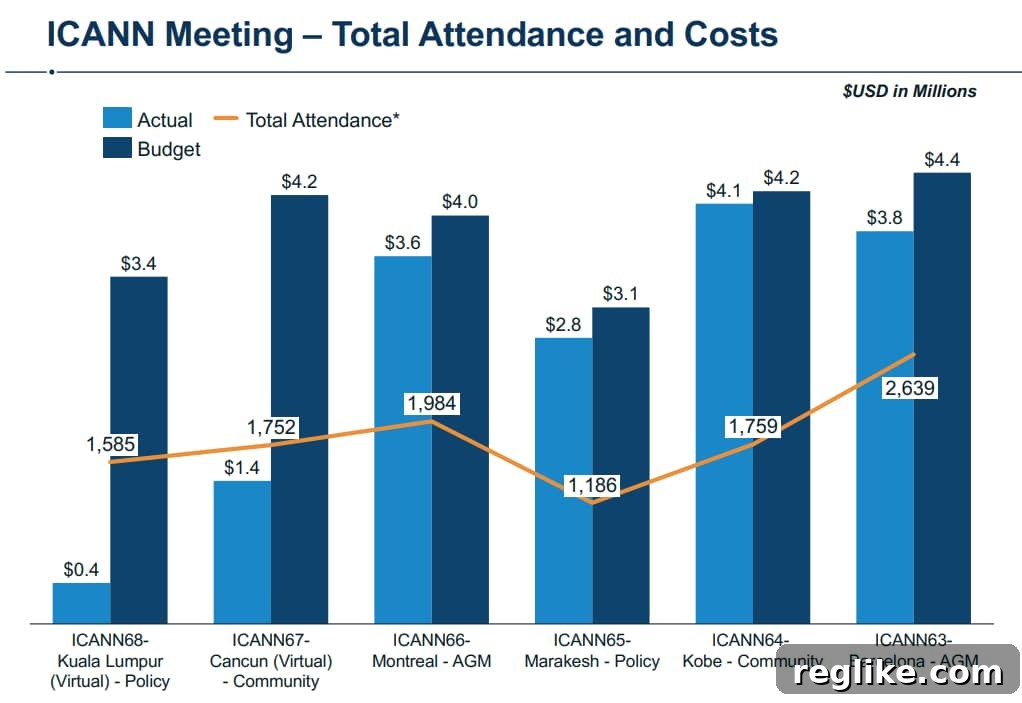
Perhaps the most significant driver of ICANN’s improved financial standing in FY2020 was the forced transition of its global meetings from physical gatherings to virtual events. Typically, ICANN holds three major public meetings each fiscal year, rotating across different continents to foster global participation and engagement within its multi-stakeholder model. These meetings are complex logistical undertakings, involving extensive travel for staff, board members, and community participants, as well as considerable costs for venue rental, catering, security, and technical infrastructure.
The onset of the pandemic meant that the last two scheduled meetings of FY2020 had to be held entirely remotely. This change alone resulted in nearly $6 million in savings. This figure underscores the immense financial burden associated with facilitating large-scale international physical gatherings. The savings were not merely theoretical; they directly contributed to ICANN’s bottom line, transforming what could have been a financially challenging year into one of unexpected fiscal strength. This direct financial benefit immediately sparked a crucial question within the ICANN community and beyond: Is it truly necessary to hold three expensive in-person meetings every year, or could a more cost-effective and potentially more inclusive model be adopted going forward?
Broader Expense Reductions and Operational Shifts
Beyond the direct savings from virtual meetings, ICANN realized an overall reduction in expenses that was $11.1 million, or 8%, lower than initially projected. This broader reduction was a cumulative effect of several pandemic-induced changes:
- Travel Restrictions: Even outside of the main public meetings, ICANN staff and leadership routinely travel for outreach, policy development, and engagement with various stakeholders. Global travel restrictions effectively curtailed much of this activity, leading to substantial savings on flights, accommodation, and per diems.
- Virtual Engagement: Many smaller workshops, committee meetings, and internal gatherings that would have previously required travel were also moved online. This not only reduced travel expenses but also potentially lowered associated administrative costs.
- Personnel Expenses: The economic uncertainty brought by the pandemic led to a slowdown in hiring new personnel. While this might have implications for long-term growth and talent acquisition, in the short term, it contributed to lower personnel-related expenditures. Organizations globally put a pause on recruitment, and ICANN was no exception, carefully managing its workforce growth during a period of flux.
These combined factors painted a picture of an organization that rapidly adapted its operational model to the new global reality, identifying and implementing efficiencies that significantly impacted its expenditure profile. The speed and scale of these adaptations highlight ICANN’s inherent flexibility and its capacity to pivot under pressure.
Unexpected Revenue Boost from Domain Name Transactions
Adding to ICANN’s positive financial narrative for FY2020 was an unexpected uplift in revenue. Total revenue for the year was $0.6 million higher than anticipated, primarily driven by higher-than-forecasted domain name transaction fees. This particular detail offers a fascinating insight into the broader internet economy during the initial phase of the pandemic.
While many traditional sectors faced severe contraction, the digital economy experienced a surge. Businesses rapidly transitioned online, individuals sought new ways to connect and entertain themselves digitally, and entrepreneurs launched new online ventures. This increased reliance on the internet translated into a higher demand for domain names, as more websites were registered or updated. Each domain registration and renewal often generates a small fee that contributes to ICANN’s funding, directly linking its financial health to the vibrancy of the global digital landscape. The modest but significant increase in these transaction fees demonstrated the fundamental resilience and growth of the internet infrastructure, even in challenging economic times, reinforcing ICANN’s vital role at its core.
The Future of ICANN Meetings: A Lingering Question
The substantial savings from virtual meetings in FY2020 undeniably brought the long-standing debate about the frequency and format of ICANN’s global public meetings back into sharp focus. The traditional model of three large, in-person gatherings annually has always been costly, representing a significant portion of ICANN’s operational budget. Proponents of physical meetings emphasize their importance for fostering informal networking, facilitating cross-cultural understanding, building consensus through face-to-face dialogue, and providing crucial accessibility for certain community members who thrive in physical environments. They argue that the multi-stakeholder model, which is at the heart of ICANN’s governance, relies heavily on these in-person interactions to function effectively.
However, the pandemic proved that much of ICANN’s essential work could indeed continue virtually. The cost savings were substantial, and virtual formats often offer increased accessibility for individuals who might be unable to travel due to financial, geographical, or personal constraints. Furthermore, reducing global travel aligns with growing environmental sustainability goals. The question is no longer “if” virtual meetings are possible, but “how” to best integrate them into a sustainable long-term strategy that balances cost-efficiency with the unique benefits of in-person engagement. A hybrid model, combining fewer in-person meetings with robust virtual participation options, is increasingly being considered as a viable path forward, potentially reshaping ICANN’s engagement landscape for years to come.
Strategic Implications and Lessons Learned
ICANN’s FY2020 financial performance offers several key strategic lessons. Firstly, it highlighted the organization’s capacity for rapid operational adaptation in the face of unforeseen global events. This agility is vital for an entity that manages a critical global resource. Secondly, the significant savings underscore areas where greater efficiency can be achieved without compromising essential functions. These savings can potentially be reinvested into strategic initiatives, strengthen ICANN’s reserve funds for future stability, or support enhanced community programs.
The insights from FY2020 will undoubtedly inform ICANN’s future budgeting and operational planning. The experience has provided valuable data on the comparative costs and benefits of different meeting formats, offering a blueprint for a potentially more flexible and economically sustainable approach to global engagement. It prompts a deeper evaluation of all expenditures, challenging long-held assumptions about necessary operational costs and paving the way for a more streamlined and efficient future.
Looking Ahead: Sustaining the Momentum
While FY2020 presented an unexpected financial silver lining due to the pandemic, the challenges for subsequent years would involve consolidating these efficiencies while ensuring the multi-stakeholder model remains vibrant and effective. The task for ICANN’s leadership and community is to harness the lessons learned from this extraordinary period. How can the organization maintain fiscal prudence without sacrificing the inclusive, global engagement that defines its mission? The balancing act between financial sustainability, operational efficiency, and community participation will continue to be a central theme in ICANN’s ongoing evolution.
Conclusion
ICANN’s financial results for fiscal year 2020 present a compelling narrative of resilience, adaptability, and unexpected financial gains in the face of a global crisis. The pandemic, while disrupting traditional operations, inadvertently served as a catalyst for significant cost reductions, particularly through the transition to virtual global meetings. Coupled with a robust domain name market, these factors ensured ICANN ended the fiscal year in a stronger financial position than anticipated. These results not only affirm ICANN’s sound financial management but also prompt critical discussions about the future operational models, especially regarding its flagship global meetings, setting a new precedent for how internet governance might effectively and efficiently be conducted in a post-pandemic world.