
Is Complexity Always the Answer? IBM’s Novel Approach to Combosquatting Detection
In the ever-evolving digital landscape, brand protection remains a paramount concern for businesses worldwide. As companies increasingly rely on their online presence, the threat of cybersquatting and its various permutations continues to grow. One particularly insidious form is combosquatting, a tactic employed by malicious actors to deceive internet users and exploit established brand trust. While the problem is significant, effective countermeasures often prioritize efficiency and simplicity. It is within this context that IBM’s recent patent application, “Guided Word Association Based on Domain Name Detection,” presents an intriguing, albeit seemingly complex, solution to an issue that many believe can be addressed with more straightforward methods.
The Persistent Threat of Combosquatting
Combosquatting, a sophisticated form of cybersquatting, involves the registration of domain names that combine a well-known brand name with an additional word or phrase, often conveying a sense of urgency, authority, or concern. These added words frequently include terms like “security,” “login,” “support,” “update,” “official,” or “verify.” For instance, a common example seen in the wild is `facebook-security.com`. Such domain names are crafted to appear legitimate at first glance, cleverly leveraging the established reputation of the targeted brand to lure unsuspecting individuals.
The primary objective behind combosquatting is usually malicious: to conduct phishing attacks, distribute malware, host fake customer support portals, or even sell counterfeit goods. By creating a deceptive online presence, cybercriminals aim to steal credentials, financial information, or personal data, leading to severe financial losses and identity theft for victims. For the targeted brand, the consequences are equally dire, encompassing reputational damage, customer distrust, diluted brand value, and significant operational costs associated with incident response and mitigation.
Combosquatting vs. Other Forms of Cybersquatting
To fully appreciate the nuances of combosquatting, it’s helpful to distinguish it from other prevalent forms of cybersquatting:
- Typosquatting: This technique preys on common typing errors made by users. Examples include registering `gogle.com` or `amazone.com`. Detecting typosquatted domains often requires sophisticated algorithms that can identify character omissions, transpositions, or substitutions.
- Classic Cybersquatting: This involves registering a domain name that is identical or confusingly similar to an established trademark with the intent to profit from the brand’s goodwill, typically by selling the domain back to the trademark owner at an inflated price.
- Name-jacking: Similar to classic cybersquatting but targeting the names of famous individuals, celebrities, or public figures.
Unlike typosquatting, which relies on subtle deviations, combosquatting uses a brand’s actual name alongside a qualifying term. This characteristic makes it, in many respects, one of the easier types of cybersquatting to detect. A simple keyword search for a brand name in combination with common deceptive terms can often uncover a significant number of these malicious registrations. For instance, any domain containing “facebook” in the second-level domain (SLD) is immediately a candidate for scrutiny, especially if combined with terms like “security” or “login.” The relative straightforwardness of this detection often leads experts to question the need for overly intricate solutions.
IBM’s “Guided Word Association” Patent: A Detailed Examination
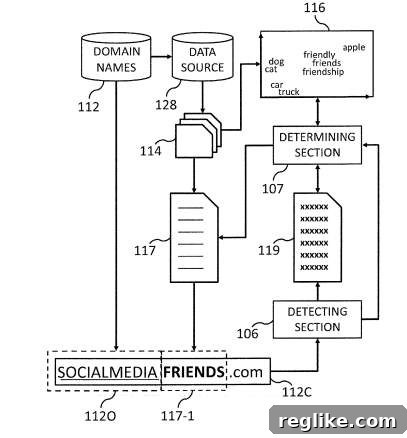
IBM’s patent application outlines a system designed to bolster defenses against combosquatting. Titled “Guided Word Association Based on Domain Name Detection,” the invention aims to provide a more structured and perhaps proactive method for identifying these deceptive domain names. At its core, the system seeks to generate and analyze potential combosquatting domains by associating relevant words with a target brand name.
The proposed method, as gleaned from the patent description, involves several key steps:
- Identification of a Target Brand: The process begins by identifying a brand name that needs protection.
- Generation of Associated Words: This is where the “guided word association” comes into play. Instead of merely relying on a static list of keywords, the system presumably employs a more dynamic approach to identify words commonly used in deceptive domain names or those logically associated with a brand’s activities (e.g., “support,” “help,” “customer,” “account,” “portal,” “webmail,” “billing,” “promo,” “deal”). This “guidance” could potentially come from analyzing existing threat intelligence, linguistic models, or even machine learning algorithms trained on patterns of malicious domain registrations.
- Creation of Candidate Domain Names: Once a list of associated words is compiled, the system combines them with the target brand name to generate a comprehensive list of candidate domain names. For a brand like “ExampleCorp,” this could include `examplecorp-login.com`, `examplecorpsecurity.net`, `secure-examplecorp.org`, and so forth.
- Registration Status Check: The system then checks whether these generated candidate domain names are currently registered. This step typically involves querying domain registration databases (like WHOIS) or specialized domain monitoring services.
- Alert and Action: If a candidate domain is found to be registered, the system flags it, triggering an alert for the brand owner, who can then initiate further investigation or legal action.
While the patent highlights an innovative approach to generating candidate domains, the core criticism revolves around its perceived complexity for a problem that often yields to simpler, keyword-driven solutions. Existing domain monitoring services routinely scan for combinations of brand names and common malicious keywords, effectively identifying most combosquats. The “guided word association” layer, while potentially more comprehensive, might introduce an unnecessary level of algorithmic sophistication for the initial detection phase.
Evaluating the Practicality: Potential Use Cases and Limitations
Despite the initial perception of complexity, IBM’s approach might find specific niches where its advanced capabilities prove beneficial. The patent hints at potential applications beyond mere reactive detection.
Proactive Registration and Threat Mitigation
One suggested use case for IBM’s system is for “proactively registering potential combosquats.” This strategy, often referred to as “defensive registrations” or “brand squatting,” involves a brand registering numerous domain variations to prevent malicious actors from doing so. While this can offer a layer of protection, it comes with its own set of challenges:
- Cost and Management: Registering and maintaining a vast portfolio of defensive domains can be incredibly expensive and administratively burdensome. Brands must weigh the cost against the actual threat level.
- Effectiveness: It’s virtually impossible to register *every* conceivable variation. Bad actors are constantly innovating, and a purely defensive registration strategy can quickly become a game of whack-a-mole.
- Drawing Attention: Sometimes, registering obscure variations can inadvertently draw attention to them, potentially inspiring malicious actors.
While IBM’s system could efficiently generate an extensive list of candidate domains for proactive registration, the fundamental question remains whether this is the most cost-effective and practical strategy for most businesses. Simpler tools can also generate such lists, and the decision to defensively register often rests on strategic business considerations rather than just technical feasibility.
Utility for Generic or Short Brands
The original text posits that IBM’s system “might also be helpful for companies with fairly generic or short brands. IBM, for example.” This observation holds merit. For brands with common or abbreviated names, the permutations of combosquatting can be exponentially larger. A brand like “Apex” or “Zenith” could be combined with a vast array of generic terms, making targeted detection more challenging. In such cases, a system that intelligently generates and monitors a broader range of associated words could indeed offer a more robust defense than simple keyword matching.
Beyond Basic Detection: Advanced Threat Intelligence?
Perhaps the true value of IBM’s patent lies not just in reactive detection or even proactive registration, but in its potential for advanced threat intelligence and predictive analysis. The “guided word association” element could be sophisticated enough to:
- Identify emerging trends in malicious domain naming conventions.
- Predict new types of deceptive terms that might be adopted by cybercriminals.
- Prioritize which combinations pose the highest risk based on their potential to mimic legitimate brand communications.
If the system can learn and adapt to the evolving tactics of cybercriminals, it could move beyond simply identifying known threats to anticipating future ones. This level of predictive capability, driven by advanced analytics or AI, would indeed justify a more complex approach, positioning the patent as a tool for next-generation brand protection rather than just enhanced detection.
The Broader Landscape of Digital Brand Protection
In practice, comprehensive brand protection requires a multi-layered strategy that combines technological solutions with legal frameworks and user education. No single tool, no matter how sophisticated, can provide a complete defense against the myriad threats present in the digital realm.
- Technological Solutions: These include domain monitoring services, DNS analytics, AI-powered threat intelligence platforms, and advanced phishing detection systems. Tools that can analyze website content, IP addresses, and email headers are crucial for identifying live threats.
- Legal Remedies: When a combosquatted domain is identified, brand owners often pursue legal action. The Uniform Domain-Name Dispute-Resolution Policy (UDRP) is a common, relatively quick, and cost-effective method to reclaim infringing domain names. National laws and trademark infringement lawsuits also provide avenues for recourse.
- User Education: Empowering customers to identify and report suspicious communications is a vital, often overlooked, layer of defense. Educating users about phishing indicators, official communication channels, and secure browsing practices can significantly reduce the success rate of combosquatting attacks.
The contributions of technology giants like IBM to cybersecurity innovation are undoubtedly important. However, the effectiveness of any solution must be evaluated in terms of its practicality, scalability, and integration into existing workflows. Sometimes, the “best” solution is not the most technically intricate, but the one that most efficiently and reliably addresses the problem at hand.
Conclusion: Balancing Innovation with Pragmatism
IBM’s patent application for “Guided Word Association Based on Domain Name Detection” is a testament to the ongoing and critical need for robust brand protection in the digital age. It represents an innovative attempt to apply a more sophisticated approach to identifying combosquatting domains. While the perceived complexity for what is often considered an “easy-to-solve” detection problem might raise eyebrows, particularly when simpler keyword-based monitoring tools exist, the underlying concepts of guided word association could potentially unlock advanced capabilities in proactive threat intelligence and predictive analysis, especially for brands with generic or short names.
Ultimately, the value of such a system will be determined by its real-world efficacy and whether its added complexity delivers a significantly superior outcome compared to more straightforward methods. The digital battleground for brand integrity is dynamic, constantly evolving, and demands solutions that are both intelligent and pragmatic. IBM’s patent sparks a valuable discussion on how technology can push the boundaries of cybersecurity, reminding us that true innovation lies not just in sophistication, but in delivering effective, sustainable defenses against an ever-present array of online threats.