
Tencent’s Recent Deployment of Chinese IDN Domains: A Harbinger of Change or a Measured Step?
The digital landscape in China is constantly evolving, and a recent development from internet behemoth Tencent has sparked considerable interest within the domain community. The deployment of two key .中国 (China) domains, as highlighted by domain expert Kassey Lee, prompts a critical question: Does this signify a turning point for Internationalized Domain Names (IDNs) in China, potentially ushering in a new era of Chinese-character websites, or is it merely a strategic, isolated move?
For years, the concept of IDNs – domain names in non-Latin scripts – has held immense promise, particularly in markets with large populations whose native languages do not use the Latin alphabet. China, with its vast internet user base and rich linguistic heritage, represents a prime candidate for the widespread adoption of IDNs. The .中国 top-level domain (TLD) was specifically created to cater to this need, allowing Chinese businesses and individuals to establish an online presence entirely in Chinese characters, theoretically enhancing brand recognition and user experience. However, the journey for .中国 has been far from straightforward, facing challenges in adoption, technical integration, and user habits.
Tencent’s Strategic Activation: 腾讯.中国 and QQ.中国
The recent news, brought to attention by long-time reader Moris via a report from CNNIC (China Internet Network Information Center), confirms that 腾讯.中国 (Tencent.china) and QQ.中国 (QQ.china) are now actively resolving. This activation is particularly significant given that these domains have been inactive for an extended period, creating speculation about Tencent’s long-term digital strategy. Currently, 腾讯.中国 efficiently forwards visitors to the main Tencent.com portal, while QQ.中国 redirects to Tencent’s popular instant messaging platform, QQ.com. This immediate forwarding strategy suggests a tactical move to secure these valuable brand assets in the Chinese IDN space, rather than a full commitment to developing distinct IDN-centric websites at this stage. It could be seen as a defensive registration, ensuring that these prime digital properties remain under Tencent’s control, or a preparatory step for future, more extensive IDN integration.
This move by a company as influential as Tencent, which dominates various sectors of the Chinese internet economy from social media and gaming to finance and cloud services, inevitably draws attention to the broader landscape of IDN adoption among major Chinese corporations. While the immediate action is forwarding, the mere activation of such prominent domains could encourage other companies to reconsider their approach to .中国 domains, potentially catalyzing a ripple effect across the industry. The decision to activate these domains, even if only for redirection, underscores a recognition of their inherent value and potential for future leverage in a progressively localized online environment.
Broader Corporate Engagement with .中国 Domains
Beyond Tencent, other notable Chinese entities have also registered and in some cases activated .中国 domains. While many, like Tencent’s current deployments, utilize forwarding, their existence paints a picture of awareness, if not always immediate full-scale development. The following table illustrates several examples of these registrations and their current actions:
| Domain | Action | Application |
|---|---|---|
| 当当网电子书.中国 | Forwards to DangDang.com | General product portal |
| 华大基因.中国 | Forwards to BGI.com | Genomic sequencing services |
| 中国移动.中国 | Forwards to ChinaMobile.com | Telecom services |
| 新華社.中国 | Forwards to XinhuaNet.com | News |
| Beijing2022.中国 | Forwards to Beijing2022.cn | Beijing 2022 Winter Olympics |
| 小度.中国 | Active site | Baidu’s Xiaodu brand smart accessories |
It is particularly interesting to note the case of 小度.中国 (Xiaodu.china). Unlike the others, this domain hosts an active website, showcasing Baidu’s smart accessories under the Xiaodu brand. This proactive development by Baidu, another internet giant, suggests a more direct commitment to leveraging the .中国 domain for brand identity and direct consumer engagement. It stands out as an example of what full IDN integration could look like, providing a native-language experience directly from the Chinese character domain. This distinction highlights that while many companies are securing their IDN assets, the actual implementation varies significantly, with some taking a more cautious, forwarding-only approach, while others, like Baidu’s Xiaodu, are embracing direct usage.
Analyzing the Trajectory of .中国 Domain Adoption
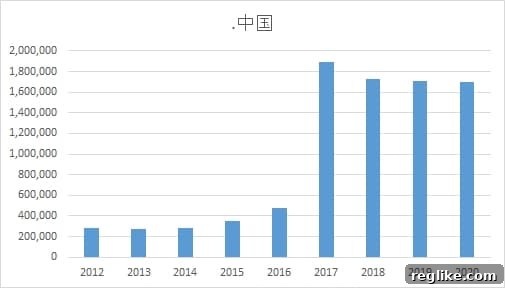
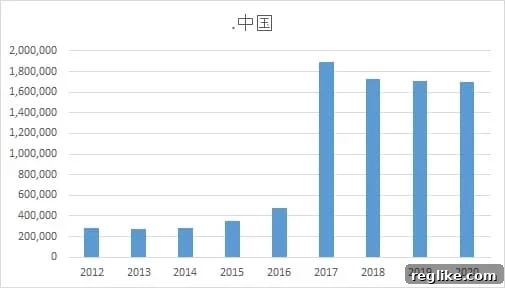
To gain a clearer perspective on the overall health and adoption rate of the .中国 extension, it’s crucial to examine historical data. As Kassey Lee previously analyzed and updated with the latest 2020 data, the general trend for Chinese IDN domains reveals a challenging landscape. The peak in registrations occurred around 2017, reaching approximately 1,895,745 domains, but has since shown a downward trajectory. This decline, visible in the accompanying chart, suggests that despite initial enthusiasm or mandatory registrations, sustained organic growth and widespread adoption have remained elusive.
Several factors could contribute to this trend. User habits, for instance, play a significant role. Many Chinese internet users have become accustomed to typing Latin characters for domain names, even for Chinese websites, preferring .cn or .com extensions. The technical complexities associated with IDNs, such as input methods across various devices, browser compatibility issues (though steadily improving), and concerns regarding punycode representation for security, may also deter mass adoption. Furthermore, the perceived lack of a compelling competitive advantage or clear SEO benefits compared to traditional Latin domains might lead businesses to prioritize existing infrastructure rather than investing heavily in new IDN deployments. The initial surge in 2017 might have been driven by promotional efforts or a speculative rush, which later tapered off as practical challenges became more apparent.
A Deep Dive into Top Chinese Internet Companies’ IDN Strategy
Given that internet companies are typically at the forefront of digital trends and innovation, an in-depth analysis of their IDN adoption provides valuable insights. Kassey Lee meticulously examined the Top 100 Chinese Internet Companies, as listed in the “Research Report on the Comprehensive Strength of Chinese Internet Companies (2020),” to ascertain the usage status of their corresponding .中国 domains. The findings offer a comprehensive snapshot of the current corporate sentiment and practical application:
| Status | Count |
|---|---|
| Not resolve | 86 |
| Developed | 2 |
| Developed by 3rd parties | 5 |
| Forward | 2 |
| For sale | 3 |
| Expired | 1 |
| Parked | 1 |
The overwhelming majority—a staggering 86 out of 100—of these prominent companies’ .中国 domains do not resolve at all. This statistic is perhaps the most telling, indicating a significant lack of active engagement or development for these specific IDN assets. While many might have registered their respective .中国 domains for brand protection or future planning, the absence of active resolution suggests these domains are largely dormant. The fact that only two domains are “Developed” (including the aforementioned 小度.中国) directly by the companies themselves, and an additional five by third parties, further underscores the limited operational deployment within this elite group.
The “Forward” category, with two instances, likely includes Tencent’s recent activations, demonstrating a cautious approach that prioritizes brand presence over full content development. The presence of domains “For sale,” “Expired,” or “Parked” points to a fragmented market where some IDN assets might be considered non-core, speculative, or simply abandoned. Collectively, these statistics paint a clear picture: despite Tencent’s recent, high-profile activations, there is no immediate indication of a widespread boom or a fundamental shift in corporate China’s strategy towards .中国 domains. The current landscape suggests that IDNs, while recognized for their potential, have yet to achieve critical mass or become a primary component of leading companies’ online presence.
Navigating Practicalities and the Future of IDNs in China
Beyond the adoption rates, several practical considerations impact the usability and eventual success of IDNs in China. A crucial point, as illustrated by the example of 滴滴.中国 (Didi.china), is the inconsistency in how domains resolve with or without the “www” prefix. While 滴滴.中国 displays content without the prefix, it fails to resolve with “www” added. Such inconsistencies can create confusion for users and complicate web development and marketing efforts. Ensuring consistent resolution across all common permutations is vital for a smooth user experience and broad accessibility.
The future of IDNs in China will likely depend on a confluence of factors. Continued improvements in browser and device support, coupled with more intuitive Chinese input methods across all platforms, will enhance user experience. A strong push from government bodies or leading industry players, perhaps through educational campaigns or incentives, could also significantly boost adoption. Moreover, if search engines begin to prioritize or offer distinct advantages to native IDN websites, it could create a powerful incentive for businesses. The increasing global trend towards a truly multilingual internet, where users can interact with digital content in their native languages from start to finish, might also gradually shift user preferences in China.
In conclusion, while Tencent’s activation of 腾讯.中国 and QQ.中国 is a noteworthy development, it currently appears to be a strategic move to secure brand assets rather than a signal of an imminent boom in .中国 domain adoption. The broader data from top Chinese internet companies indicates that most IDN domains remain unutilized, highlighting ongoing challenges in mass adoption. While the vision of a fully Chinese-character internet remains compelling, realizing this potential requires overcoming technical hurdles, influencing user behavior, and demonstrating clear value propositions for businesses. The journey for .中国 domains is far from over, and how leading internet companies choose to integrate them in the coming years will be crucial in shaping the future of China’s digital identity.