
The FamilyAlbum.com Saga: Unpacking GoDaddy’s Controversial Domain Deletion and Its Implications
The digital landscape is a vast and dynamic space, and at its core lie domain names – the virtual addresses that define online identities and businesses. Owning a valuable domain name can be akin to owning prime real estate in the digital world, making its security and proper management paramount. This is precisely why the story of FamilyAlbum.com being controversially “deleted” by GoDaddy due to an alleged invalid WHOIS email address sent ripples through the domain community. What initially appeared to be a straightforward administrative action quickly unfolded into a complex narrative, raising significant questions about registrar responsibilities, ICANN policies, and the fundamental rights of domain registrants. Let’s delve into the details of this pivotal case and explore its broader implications for domain owners everywhere, emphasizing transparency and due process in domain management.
The Core of the Dispute: Key Facts Surrounding FamilyAlbum.com
The incident surrounding FamilyAlbum.com, a domain name of considerable intrinsic value, brought to light several concerning aspects of domain management and registrar conduct. Here’s a detailed look at the key elements that shaped this controversy, which serves as a cautionary tale for all domain owners:
-
GoDaddy’s Unilateral Action and the Initiating User Complaint
GoDaddy, one of the world’s largest domain registrars, unilaterally removed the domain registration from its previous owner. This drastic action was reportedly initiated after a third-party user lodged a complaint, alleging that the registrant had failed to respond to inquiries sent to the email addresses listed in both the domain’s public WHOIS record and the registrant’s private GoDaddy account. The underlying premise was that the registrant’s contact information was either inaccurate or non-responsive, thereby triggering a compliance procedure within GoDaddy’s system.
Such complaints are not uncommon in the domain space. Accurate WHOIS data is a cornerstone of the internet’s operational integrity, serving multiple vital functions. It facilitates contact between domain owners for technical issues, business inquiries, and dispute resolution. It also plays a crucial role in combating spam, phishing, and other malicious online activities. However, the subsequent handling of this particular complaint by GoDaddy is where the situation diverged significantly from what many consider standard operating procedures and established industry policies.
-
The Critical Contradiction with ICANN Policy: Deletion vs. Transfer of Ownership
GoDaddy publicly asserted that its actions were entirely consistent with ICANN (Internet Corporation for Assigned Names and Numbers) policy regarding inaccurate WHOIS data. ICANN is the global non-profit organization responsible for coordinating the maintenance and procedures of several databases related to the namespaces and numerical spaces of the Internet, ultimately ensuring its stable and secure operation. However, sources closely affiliated with ICANN quickly highlighted a crucial distinction that GoDaddy seemingly overlooked or misrepresented.
While ICANN policies do empower registrars to take action against domains with persistently inaccurate WHOIS information, there’s a significant difference between “deleting” a domain and “transferring” it to another customer. If GoDaddy had genuinely deleted the domain, making it available to the public on a first-come, first-served basis, its actions might have been considered within the bounds of — though not strictly required by — ICANN policy. The critical error, and indeed the core of the controversy, was that GoDaddy did not merely delete the domain. Instead, it directly transferred ownership to another customer, an entity that reportedly had a “backorder” placed on the domain. This is not a standard ICANN-mandated procedure for inaccurate WHOIS. ICANN’s Registrar Accreditation Agreement (RAA) focuses on the *accuracy* of data and allows for suspension or cancellation after due process, but not typically a direct transfer to a specific third party through internal mechanisms.
This direct transfer bypasses the spirit of ICANN’s guidelines, which aim to ensure fairness, transparency, and prevent registrars from exploiting their privileged position for commercial gain. Such an action can deny the original registrant due process and creates a perception of an unfair advantage being granted to a specific customer, raising serious ethical and procedural questions about the registrar’s role as a neutral arbiter.
-
The Significant Commercial Value of FamilyAlbum.com
The financial aspect of this case cannot be overstated. FamilyAlbum.com is unequivocally a valuable domain name. Its intrinsic worth is derived from its clear, descriptive nature, high memorability, and broad appeal, making it ideal for a multitude of online ventures related to photography, genealogy, personal digital archives, or even social networking. To underscore this significant market value, a comparable domain, FamilyPhotos.com, had recently sold for an impressive $35,000. While FamilyAlbum.com might not command an identical price due to market nuances, it undeniably belongs to a category of premium generic domains highly sought after by businesses and investors seeking strong brandable assets for their online presence.
The high value of the domain intensifies the scrutiny of GoDaddy’s actions. When a digital asset potentially worth tens of thousands of dollars changes hands under such controversial circumstances, questions about transparency, fairness, and potential conflicts of interest naturally arise. Was the rapid transfer motivated, consciously or unconsciously, by the domain’s inherent value, or was it simply a standard procedure misapplied to a high-profile, desirable asset? This aspect fueled suspicions and highlighted the immense power registrars wield over domain ownership.
Decoding GoDaddy’s Communication to the Former Owner: A Closer Look at the Notice
Understanding the exact message GoDaddy conveyed to the previous owner provides crucial insights into their operational protocol and the basis for their decision. The notice received by the registrant stated:
“On 12/19/2006 we sent a notice to you at the admin/tech contact email address and the account email address informing you of invalid data in breach of the domain registration agreement and advising you to update the information or risk cancellation of the domain. The contact information was not updated within the specified period of time and we canceled the domain. The domain has subsequently been purchased by another party. You will need to contact them for any further inquiries regarding the domain.”
Upon closer examination, a significant omission in this message becomes apparent: it does not explicitly state that the notification email bounced back. The phrasing “informing you of invalid data” combined with “contact information was not updated” implies non-responsiveness rather than provable invalidity. In subsequent discussions with the former owner, there was no clear indication or admission that their email address was, in fact, invalid or non-functional. GoDaddy, notably, has not provided definitive proof of an email bounce or other evidence that the email address was technically inoperative. While it’s certainly plausible for an email to bounce for various technical reasons (e.g., mailbox full, server issues, aggressive spam filters), the absence of concrete, verifiable evidence from GoDaddy leaves a critical gap in their justification for the domain’s cancellation.
This ambiguity is crucial because the distinction between an email being truly “invalid” (i.e., non-existent or permanently unreachable) and merely “unresponded to” (due to oversight, travel, or legitimate filters) has profound implications for domain ownership rights and the rigorous application of ICANN policies. ICANN generally requires actual proof of invalidity, not just a lack of response, before extreme measures like domain cancellation are taken.
GoDaddy’s Internal Contradiction: “Not Required to Respond”
Adding another layer of complexity and perceived inconsistency, an investigation into GoDaddy’s own publicly available tools revealed a conflicting policy statement that directly challenged their actions in the FamilyAlbum.com case. While conducting a standard WHOIS search on GoDaddy’s platform, a prominent link appeared at the bottom of the entry, inviting users to “report inaccurate data.” This link was visible even for domains not registered through GoDaddy, suggesting a standard and universally applicable procedure for community oversight and data integrity.
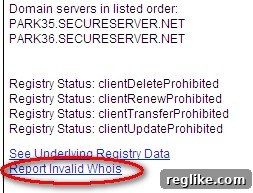
Clicking this link leads directly to a dedicated form specifically designed for reporting invalid WHOIS information. Crucially, at the bottom of this very form, a clear and unambiguous disclaimer reads:
“*The registrant is not required to respond to an email, phone, or postal mail inquiry. We need evidence that the email is invalid (such as a bounce), the phone is invalid (such as a disconnection), or the mail has been returned as undeliverable.”
This statement directly contradicts the implicit premise on which FamilyAlbum.com was reportedly “canceled” – that a lack of response constituted grounds for action. If a registrant is “not required to respond to an email,” then merely failing to reply cannot, by GoDaddy’s own stated public policy, be sufficient grounds for domain deletion. The explicit requirement, as articulated by GoDaddy itself through its public-facing tools, is for *concrete evidence* of invalidity – a bounce message from the email server, a disconnected phone line, or mail returned as undeliverable. This stark disparity between stated policy and applied action raises serious questions about internal consistency, due process, and whether the company truly adhered to its own published standards in the FamilyAlbum.com case. It suggests that either the internal process leading to the domain’s cancellation was flawed, or the reasons provided for the action were inconsistent with their own widely accessible guidelines for reporting and verifying invalid data.
Further Confusion: GoDaddy Support’s Inconsistent Narrative
The situation became even more muddled and contradictory with an article detailing a conversation with a GoDaddy support representative regarding the FamilyAlbum.com case. The account provided by the support team member, after consulting with a supervisor, painted a significantly different picture of the events:
The GoDaddy representative put me on hold after I described the situation to him and about 3 minutes later he returned after speaking with his supervisor. Apparently, the supervisor had been a trainer at the time this situation occurred 1 – 2 years ago. The article referred to above shows a letter which appears to be from GoDaddy Domain Services and puts the date 12/19/2006 on the incident. I do not know if these are the same or different situations, as I do not know the sources of the other article.
What Happened According To GoDaddy
The GoDaddy representative relayed the following to me:The party who had the domain backordered had met the owner of the domain previously and had found out that the email was invalid and that the owner was going to be out of town for a couple of weeks. So, they placed a back order and sent a complaint that the email was invalid to GoDaddy. GoDaddy then sent an email AND called the phone number they had on file for the owner where they left him a voicemail. When he did not respond in 10 days, per ICANN rules and regulations they were required to delete the account.
When the account became available, the person who had placed the backorder received the domain.
Upon the original owner’s return from his trip, he received the voicemail and contacted GoDaddy who advised him to contact the other party to see if they would release the domain back, which the new owner did not agree to do. What followed was a dispute between GoDaddy, ICANN, the original owner and the guy who backordered the domain.
This narrative from GoDaddy support introduces several new, and potentially contradictory, elements that further complicate the FamilyAlbum.com saga. First, the timeline seems incongruous, referring to an incident 1-2 years prior to the reported date of 12/19/2006. This discrepancy strongly suggests the support representative might have been describing a different case entirely, or misremembering crucial details. This points to a systemic issue within GoDaddy’s support structure, where representatives might confuse distinct incidents or lack access to accurate, up-to-date information for specific high-profile cases, leading to inconsistent customer experiences.
Second, the support story claims that the party with the backorder *already knew* the email was invalid and that the owner would be out of town. This raises pointed questions about whether the “complaint” was an opportunistic move, leveraging pre-existing knowledge to acquire a valuable domain. While not inherently illicit for the complainant to seek a valuable domain, it highlights the potential for abuse when registrar policies are unclear, inconsistently applied, or when the process lacks sufficient safeguards against exploitation.
Most critically, the support representative boldly asserted that “per ICANN rules and regulations they were *required* to delete the account” after 10 days of no response. This statement is factually incorrect and represents a significant misinterpretation or misrepresentation of ICANN policy. There is no ICANN policy that *mandates* a registrar to delete a domain solely for unresponsive or even invalid WHOIS information within such a rigid timeframe. Registrars are *permitted* to take action, including suspension or deletion, but it is not a mandatory requirement, especially not under a strict 10-day non-response timeline without demonstrable proof of actual invalidity (like a bounce message). This significant misstatement by a GoDaddy support staff member, supposedly backed by a supervisor, underscores a deeper, more troubling problem: inadequate training and understanding of the very policies that govern their operations and the broader domain name system.
The Wider Implications: GoDaddy’s Training and ICANN Policy Misinterpretations
Regardless of how one views the specifics of the FamilyAlbum.com case, one undeniable conclusion emerges: GoDaddy’s customer support and internal communication processes require substantial improvement and rigorous oversight. This incident is not an isolated one; it highlights a recurring pattern of GoDaddy support representatives citing ICANN policies inaccurately. In previous instances, GoDaddy staff have incorrectly informed customers that ICANN policy *required* them to block the transfer of a domain if its WHOIS record had been edited within the preceding 60 days. This is another clear misrepresentation of ICANN’s Registrar Transfer Policy, which generally allows transfers after 60 days from initial registration or a previous transfer, but doesn’t strictly prohibit transfers after a WHOIS update unless the registrant specifically opts for a 60-day lock, which is a different mechanism.
Such consistent misinterpretations of critical regulatory policies by a major registrar have several detrimental effects on the domain ecosystem and individual registrants:
- Erosion of Trust: When customers receive incorrect information about their domain rights, obligations, and the underlying regulatory framework, it fundamentally erodes trust in the registrar and the broader domain industry. Registrants rely on their registrars for accurate guidance.
- Legal and Ethical Concerns: Misrepresenting policies, particularly those set by a respected governing body like ICANN, can have significant legal and ethical ramifications for the registrar, potentially exposing them to disputes, costly litigation, and reputational damage. It can also lead to unfair outcomes for registrants.
- Confusion for Registrants: Inaccurate information creates widespread confusion among domain owners, making it incredibly difficult for them to understand their rights, responsibilities, and the proper procedures for managing their valuable digital assets. This lack of clarity can lead to costly mistakes.
- Vulnerability to Exploitation: When registrars misapply or misunderstand policies, it can inadvertently create loopholes or opportunities for bad actors to exploit the system, as potentially hinted at in the support narrative of FamilyAlbum.com where a backorder party seemed to have prior knowledge. Such systemic weaknesses undermine the security and integrity of domain ownership.
The imperative for registrars like GoDaddy to invest in robust, comprehensive, and ongoing training for their support teams cannot be overstated. Such training ensures that representatives are not only knowledgeable about company-specific procedures but also possess a deep, accurate, and nuanced understanding of ICANN policies, relevant domain law, and industry best practices. This commitment to accuracy and transparency is crucial for maintaining fairness, preventing disputes, fostering trust, and ensuring robust consumer protection within the vital domain name system.
Protecting Your Digital Asset: A Call to Action for Every Domain Owner
The FamilyAlbum.com controversy serves as a stark and powerful reminder of the paramount importance of diligent domain management. In a world where domain names are increasingly critical assets for both personal branding and multi-million dollar business ventures, registrants must be proactive and vigilant in safeguarding their digital property. While registrars bear significant responsibility for upholding policies and providing accurate services, ultimate protection often begins with the owner.
Here are crucial, actionable steps every domain owner should undertake to secure their invaluable digital assets:
- Verify Your WHOIS Records Regularly and Rigorously: This is perhaps the most critical takeaway from the FamilyAlbum.com case. Ensure that all contact information – including primary and secondary email addresses, phone numbers, and postal addresses – listed in your domain’s WHOIS record is current, accurate, and, most importantly, fully functional. Periodically send test emails to these addresses to confirm deliverability and check that calls ring through. An outdated or invalid email address can leave you severely vulnerable to losing control of your domain, as critical notices from your registrar regarding renewals, transfers, or policy compliance may never reach you. Treat your WHOIS data with the same care as your banking information.
- Understand Your Registrar’s Policies and Terms: Familiarize yourself with the terms and conditions of your domain registration agreement with your registrar. While these documents can be lengthy and dense, understanding key clauses related to WHOIS accuracy requirements, domain renewals, transfer procedures, and dispute resolution mechanisms is absolutely vital. Knowing your rights and your registrar’s obligations is your first line of defense.
- Enable Domain Lock (Transfer Lock) Where Available: Most registrars offer a domain lock feature, also known as a transfer lock. This security measure prevents unauthorized transfers of your domain to another registrar. While not a substitute for accurate WHOIS data, it adds an essential extra layer of security against malicious or accidental transfers. Ensure this feature is always enabled unless you are deliberately initiating a transfer.
- Consider Domain Privacy Services (for Individuals): For individual registrants, domain privacy services can protect your personal contact information from being publicly displayed in the WHOIS database, thereby reducing unsolicited spam, telemarketing calls, and potential identity theft. However, if using privacy, it’s crucial to ensure that the privacy service provider is reputable and has a reliable system for promptly forwarding legitimate communications from your registrar or third parties to your actual contact information.
- Monitor Your Domain’s Status and Expiration Dates Diligently: Regularly check your domain’s expiration date through your registrar’s portal or a WHOIS lookup tool. Set up multiple renewal reminders through your registrar, calendar apps, or other personal systems. Also, be vigilant for any unusual activity in your domain account, unexpected communications from your registrar, or changes to your domain’s status.
- Maintain Multiple and Updated Contact Methods: Beyond the primary WHOIS email, ensure your account with your registrar has up-to-date phone numbers and alternative email addresses. If one contact method fails, others can serve as backups, increasing the chances of you receiving critical notifications.
The story of FamilyAlbum.com is a powerful testament to the complexities, potential pitfalls, and power dynamics inherent within the domain name ecosystem. It underscores the critical need for registrars to adhere strictly to ICANN policies, operate with utmost transparency, and provide consistently accurate information to their customers. For domain owners, it’s a powerful call to action: remain vigilant, keep your information current, and understand your rights to protect your invaluable digital assets. The ever-evolving nature of the internet demands nothing less than proactive and informed stewardship.
I will continue to keep you posted on any further developments in this significant case as more details come to light. In the meantime, the pressing question for every online presence holder remains: Have you verified your WHOIS records are accurate and up-to-date lately?