
In a significant and highly publicized pivot, domain name registrar Epik has signaled a dramatic shift in its operational philosophy, moving away from its long-held reputation as a sanctuary for “absolutist free speech” websites. This policy change, communicated through a series of often contradictory public statements, has thrust the company back into the spotlight, most notably following the controversial suspension of the Kiwi Farms domain. The evolving narrative from Epik has left many in the industry and among its user base confused about the company’s future direction and its commitment to principles that once defined its brand.
Epik’s Controversial Transformation: Navigating Free Speech and Content Moderation
The digital landscape is in a constant state of flux, grappling with complex questions surrounding online expression, content moderation, and the inherent responsibilities of internet service providers. At the heart of this ongoing debate, domain registrar Epik has recently become a focal point, indicating a profound reevaluation of its foundational principles. For many years, Epik cultivated an image as a staunch defender of unrestricted online speech, often attracting websites that faced scrutiny or deplatforming from other service providers due to their controversial content. However, recent events, particularly the high-profile suspension of the problematic Kiwi Farms domain, suggest a new chapter is unfolding, one that directly challenges Epik’s historical identity and raises critical questions about the future of internet governance and corporate accountability.
The company’s recent public pronouncements, primarily disseminated via its official Twitter account, clearly reveal a departure from its previous stance. These statements articulate a distinct desire to disassociate from certain types of domains previously welcomed onto its platform. This shift is not merely a subtle adjustment to its Terms of Service; it appears to be a fundamental rethinking of its business model, its ethical obligations, and its position within an increasingly scrutinized online environment. The implications of this significant change are far-reaching, affecting not only Epik’s current clientele and its brand reputation but also potentially setting a new precedent for how domain registrars might navigate the delicate balance between enabling broad free expression and actively combating harmful, illegal, or abusive content online.
The Catalyst: The Controversial Suspension of Kiwi Farms
The immediate trigger for Epik’s recent flurry of activity and its subsequent policy announcements appears to be the high-profile and contentious suspension of Kiwi Farms. Kiwi Farms is a website that has long been a subject of intense criticism and controversy across the internet. According to its widely recognized description on Wikipedia, the platform “facilitates the discussion and harassment of online figures and communities. Their targets are often subject to organized group trolling and stalking, as well as doxxing and real-life harassment.” Such activities place Kiwi Farms squarely in the crosshairs of internet ethics debates, making it a particularly challenging client for any internet service provider attempting to uphold a standard of safety and decency.
On December 12, the operator of Kiwi Farms publicly accused Epik of unilaterally seizing its domain due to alleged Terms of Service (TOS) violations. This initial suspension sent ripples through the online communities that closely monitor deplatforming efforts and digital rights. Following the swift suspension from Epik, the Kiwi Farms domain quickly migrated to NameSilo, and subsequently found a new home at Namecheap. This rapid series of domain transfers illustrates the fluid nature of domain management and highlights the persistent challenge in fully deplatforming determined online entities, even those deemed highly problematic. The decision to suspend Kiwi Farms, a site notorious for its extreme content, would have historically been unexpected from Epik, given its long-standing reputation as a “free speech haven,” thus underscoring the profound significance of the registrar’s evolving perspective.
Epik’s Conflicting Communications: A Masterclass in Public Relations Missteps
What followed the Kiwi Farms suspension was a bewildering series of perplexing and often contradictory communications emanating from Epik’s official Twitter account. These public statements painted a vivid picture of internal disarray, a lack of clear strategy, and a palpable struggle to articulate a coherent, consistent policy. These public missteps have only intensified the scrutiny surrounding the company’s actions and its true motivations.
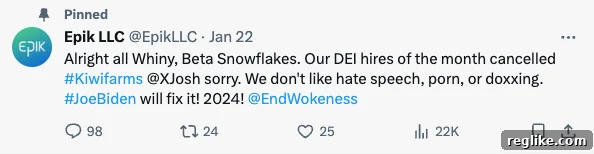
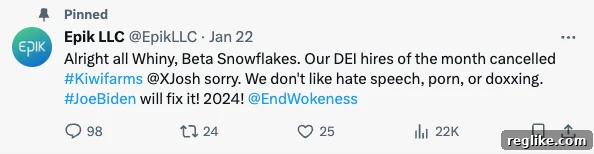
On January 22, Epik’s Twitter account posted a tweet that was, at best, ambiguous. It indicated a general reluctance to host certain domains without offering specific elaboration or defining the parameters of this new policy. The tweet itself remained vague, merely hinting at a new, undefined policy regarding unwelcome content, leaving much to speculation.
Further exacerbating the widespread confusion, a tweet that has since been deleted, posted just the day prior, offered more specific, albeit problematic, reasons for the domain cancellation. This now-removed tweet explicitly cited doxxing and the alleged hosting of child pornography as the grounds for the suspension. It even included a screenshot of the purported violation, accompanying it with a strong statement:
Here’s the complaint received that violated our TOS for doxxing. We believed this to be underage porn also. Regardless, Epik doesn’t want to do business with websites like this. If we misread this we apologize. Did we make the right choice in cancelling KF?
The accusation of hosting child pornography is, without doubt, an extremely grave one, carrying significant legal and ethical weight. However, the Kiwi Farms operator quickly countered these claims, asserting that the individual depicted in the image was 19 years old, which, while not absolving the site of other potential violations, directly challenged Epik’s serious accusation. This immediate dispute raised serious questions about the thoroughness of Epik’s verification process and the veracity of its definitive claims, highlighting the company’s apparent haste and lack of definitive proof in its public condemnations.
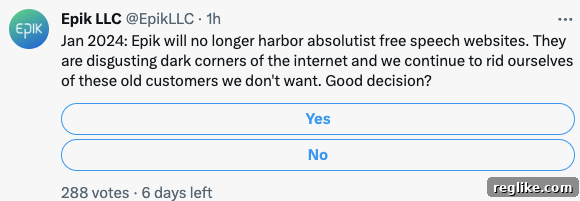
Adding yet another bewildering layer to the already convoluted narrative, Epik’s Twitter account posted a survey shortly after, making an even bolder, and frankly startling, declaration: “Epik will no longer harbor absolutist free speech websites.” This statement directly contradicted its long-standing brand identity and was accompanied by a harsh and dismissive judgment: “They are disgusting dark corners of the internet and we continue to rid ourselves of these old customers we don’t want. Good decision?”
These rapid, conflicting messages and declarations did not cease there. In response to mounting criticism and widespread questions regarding the legality and ethics of their actions, Epik offered a remarkable variety of shifting justifications, each further muddying the waters:
- Initially, the company made a striking claim: “We were forced to help the owner switch to another registrar by US authorities…” This statement implied direct governmental intervention, which, if true, would have lent a significant degree of legitimacy and inevitability to their actions, shifting blame from internal decisions.
- However, when Kiwi Farms’ owner publicly and emphatically refuted any involvement of law enforcement, Epik quickly retracted its statement. In a stunning admission, it stated, “I think you caught us. It was woke liberal employees here cancelling you because they didn’t like the hate speech on your site.” This confession, abruptly blaming internal employee preferences, was a stark and unprofessional contrast to their previous claim and further undermined their rapidly dwindling credibility.
- In yet another bewildering tweet, the company declared, “Yeah. We’re not really into ‘free speech’. The old owners were. That’s not our thing. We offer .25 over cost domain registrations. 9.99 .com’s initially and upon renewal. Did we handle your situation badly? Yes. 100%. You had child porn on your site. We’re sorry We have no agenda.” This statement simultaneously disavowed its historical commitment to free speech, confirmed its past branding, reiterated the grave child pornography accusation (despite prior disputes and the operator’s counter-claim), offered an apology for mishandling, and then bizarrely pivoted to advertising its low domain registration costs. The concluding claim of “no agenda” felt particularly disingenuous and unconvincing given the preceding chaotic and contradictory declarations.
- Recognizing the widespread confusion and likely internal chaos, Epik then softened its tone slightly, making a partial admission of its errors: “We screwed this up many different ways. And are learning. We are trying to establish better processes and guidelines so that we don’t have employees go rogue on us. What is CP? 5 employees see it differently, so we are undergoing some hard questions to try to get better. sorry” This candid admission of internal disarray and the alarming revelation that “5 employees see [child pornography] differently” highlighted a severe lack of clear internal policy, standardized definitions, and adequate training, particularly concerning such a sensitive, legally critical, and morally unambiguous issue.
This cascade of inconsistent, defensive, and often self-incriminating tweets created an undeniable public relations nightmare for Epik. It left both existing customers who valued its former stance and potential new clients wondering what Epik truly stands for, what its current operational philosophy is, and what types of content it will tolerate moving forward. The company’s communication strategy appears to be a reactive, uncoordinated, and ultimately damaging effort rather than a deliberate, well-planned policy shift.
Epik’s Shifting Identity: New Ownership and an Uncertain Future
Epik’s dramatic shift in identity and policy can be partially understood in the broader context of its recent corporate changes. Long known as a controversial domain name registrar and a haven for websites that other, more mainstream registrars might decline to host, Epik itself underwent a significant corporate transition. After reportedly encountering substantial financial difficulties, the company was acquired in June of 2023. Crucially, the identity of the new owner remains undisclosed, adding an opaque and mysterious layer to the current policy upheavals. It is highly plausible, if not probable, that this new, unknown ownership is the driving force behind the aggressive push to redefine Epik’s brand, actively moving it away from its polarizing “free speech absolutist” image towards a more conventional, and perhaps less controversial, market position that might appeal to a broader client base.
The core challenge for Epik lies in successfully navigating this complex transition without completely alienating its historical customer base, who were drawn to its original promise, while simultaneously attracting a new demographic that aligns with its evolving stance. The company’s previous reputation, while appealing to a specific niche, also brought significant public scrutiny, frequent controversy, and potential operational risks. A new owner might logically seek to shed this burdensome baggage and steer the company in a direction that prioritizes stability and mainstream acceptance. However, the current rollout of these significant policy changes has been anything but smooth or strategic, indicating potential internal conflicts or a severe lack of experience in crisis communication and brand management.
The Broader Implications: Domain Registrars, Free Speech, and Digital Ethics in the 21st Century
Beyond Epik’s immediate struggles and internal turmoil, this entire episode underscores a larger, more critical debate concerning the evolving role and inherent responsibility of domain registrars in shaping the internet. Registrars, while not the direct content hosts, provide the fundamental addressing system and infrastructure for websites. Their decisions on who can register, maintain, and transfer a domain name therefore have profound implications for online presence, digital visibility, and ultimately, freedom of speech online.
The concept of “free speech” in the online realm is under constant re-evaluation and redefinition. While enshrined as a fundamental right in many democratic constitutions, its practical application in the digital sphere, especially concerning privately owned platforms and infrastructure providers, is exceptionally complex. Where does the legitimate line between protected speech and harmful content (such as doxxing, harassment, incitement to violence, or illegal material like child exploitation) truly lie? And perhaps more importantly, who is ultimately responsible for drawing and consistently enforcing that crucial line?
Epik’s previous business model enthusiastically embraced a broad, almost unqualified, interpretation of free speech, often at the perceived cost of hosting sites deemed reprehensible or dangerous by significant portions of the public and other internet service providers. Its current, albeit confused and inconsistently applied, attempts to moderate content actively reflect a growing trend among internet infrastructure providers to take more active and interventionist roles in policing online behavior. This trend is driven by a confluence of various factors, including mounting public pressure, evolving regulatory expectations, and a pragmatic desire to avoid direct association with illegal or deeply offensive content, which can severely damage a brand’s reputation and financial viability.
However, this significant shift towards increased moderation also presents its own unique set of challenges and potential pitfalls. Without clear, transparent, consistently applied, and robustly communicated policies, registrars risk effectively becoming arbitrary censors, wielding immense power over who can participate in the online conversation. The alarming confusion within Epik’s own ranks regarding what constitutes “CP” (child pornography) starkly highlights the immense difficulty in establishing universal guidelines and definitions, particularly for nuanced or rapidly evolving forms of online harm. Furthermore, while the practice of “deplatforming” can be an effective and necessary tool against malicious actors and illegal content, it also raises legitimate concerns about potential abuse, censorship creep, and the erosion of fundamental digital rights. The Kiwi Farms operator’s very real threat to sue Epik further complicates matters, illustrating the significant legal and financial risks associated with contentious content moderation decisions.
Ultimately, the entire Epik saga serves as a potent and invaluable case study in the ongoing global struggle to define and enforce the internet’s ethical boundaries. It vividly illuminates the immense pressure on infrastructure providers to responsibly address harmful content, the inherent complexities of implementing consistent and fair moderation policies, and the significant challenges of effectively communicating such fundamental shifts to a diverse global audience. The internet industry as a whole is grappling with these profound questions, and Epik’s turbulent transformation is a stark reminder that clear, principled, and transparent leadership is absolutely essential in this critically important and rapidly evolving digital domain.
As the dust eventually settles from this tumultuous period, and assuming Epik eventually solidifies and clearly communicates its new policies and operational philosophy, it will be absolutely crucial to observe how this transformation impacts its brand image, its market share, and its overall standing within the broader internet governance ecosystem. The days of Epik as an unquestioning, open-door haven for “absolutist free speech” websites appear to be definitively over, but what exactly will take its place, and how successfully it navigates this new identity, remains to be definitively seen.