
Navigating the Dynamic Domain Market: Insights from a Recent Industry Survey
The domain name industry is in constant flux, shaped by technological advancements, evolving business strategies, and shifts in digital consumer behavior. For domain investors, businesses, and online entrepreneurs, staying abreast of these changes is not just beneficial, but essential for making informed decisions. A recent comprehensive survey conducted by Domain Name Wire offers invaluable insights into the current landscape, exploring trends in domain marketplaces, the role of brokers, and future projections for domain values. This deep dive into the survey results aims to unpack the nuances of the market, providing clarity and strategic guidance for anyone involved in the digital real estate world.
Domain Marketplaces: A Central Hub for Digital Assets
Domain marketplaces serve as the primary arenas where domain names are bought, sold, and traded. The survey illuminated interesting patterns regarding how participants interact with these platforms, revealing both established habits and a clear appetite for expansion.
Marketplace Usage Habits: A Preference for Simplicity
A significant finding from the survey indicates that the majority of domain investors tend to concentrate their efforts on a limited number of marketplaces. Specifically, 30% of respondents reported using just one marketplace, while an additional 32% utilized two. This suggests a preference for streamlined operations, potentially driven by factors such as familiarity with a platform’s interface, established trust, or the desire to avoid managing multiple accounts and varying fee structures. Limiting marketplace exposure can simplify portfolio management, allowing sellers to master the intricacies of specific platforms and optimize their listings for maximum visibility within those ecosystems. However, this focused approach also carries the potential risk of narrower reach and missing out on unique buyer segments present on other platforms.
The Shifting Landscape: A Readiness for Expansion
Despite the current tendency towards using fewer platforms, the survey also highlighted a significant willingness to adapt and expand. A notable 58% of respondents indicated that they are considering adding their domains to one or more additional marketplaces in the coming year. This forward-looking sentiment suggests an acknowledgment among sellers that diversification of listing channels could unlock new opportunities. The motivations behind this potential expansion are multifaceted:
- Wider Audience Reach: Different marketplaces attract different types of buyers. Expanding to new platforms can expose domains to a broader and more diverse pool of potential purchasers.
- Niche Market Access: Some marketplaces specialize in certain types of domains (e.g., premium domains, specific TLDs, geographic domains), offering a more targeted audience.
- Competitive Pricing and Features: New or emerging marketplaces may offer more competitive listing fees, innovative selling tools, or better exposure for certain types of inventory.
- Risk Mitigation: Relying on a single platform can be risky; diversifying across multiple marketplaces can mitigate the impact of policy changes, technical issues, or platform-specific market slowdowns.
This trend underscores a dynamic market where sellers are continuously evaluating their strategies to optimize sales and returns.
Listing Strategies: Make Offer vs. Buy Now
The method by which domains are listed — whether at a fixed “buy now” price or as an open “make offer” opportunity — is a crucial strategic decision for sellers. The survey revealed a fascinating split in preferences, with domain sellers almost equally divided between listing the majority of their portfolios as “make offer” (37%) and “buy now” (37%) prices. This near-even distribution was surprising to many, as it challenges the common perception that most sellers prefer the flexibility of negotiation.
The “buy now” option offers simplicity and speed. Buyers know exactly what they need to pay, enabling instant transactions. This strategy often works well for domains with clear market value, strong branding potential, or those priced competitively for quick sale. For sellers, it eliminates the back-and-forth of negotiation, saving time and often resulting in faster sales cycles. It also communicates a clear, confident valuation for the domain.
Conversely, the “make offer” approach caters to the art of negotiation. It allows buyers to propose a price they deem fair, which can be particularly effective for unique, high-value, or less liquid domains where market value might be harder to pinpoint precisely. For sellers, it provides flexibility, allowing them to test the market, gauge buyer interest, and potentially achieve a higher price than a pre-set figure. It also enables sellers to filter out casual inquiries and engage only with serious buyers.
Adding another layer to this complexity, 26% of respondents indicated a balanced approach, splitting their portfolios with approximately half listed at fixed prices and half available for offers. This hybrid strategy allows sellers to leverage the benefits of both methods, applying “buy now” to more straightforward, quick-sale assets and “make offer” to premium or harder-to-value domains. This nuanced approach reflects a sophisticated understanding of market dynamics and portfolio segmentation, catering to diverse buyer behaviors and domain characteristics. The prevalence of these varied strategies highlights the evolving sophistication of domain investors in optimizing their sales processes.
Domain Brokers: Facilitating High-Value Transactions
While marketplaces cater to a broad spectrum of domain sales, domain brokers typically specialize in facilitating high-value or complex transactions, often involving sensitive negotiations and confidential sales. Their role in the ecosystem is distinct, and the survey provided insights into their usage and perceived effectiveness.
Broker Usage: A Selective Partnership
The survey revealed that only 34% of respondents utilized a domain broker to sell a domain name in the previous year. This lower percentage is entirely logical given the nature of broker services. Brokers are inherently selective about the inventory they choose to represent, typically focusing on premium domain names that command substantial prices and require a more hands-on, expert-driven sales approach. This selectivity is driven by several factors:
- Commission-Based Model: Brokers primarily earn through commissions on successful sales, making high-value domains more attractive investments of their time and resources.
- Time and Effort Investment: Brokering a domain involves significant time, market research, outreach, and negotiation expertise, which is justified only for domains with substantial profit potential.
- Confidentiality and Discretion: Many high-profile domain sales require utmost discretion, a service brokers are uniquely positioned to provide, shielding the identities of both buyers and sellers.
Therefore, the lower usage rate reflects the specialized and premium nature of broker services rather than a lack of interest in the concept itself. Brokers serve a crucial niche for specific types of domain assets.
Seeking New Brokerage Partnerships
An intriguing finding was that 42% of respondents who used brokers planned to try a *different* domain broker to sell domains in the coming year. This indicates a dynamic search for optimal brokerage relationships and suggests several underlying reasons:
- Seeking Better Results: Previous brokerage experiences might not have met expectations in terms of sales price, speed, or communication.
- Niche Expertise: Different brokers may have specialized knowledge or connections within specific industries or for particular types of domain names (e.g., tech, finance, geographic).
- Expanding Reach: Sellers might be looking for brokers with a wider network of high-net-worth individuals or corporate buyers.
- Changing Portfolio Needs: As a seller’s domain portfolio evolves, so might their need for different brokerage services.
This willingness to experiment with new brokers highlights the importance of finding the right fit for a given domain asset and the ongoing pursuit of maximizing sales potential within the premium segment of the market.
Domain Values: Projecting the Future of Digital Assets
Perhaps the most eagerly anticipated section of the survey revolved around projections for future domain values. Understanding market sentiment about pricing trends is critical for both current investors and prospective buyers.
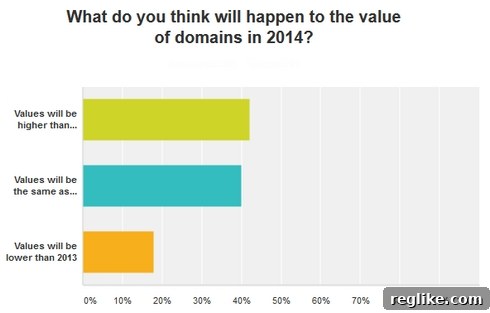
The overall outlook for domain values in the coming year was surprisingly optimistic, reflecting a robust and confident market:
- 42% of respondents expect domain prices to go up.
- 40% anticipate them to remain stable.
- Only 18% believe prices will decrease.
This data paints a picture of a market largely anticipating growth or stability, with a significant majority showing confidence in the appreciation of digital assets. Several factors could contribute to this positive outlook: the increasing digitalization of businesses globally, the finite supply of premium domain names, the rise of new startups constantly seeking strong online identities, and the growing recognition of domains as valuable intangible assets.
The Nuance of New TLDs and .com Dominance
The advent of new generic Top-Level Domains (gTLDs) over the past few years introduced a new layer of complexity to the domain market, prompting discussions about their potential impact on established TLDs, particularly .com. The survey delved into this specific concern, revealing a nuanced perspective.
.com Domains: Resilient in the Face of New Competition
When respondents were asked specifically what new TLDs would do to the value of .com domains, the numbers closely mirrored the overall sentiment for domain values: a significant portion expected .com values to rise or remain stable. This finding powerfully underscores the enduring strength and perceived value of the .com extension. Despite the proliferation of hundreds of new TLDs (like .app, .tech, .shop, .online), .com continues to hold its ground as the undisputed “gold standard” of the internet. Its unparalleled brand recognition, widespread trust, memorability, and historical dominance provide a powerful moat against dilution. Businesses and consumers alike instinctively associate professionalism and authority with a .com address, making it the preferred choice for primary online identities.
Alternative TLDs: Facing Increased Competition
However, the outlook shifts dramatically when considering the impact of new TLDs on the value of “alternative” TLDs (which generally refers to older, established extensions like .net, .org, .info, .biz, and even country-code TLDs in some contexts, as distinct from the newer gTLDs). More than half of the survey respondents expect the values of these .com alternatives to drop in the wake of new TLD launches. This critical distinction highlights a phenomenon often referred to as “the middle ground problem.”
Previously, if a desired .com domain was unavailable, businesses might have opted for a .net or .org as the next best alternative. With the introduction of highly descriptive and relevant new gTLDs, the choice has become more complex. Now, if a .com isn’t available, a company might instead choose a specific and meaningful new gTLD (e.g., example.tech for a technology company, example.app for an application, example.store for an e-commerce venture) rather than an older, less specific alternative like .net. This shift in preference could divert demand away from traditional alternative TLDs, thereby exerting downward pressure on their market value. The perceived “datedness” or lack of specificity of some older alternatives might make them less attractive compared to the fresh, industry-specific options presented by new gTLDs. This forces owners of alternative TLDs to re-evaluate their pricing and marketing strategies, potentially facing a more competitive landscape.
Key Factors Influencing Domain Value
Beyond the impact of new TLDs, several intrinsic and extrinsic factors consistently influence the value of a domain name. Understanding these elements is crucial for anyone seeking to assess, buy, or sell digital real estate:
- Brandability and Memorability: A short, catchy, easy-to-remember domain name is inherently more valuable. It supports branding efforts and reduces marketing spend.
- Keyword Relevance: Domains containing high-volume keywords relevant to a specific industry or product can attract organic search traffic and are highly sought after by businesses in that niche.
- Length and Simplicity: Shorter domains are generally more desirable as they are easier to type, remember, and communicate.
- TLD (Top-Level Domain): As discussed, .com remains supreme, but relevant new gTLDs are gaining traction. The right TLD can significantly enhance a domain’s appeal.
- Age and History: Older domains with a clean history (no spam, good backlinks) can carry more authority and may benefit from established SEO rankings, making them more valuable.
- Traffic and Revenue Potential: Domains that already generate traffic or revenue (e.g., developed websites) command higher prices due to their proven performance.
- Market Trends: The popularity of certain industries, technologies, or keywords can create demand spikes for relevant domains.
Conclusion: Adapting to an Evolving Digital Landscape
The Domain Name Wire survey offers a comprehensive snapshot of a dynamic and evolving domain name market. It highlights a community of investors and sellers who are, on one hand, comfortable with their established tools and processes, and on the other, actively seeking new avenues for growth and optimization. The preference for using a limited number of marketplaces coexists with a strong intention to explore additional platforms, signaling a strategic readiness to adapt to changing market conditions and expand reach. Similarly, the diverse approaches to pricing—whether “make offer” or “buy now”—underscore the strategic depth employed by sellers in valuing and marketing their digital assets.
The insights into domain brokers reinforce their specialized role in handling premium transactions, while the significant interest in exploring new brokerage relationships points to a continuous quest for optimal partnerships and improved sales outcomes. Most importantly, the survey’s projections on domain values provide a largely optimistic outlook, reaffirming the enduring worth of digital real estate in an increasingly online world. While .com domains are expected to maintain their strong position, the emergence of new TLDs is clearly influencing the landscape for older alternative extensions, prompting a re-evaluation of their market position.
For domain investors and businesses, the key takeaway is the imperative to remain agile and informed. Understanding marketplace dynamics, refining listing strategies, leveraging brokers for high-value assets, and staying attuned to the impact of new TLDs are all crucial elements for success. The digital landscape will undoubtedly continue to evolve, but with careful analysis and adaptive strategies, participants in the domain market can confidently navigate its complexities and capitalize on future opportunities.