
.com and .net registry provides added detail about NXD traffic.
Unlocking Value: VeriSign Enhances DomainScore for Deeper NXD Traffic Insights
In the dynamic world of domain names, understanding the invisible currents of internet traffic can be the key to unlocking significant value. For years, domain investors, developers, and businesses have sought reliable data to inform their decisions, especially concerning unregistered domains. Recognizing this critical need, VeriSign, the trusted registry operator for the prominent .com and .net domains, has significantly enhanced its DomainScore tool. This latest update provides unprecedented insight into the traffic patterns of unregistered domains, transforming how we perceive and potentially monetize “NXD” (Non-Existent Domain) traffic.
The Evolving Landscape of NXD Traffic Analysis
NXD traffic refers to the requests made to domain names that are currently unregistered. This phenomenon can arise from various sources: user typos, outdated bookmarks, broken links, residual traffic from expired domains, or even malicious bot activity. For domain investors, capturing and understanding this traffic has long represented a potential goldmine. A domain name that consistently receives a substantial volume of NXD traffic, even before registration, could indicate inherent value, strong brand recall, or a historical reputation that makes it highly attractive for future development or domain parking.
Previously, VeriSign’s DomainScore offered a foundational step in this analysis by providing a relative score indicating the sheer volume of traffic an unregistered domain name received. While this initial scoring system was revolutionary, it came with a significant limitation: it didn’t adequately qualify the type or quality of the traffic. This often led to frustration among registrants who, based on a high DomainScore, invested in a domain only to find that the promised traffic didn’t translate into meaningful engagement, conversions, or revenue. Such traffic often turned out to be largely irrelevant, bot-driven, or from undesirable geographic locations.
DomainScore’s Transformative Updates: Beyond Mere Volume
The latest enhancements to DomainScore directly address these critical shortcomings, moving beyond simple traffic volume to deliver truly actionable intelligence. The update introduces two pivotal data points that profoundly alter the landscape of domain traffic analysis:
- Time-of-Day Traffic Information: This feature reveals when traffic to an unregistered domain typically occurs throughout a 24-hour cycle.
- Geographical Location Information: This data pinpoints the origin of the NXD traffic, specifying countries or regions.
These additions empower users with a much richer context, enabling them to make more informed decisions about domain registration, development, and monetization strategies. The era of blind registration based solely on a numerical score is rapidly drawing to a close.
The Power of Time-of-Day Analytics
Understanding when traffic hits a domain provides invaluable clues about its nature and potential. For instance:
- Identifying Bot vs. Human Traffic: Consistent, uniform traffic spikes at odd hours, or a flat, unvarying distribution, might suggest automated bot activity rather than genuine human interest. Human-driven traffic often shows peaks during typical working hours or evening leisure times, aligning with global internet usage patterns.
- Targeting Specific Audiences: If a domain consistently receives traffic during specific business hours in a particular time zone, it could indicate a professional or industry-specific interest. This insight can guide development efforts, allowing a registrant to tailor content or services to that specific temporal audience.
- Optimizing Monetization: For parked domains, ad networks often perform better during peak human traffic hours. Knowing these peaks allows for better ad placement strategies or dynamic adjustments to maximize click-through rates and revenue.
The visual representation of this data, often through a column chart like the one exemplified below, instantly highlights patterns. Observing “lots of requests but few unique requests” can serve as a critical warning sign. A high volume of requests coupled with a low number of unique visitors often points towards bot traffic or repeated automated pings, which hold little to no commercial value. Conversely, a healthy ratio of requests to unique visitors, especially during typical user activity periods, is a strong indicator of genuine human interest.
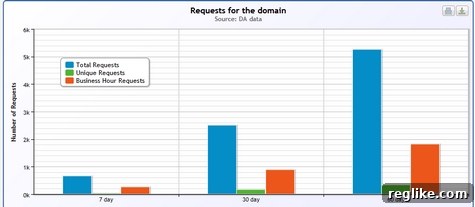
The column chart above, illustrating traffic patterns, is a prime example of the granular insight now available. Such data allows for a qualitative assessment of traffic, moving beyond raw numbers to understand its underlying composition. When traffic consistently arrives at specific times, it might even hint at the type of site or service it was historically associated with, further refining a domain’s potential.
Geographical Insights for Smarter Investments
Perhaps one of the most impactful additions is the geographical location data. The origin of traffic is paramount for several reasons, especially for domain parking and monetization:
- Monetization Efficiency: Not all traffic is created equal in terms of revenue potential. For instance, if you’re planning to park a domain and monetize it through advertising, traffic originating from the United States typically yields significantly higher click values and conversion rates compared to traffic from regions like China or developing nations. This is due to factors such as higher advertiser budgets, stronger consumer purchasing power, and more sophisticated ad markets in Western countries.
- Targeted Development: If a domain shows strong NXD traffic from a specific country or region, it presents a clear opportunity for geo-targeted development. A business could launch a localized version of a website, an e-commerce store, or a service specifically catering to that geographic demographic.
- Legal and Regulatory Considerations: Understanding the origin of traffic can also be crucial for navigating legal and regulatory frameworks. Certain types of content or services might be restricted in particular regions, and knowing where your potential audience resides can help avoid compliance issues.
- Market Demand Indicators: Consistent NXD traffic from a specific geographic location for a particular keyword or phrase can signal unmet market demand in that region, offering a first-mover advantage for businesses.
- Brand Protection: For established brands, monitoring NXD traffic, especially from specific geographies, can help identify potential instances of typosquatting or brand abuse in emerging markets.
The ability to filter and analyze NXD traffic by its geographical origin transforms domain valuation. It allows investors to prioritize domains with a higher percentage of traffic from economically viable regions, leading to more profitable domain parking and development ventures.
Complementary Tools: DomainView Enhancements
Beyond the groundbreaking updates to DomainScore, VeriSign has also directed attention to its other valuable resource: DomainView. This tool provides broader insights into the domain name space, and its latest enhancements further support informed decision-making. VeriSign has specifically improved the user interface (UI) of DomainView, making it more intuitive and user-friendly. Additionally, the historic data capabilities have been strengthened, allowing users to track trends and understand the long-term performance and popularity of domain names over time. These improvements, coupled with the granular insights from DomainScore, create a powerful suite of tools for anyone involved in the domain industry.
Conclusion: A New Era for Domain Intelligence
VeriSign’s commitment to innovation, exemplified by these significant enhancements to DomainScore and DomainView, marks a pivotal moment for the domain name ecosystem. By providing unparalleled depth into NXD traffic—offering insights into its time-of-day patterns and geographical origins—VeriSign has equipped domain investors, registrants, and developers with the intelligence needed to make truly strategic decisions.
No longer will domain acquisitions be based on mere speculation or incomplete data. With the ability to discern the quality, intent, and origin of traffic even before registration, the path to successful domain monetization and development has become clearer and more reliable. These tools foster a more transparent, efficient, and profitable domain marketplace, ensuring that the value inherent in every .com and .net address can be more accurately identified and unlocked.