
Unpacking the .CEO Domain Launch: A Critical Look at Its Marketing Strategy
The introduction of new generic top-level domains (gTLDs) has consistently sparked debate and offered fresh opportunities in the digital landscape. Among these, the .CEO domain was positioned to offer a unique, authoritative online identity for chief executives. However, from its inception, the concept of .ceo as a standalone domain has been met with skepticism by many industry observers. While there’s undeniable potential for a robust, exclusive network tailored for CEOs—a venture in which the company behind .ceo purportedly holds significant social networking expertise—the true value proposition seemed to lie more in the community aspect rather than merely a new domain extension. The early performance and, more critically, the marketing execution for .ceo have only amplified these initial concerns, raising questions about its strategic direction and the fundamental understanding of its target audience.
Early Performance Metrics: A Troubling Start for .CEO
An update from dotCEO, detailing its first 30 days in operation, has provided a window into its initial traction, or rather, the lack thereof. The numbers presented paint a less-than-rosy picture, prompting a deeper dive into the registry’s approach. With a reported 1,023 domain registrations, the raw figure might seem modest but understandable for a niche TLD. However, a significant caveat quickly emerges: 93 of these registrations are categorized as “promo.” This distinction, while commendably disclosed by the registry—a practice not universally adopted by all domain operators who might simply inflate their figures—suggests that a notable portion of these early adopters received their domains for free. This raises immediate questions about organic demand and the perceived value of the .ceo domain in the market. Genuine demand, typically reflected in paid registrations, appears to be considerably lower than the headline number suggests, pointing to an uphill battle for market penetration and sustained growth.
The effectiveness of any domain launch, particularly for a premium gTLD targeting an influential demographic, hinges on meticulous planning, a compelling value proposition, and, above all, flawless execution of its marketing strategy. The .ceo domain, unfortunately, appears to be faltering precisely where it should excel: in its marketing and public presentation. This isn’t merely a minor oversight; it’s a critical misstep that risks undermining the entire project. When a company, especially one with a claimed background in social networking and digital outreach, struggles to effectively market its own product, it sends a powerful, negative signal to potential customers and industry stakeholders alike. The initial numbers, coupled with subsequent observations, suggest a significant disconnect between ambition and operational reality.
Inconsistent Messaging and Questionable Data Representation
Further examination reveals a troubling inconsistency in the messaging disseminated by dotCEO. The homepage of home.ceo, intended as a central hub and showcase for the domain, prominently displays a figure of “3,568 Influential CEOs.” This number starkly contrasts with the recently released registration data, which hovers around a thousand domains. Such a significant discrepancy between public claims and reported statistics is not merely confusing; it actively erodes trust and credibility. For a domain aiming to attract and serve a demographic that values precision, transparency, and authoritative data, presenting conflicting figures is a critical misjudgment. CEOs, by nature of their roles, are astute decision-makers accustomed to scrutinizing data; inconsistent messaging can swiftly lead to skepticism and disengagement.
The issue of conflicting numbers isn’t just about accuracy; it’s about the perceived integrity of the brand. If the core promotional platform cannot maintain consistency in its fundamental metrics, how can potential registrants trust the overarching value proposition or the future stability of the domain? This type of marketing approach, characterized by inflated or vague statistics, often backfires, especially in an era where information is easily verifiable. It signals a lack of transparency and a potential desperation to project an image that doesn’t align with reality. For a TLD designed to confer status and professionalism, such elementary errors in its public-facing communications are particularly damaging.
Flawed Showcase: The Errors Plaguing Home.ceo’s Profiles
The home.ceo site’s credibility takes another severe hit when one examines the very examples it puts forth to showcase the domain’s utility and appeal. The homepage spotlights six “CEO profiles,” ostensibly as exemplars of how the .ceo domain can elevate an executive’s online presence. Yet, these examples are riddled with basic factual errors and operational flaws that undermine their purpose entirely. For instance, one profile incorrectly identifies Christine Jones as the governor of Arizona—a significant factual inaccuracy that immediately calls into question the diligence and accuracy of the content presented. Such errors are not minor typos; they are glaring mistakes that demonstrate a lack of attention to detail, which is particularly egregious when the target audience is composed of leaders who demand precision.
Beyond factual errors, the selection of profiles itself raises eyebrows. A notable five out of the six examples highlighted are individuals deeply entrenched within the domain industry. While these individuals might be early adopters, their prevalence in the showcase suggests a narrow appeal rather than broad, cross-industry adoption. The sole exception to this domain industry bias is an individual who is reportedly compensated to promote .ceo, further diminishing the perceived organic endorsement of the domain. This curated selection, heavy on internal or paid promoters, fails to convincingly demonstrate wide-ranging appeal or genuine utility for the broader CEO community. It comes across as insular and self-serving rather than a true reflection of market success.
Perhaps most damning is the discovery that only four of these six supposedly exemplary domains actually resolve to a live website. This technical failure is unacceptable for any domain registry, let alone one marketing itself to a discerning executive audience. If the showcase examples themselves are broken, what message does that send to potential registrants about the reliability and functionality of the .ceo domain? The problem extends to the very top: even Jodee Rich, the CEO of .CEO himself, has a .ceo web address that reportedly does not resolve. This is an astonishing oversight—a failure of the most basic functionality by the very person leading the initiative. It’s akin to a car manufacturer showcasing a new model whose engine doesn’t start. Such fundamental operational failures are catastrophic for user trust and severely hamper any efforts to establish the .ceo domain as a credible, functional online asset.
The “Hot dotCEO Domains Sold” Section: Misleading Impressions
The issues continue with the emailed update’s section titled “Hot dotCEO Domains Sold,” which features prominent names such as LarryEllison.ceo, alongside CEOs from L’Oréal, McDonald’s, GoDaddy, and Zoetica Media. While these names undeniably carry significant weight and would be impressive endorsements, a closer inspection reveals a pattern that is, once again, misleading. Of these five high-profile examples, only the last one, Zoetica Media, actually resolves to a live website—and even that site is described as essentially a .ceo template page. This suggests a lack of unique, substantive content or true adoption by the individual CEO.
The predominant interpretation for the other four major names—Larry Ellison, and the CEOs of L’Oréal, McDonald’s, and GoDaddy—is that their .ceo domains are purely defensive registrations. Defensive registrations are common practices where companies or high-profile individuals acquire domain names merely to prevent others from registering them and potentially misusing their brand or identity. They rarely indicate an intent to actively develop and use the domain. By listing these as “Hot dotCEO Domains Sold” without clarifying their nature, the registry creates a false impression of active engagement and endorsement from these influential figures. This tactic, while perhaps attempting to leverage brand association, ultimately backfires by highlighting a lack of genuine user adoption and active participation. It underscores a fundamental weakness in the .ceo’s ability to attract active, content-driven users beyond mere placeholders. The widespread use of template pages further evokes memories of other TLDs, like .tel, which struggled to gain traction precisely because their mandated templates offered limited flexibility and creative control, thus hindering widespread adoption and innovation.
“VIP CEO Identities”: A Masterclass in Misdirection
Perhaps the most concerning example of the registry’s marketing strategy is found under the headline “VIP CEO Identities.” This section, featuring an image as seen below, is designed to give the impression that high-profile individuals are actively embracing and building out their .ceo domains.
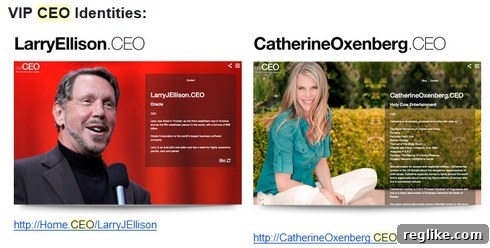
The inclusion of examples like Larry Ellison, particularly after his name appeared in the “Hot dotCEO Domains Sold” section, strongly suggests that these prominent figures are fully on board and have actively developed their respective .ceo websites. The implication is clear: these are successful individuals leveraging the .ceo domain to enhance their digital presence. However, this impression quickly crumbles upon closer inspection. The critical detail lies in the URL displayed beneath the picture. Instead of pointing to LarryEllison.ceo, it directs to one of dotCEO’s own placeholder pages. This subtle but significant manipulation is designed to create a perception of endorsement or active use where none exists. It’s a deliberate attempt to link a high-profile name with the domain without actual participation from that individual.
This tactic is not only disingenuous but also potentially damaging to the brand image of .ceo. Such practices can be perceived as deceptive, exploiting the reputations of others to elevate one’s own product. The revelation that the other three examples in this “VIP CEO Identities” section are also owned by the registry further reinforces this pattern of misleading presentation. It indicates a systemic approach to marketing that prioritizes illusion over substance. For a domain intended for leaders who value authenticity and direct communication, this strategy is profoundly counterproductive. It undermines the very foundation of trust that is essential for a domain like .ceo to flourish among its target demographic. This kind of marketing does not build a legitimate community; it creates a façade, which is ultimately unsustainable and detrimental to long-term growth.
The Broader Marketing Blunder: Missed Opportunities and Future Implications
Given the presumed expertise of the company behind .ceo in social networking and digital marketing, one would have anticipated a robust, multi-channel marketing blitz across various digital platforms. The initial expectations were for a dynamic campaign that would leverage the prestige of the CEO title and the power of a dedicated online identity. Indeed, some marketing efforts are evidently underway, as highlighted by a report from The Register regarding Jodee Rich’s promotional activities. Yet, despite these efforts, the overall campaign appears to be falling flat, failing to resonate with its intended audience or to generate genuine excitement and adoption. This failure isn’t merely about low registration numbers; it’s about a fundamental miscalculation of how to engage and convince a sophisticated and discerning demographic like chief executives.
Effective marketing for a niche TLD like .ceo requires a deep understanding of the target audience’s needs, challenges, and aspirations. CEOs are not typically swayed by generic marketing platitudes or misleading examples. They are looking for tangible value, demonstrable utility, and a platform that genuinely enhances their personal brand and professional network. The current marketing strategy, characterized by inconsistent data, flawed examples, and deceptive presentations, fails on all these fronts. It not only alienates potential users but also undermines the credibility of the entire .ceo initiative. The missed opportunities are significant: instead of showcasing real-world success stories, facilitating genuine networking, or demonstrating clear advantages for personal branding and executive communication, the registry has inadvertently highlighted its own operational shortcomings and a questionable approach to promotional content.
The long-term viability of the .ceo domain hinges on its ability to build a foundation of trust, authenticity, and real utility. Without these, it risks being relegated to the vast digital graveyard of domain extensions that failed to find their footing. For .ceo to succeed, a radical overhaul of its marketing strategy is imperative. This would involve prioritizing transparency, showcasing genuine user adoption, rectifying technical issues, and developing a compelling narrative that truly speaks to the unique needs and aspirations of chief executives globally. Otherwise, this promising concept, backed by a seemingly experienced team, will continue to struggle, failing to live up to its ambitious name and potential.