
Southwest Airlines’ “Bags Fly Free” Strategy: A Masterclass in Marketing and Brand Loyalty
In an era where airlines increasingly rely on ancillary fees to bolster their bottom lines, the practice of charging for checked luggage has become a pervasive, and often contentious, standard across the global airline industry. What began as a strategic move to offset rising fuel costs and economic pressures has evolved into a significant revenue stream, fundamentally altering the economics of air travel. For many passengers, these added charges transform an initially attractive ticket price into a frustratingly higher total cost, leading to widespread dissatisfaction and a constant search for more transparent alternatives. This shift has created a unique opportunity for airlines willing to defy the trend, making their approach to luggage fees a critical differentiator in a highly competitive market.
Amidst this landscape, one airline has consistently carved out a distinct identity by swimming against the current: Southwest Airlines. Renowned for its unique business model and customer-centric approach, Southwest has famously championed a “no bag fee” policy for two checked bags, a stark contrast to nearly every other major carrier. This isn’t just a policy; it’s a cornerstone of their brand identity and a powerful marketing tool. Southwest understands that in a market saturated with hidden fees and complex pricing structures, transparency and simplicity can be incredibly valuable assets. By maintaining its commitment to allowing bags to fly free, Southwest has not only garnered immense customer loyalty but has also positioned itself as a champion for the traveler, effectively turning a common industry pain point into a significant competitive advantage.
The Power of “Bags Fly Free”: Marketing, Messaging, and Domain Acquisition
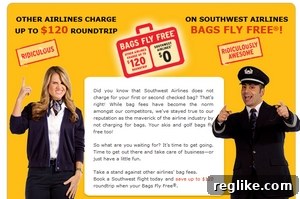
Southwest Airlines has masterfully leveraged its “Bags Fly Free” policy into a highly recognizable and effective marketing campaign. Far from being a quiet policy, it has been transformed into a catchy slogan that permeates their advertising. The airline has produced numerous humorous and memorable commercials that highlight the absurdity of paying for bags, often showcasing the relief and joy of passengers who choose Southwest. These campaigns effectively communicate the value proposition, resonating deeply with consumers who are tired of unexpected costs. The message is clear, simple, and emotionally appealing: fly Southwest, and your bags fly free, no strings attached.
This commitment to its “Bags Fly Free” message recently culminated in a significant strategic move: the acquisition of the BagsFlyFree.com domain name. Until recently, this highly relevant domain was under different ownership, registered to an entity in China and monetized through an advertising platform like Above.com, likely generating passive income from traffic related to bag fees or travel comparisons. However, a recent change in its Whois record reveals that the domain now belongs to Name Advisers, a division of MarkMonitor’s domain acquisition group. For large corporations like Southwest, MarkMonitor serves as their dedicated domain name registrar and brand protection agency, managing their vast portfolio of digital assets and safeguarding their online presence. This acquisition is a testament to Southwest’s commitment to consolidating its brand messaging across all digital touchpoints.
Strategic Implications of the BagsFlyFree.com Domain Acquisition
The acquisition of BagsFlyFree.com opens up a realm of strategic possibilities for Southwest Airlines. It will be particularly interesting to observe how the airline chooses to utilize this valuable digital asset. The most straightforward approach would be to simply forward the domain to an existing page on their main website, such as Southwest.com/bagsflyfree. This would ensure that anyone typing in the intuitive BagsFlyFree.com immediately lands on relevant information about their baggage policy, streamlining the customer journey and reinforcing the brand message.
However, Southwest, known for its innovative marketing, could pursue a more dynamic and engaging strategy. They might develop BagsFlyFree.com into a dedicated, interactive landing page. This page could feature exclusive content, such as new commercials related to the “Bags Fly Free” theme, customer testimonials, or even a mini-game or contest that further emphasizes the benefit. Such a dedicated platform could serve as a powerful conversion tool, directly addressing a common pain point for travelers and showcasing Southwest’s solution in a focused environment. It could also act as a hub for future marketing campaigns, creating a memorable and easily shareable online destination that reinforces their unique value proposition.
The Enduring Value of a Strong, Keyword-Rich Domain Name
In today’s digital-first world, a strong, memorable, and keyword-rich domain name is more than just a web address; it’s a critical component of brand identity, marketing strategy, and overall online presence. The acquisition of BagsFlyFree.com perfectly illustrates this principle. Such a domain offers multiple benefits:
- Enhanced Brand Recognition and Recall: A domain like BagsFlyFree.com is incredibly intuitive and directly communicates a key brand differentiator. It’s easy for customers to remember and associate with Southwest’s unique offering, strengthening brand recall and top-of-mind awareness.
- Direct Navigation and Reduced Friction: For consumers actively searching for airlines without bag fees, or those simply recalling Southwest’s famous slogan, typing BagsFlyFree.com offers a direct path to relevant information, bypassing search engines and potential competitors. This reduces friction in the customer journey.
- SEO Benefits and Authority: While direct SEO benefits from exact-match domains have evolved, a relevant domain still contributes to overall brand authority and can improve click-through rates from search results if it clearly communicates the page’s content. More importantly, it acts as a strong signal to users about the brand’s core offering.
- Marketing Synergy and Campaign Anchor: The domain provides a perfect anchor for integrated marketing campaigns. Whether it’s mentioned in TV ads, social media posts, or print media, BagsFlyFree.com serves as a concise and powerful call to action, reinforcing the marketing message across all channels.
- Competitive Advantage and Brand Protection: Owning such a highly relevant domain prevents competitors or other entities from using it to confuse customers or dilute Southwest’s brand message. It’s a proactive measure in safeguarding digital brand assets.
- Customer Trust and Perception: A clear, professional, and relevant domain name instills confidence and trust in consumers. It signals that the brand is serious about its promises and committed to a seamless online experience.
The Broader Impact of Bag Fees on Customer Experience and Industry Trends
The debate around bag fees extends far beyond a simple transaction; it deeply impacts customer perception, loyalty, and the overall travel experience. For many passengers, the added cost of checking a bag feels like a penalty, transforming what should be an exciting journey into a source of frustration. This frustration often stems from a lack of transparency in initial pricing, where a seemingly cheap flight suddenly becomes expensive once all the “extras” are tallied. Airlines that charge for bags often face criticism for nickel-and-diming customers, leading to negative reviews and a decline in customer satisfaction.
Southwest’s unwavering “Bags Fly Free” policy directly addresses these pain points. By removing the financial uncertainty associated with luggage, Southwest provides a more transparent and predictable travel experience. This approach fosters a sense of fairness and respect for the customer, distinguishing Southwest from its rivals. It transforms a potential source of anxiety into a reason to choose Southwest, creating a powerful emotional connection and reinforcing loyalty. In a crowded marketplace, where product differentiation can be subtle, Southwest’s clear stance on bag fees offers a tangible and highly valued benefit.
The Future of Airline Pricing: A Battle for Transparency and Trust
The ongoing struggle between airlines and passengers over ancillary fees, particularly bag fees, highlights a broader tension in the industry: the balance between maximizing revenue and fostering customer loyalty. While many airlines have found financial success in unbundling services, the long-term impact on brand perception and customer trust remains a critical consideration. Southwest Airlines continues to prove that a different path is viable, and indeed, highly profitable. Their strategy suggests that sometimes, the greatest competitive advantage lies not in adopting industry norms, but in courageously defying them to prioritize the customer experience.
As the travel industry continues to evolve, it will be fascinating to observe whether other airlines will eventually follow Southwest’s lead, at least partially, or if the “unbundled” model will remain dominant. The success of campaigns like “Bags Fly Free” certainly puts pressure on competitors to re-evaluate their own strategies. Ultimately, the battle for customer loyalty will likely be won by those airlines that can best balance competitive pricing with a transparent, predictable, and positive travel experience, ensuring that passengers feel valued rather than merely a source of additional revenue. Southwest’s strategic acquisition of BagsFlyFree.com is not just about a domain name; it’s a powerful reinforcement of its brand promise and a clear signal of its continued commitment to its unique, customer-friendly approach in the skies.