
The Future of Domain Parking: Will Auto-Generated Modules Revolutionize Parked Pages?
In the continually evolving digital landscape, domain names represent significant virtual real estate. For many years, “parked pages” — essentially placeholder websites for unused or undeveloped domains — primarily served as static platforms for displaying advertisements. Their main purpose was to capture and monetize incidental type-in traffic. However, this rudimentary approach is undergoing a profound transformation. Domain name parking companies are relentlessly innovating, driven by the goal of creating parked web sites that not only look more like real, developed online properties but also offer a richer user experience. Services like DomainEmbarking.com, currently in its Beta 2.0 phase, appear to be at the forefront of this movement, hinting at a future where parked domains are dynamic, engaging, and genuinely valuable assets.
The Dynamic History of Automated Website Generation
The Early Era: Promises and Pitfalls of Mass Content Creation
To fully grasp the advancements currently reshaping domain parking, it’s crucial to examine the historical trajectory of automated website generation. A few years ago, a wave of astute entrepreneurs identified a lucrative opportunity: to mass-develop websites based on highly specific niche keywords, thereby quickly penetrating search engine rankings. This period saw the emergence of various software programs designed to auto-generate websites, often comprising thousands of pages, with astonishing speed. The typical workflow involved users submitting a handful of core keywords, which the software would then expand upon by generating lists of related keywords, frequently sourced from services like Overture. Content was subsequently acquired by “screen-scraping” search results and news articles that contained these selected keywords, creating a seemingly vast repository of information.
For a fleeting but impactful period, this strategy proved remarkably effective. Many early adopters, including this author, reported substantial daily earnings, often exceeding $1,000. The appeal was immense: deploy a domain, let the software populate it with content, and watch the advertising revenue accrue. Yet, this era of easy monetization was inherently unsustainable. Major search engines, most notably Google, soon began to implement rigorous quality controls and refine their algorithms to combat what they perceived as low-quality, spammy content. Google’s crackdown unfolded on two primary fronts.
Firstly, the company issued directives to its AdSense publishers, stipulating that these rapidly generated, often thin-content sites failed to meet its quality expectations. This policy shift rapidly diminished the revenue streams for many site owners, signaling the end of an effortlessly profitable strategy. Secondly, Google’s engineers continuously tweaked their search algorithms to identify and demote these mass-produced websites. Key factors, such as the unnatural speed at which a site acquired thousands of pages of content, became red flags. A website appearing with 1,000 pages on its very first day was rightly deemed illegitimate and subsequently penalized or removed from search results.
The Evolution Towards Value-Added Content Aggregation
The stringent actions taken by search engines compelled entrepreneurs to rethink their approach. The new imperative was to create auto-generated websites that not only bypassed penalties but also genuinely offered value to users. This marked a significant paradigm shift from focusing solely on keyword stuffing and quantity to prioritizing relevance, utility, and a semblance of human curation. While numerous companies ventured into this space, some demonstrated superior capabilities in achieving this delicate balance. A compelling example of this advanced generation of auto-generated content was epitomized by services like Kosmix (which later merged with WalmartLabs), showcasing how automation could produce genuinely informative and user-friendly pages.
Consider an auto-generated page crafted by Kosmix, for instance, on the topic of “hybrid cars”:
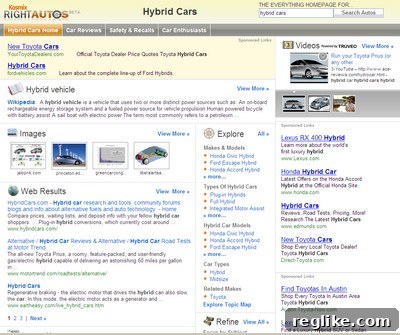
Such a page was a masterclass in content aggregation. It seamlessly integrated freely available, high-quality information from diverse sources: encyclopedic data from Wikipedia, up-to-the-minute search results, relevant headlines from RSS feeds, practical Q&A responses from platforms like Yahoo! Answers, and engaging video content from various sites. The brilliance of this aggregation model was its ability to present a cohesive, comprehensive resource. To the average visitor, such a page felt like a meticulously researched and compiled repository of information, making it virtually indistinguishable from content painstakingly assembled by a human editor or researcher.
Domain Embarking: Ushering in a New Era for Parked Domains
Introducing “Domain Parking on Steroids”
Capitalizing on these sophisticated content aggregation techniques, domain name companies are now applying similar principles to enhance parked domains significantly. Domain Embarking is a key player in this innovative sphere, offering a service that promises to democratize this advanced auto-generation, making it accessible to a wider array of domain owners. The service is aptly described as “domain parking on steroids” because it elevates the concept from mere ad display to the creation of comprehensive, multi-page websites that offer a far richer and more engaging user experience.
A notable feature of Domain Embarking is its preview functionality, which allows potential users to visualize exactly how a site will appear based on their chosen keywords, offering a tangible glimpse into the service’s output before any commitment. For example, generating a site using a keyword such as “Austin” could produce results similar to this illustrative example: view here.
Comprehensive Content Aggregation and Intelligent Site Structure
Domain Embarking’s proprietary system is designed to intelligently pull in a diverse and robust array of content and advertisements from a multitude of sources. These typically include dynamic display advertising from Google AdSense, real-time news headlines pertinent to the chosen keyword, relevant embedded videos, affiliate product listings from e-commerce giants like Amazon.com, unique merchandise from platforms such as CafePress, rich encyclopedic entries from Wikipedia, and compelling visual content from Flickr. This extensive tapestry of information is then meticulously organized and structured into a multi-page website, typically consisting of eight distinct sections. Beyond the central homepage, the system automatically creates dedicated pages for blogs, photos, videos, and other categories directly related to the primary topic, mimicking the structure of a fully developed website.
Addressing the Nuances of Contextual Relevance
Despite the impressive capabilities of computer-generated sites, they invariably face inherent limitations, particularly concerning contextual relevance and semantic understanding. Automation relies heavily on keyword matching, which often struggles to account for the subtle semantic nuances or the precise intent behind a user’s query. The “Austin” example illustrates this challenge perfectly: when “Austin” was selected as the keyword, the user likely intended to reference Austin, Texas—their hometown. However, the automated system, lacking sophisticated contextual awareness, also pulled in affiliate content from Amazon related to individuals named Austin, such as an exercise video featuring “Denise Austin.” This highlights a common hurdle for auto-generated content: the difficulty in distinguishing between homonyms, different meanings of the same keyword, or various entities sharing a name.
Nevertheless, Domain Embarking generally performs commendably in generating visually appealing and well-structured sites, complete with effective internal cross-linking. This sophisticated presentation and content organization are crucial for creating the illusion of a genuinely developed website. However, it is imperative for domain owners to understand that a well-structured and content-rich site does not automatically guarantee high search engine rankings. Search engine optimization (SEO) remains a complex, multi-faceted discipline, with algorithms evaluating a vast array of factors beyond mere content aggregation.
Strategic Decision-Making for Domain Owners: Understanding Traffic Sources
When evaluating the suitability of a service like Domain Embarking, domain owners must carefully consider their primary source of incoming traffic. If a domain name predominantly receives “type-in traffic” — users directly typing the domain name into their browser — then traditional domain parking services that are highly optimized for direct monetization through high click-through rates on advertisements might still yield superior returns. These services are fine-tuned for immediate revenue generation from direct visitors. Conversely, if the overarching objective is to attract traffic primarily from search engines, then Domain Embarking, with its emphasis on creating content-rich, multi-page websites designed to appeal more favorably to search algorithms, presents a compelling and potentially more effective alternative.
Deciphering the Monetization Model: Revenue Share and Transparency
Understanding the Network-Wide Revenue Share Structure
A comprehensive understanding of the revenue model is absolutely critical for any domain owner contemplating the use of auto-generated parking solutions. According to Domain Embarking’s Frequently Asked Questions (F.A.Q.s), the company offers a 50% revenue share derived from the AdSense ads displayed across its entire network. While a straightforward 50% split might initially appear equitable, there’s a crucial caveat. Earnings are not calculated based on the specific performance or click-through rates of individual domains, but rather from the aggregated, average AdSense earnings across the entire Domain Embarking network. This implies that if you own a premium domain associated with highly lucrative pay-per-click (PPC) keywords (e.g., “mortgages,” “insurance quotes,” “personal injury attorney”), a portion of the potentially higher earnings generated from those valuable clicks will, in effect, be distributed to subsidize domains with lower per-click values across the broader network. This aggregated pooling model can substantially dilute the potential earnings for owners of high-value, high-performing domains.
Benchmarking Revenue Share Against Industry Standards
Furthermore, a 50% revenue share for the domain owner is generally considered to be at the lower end when compared to what many other established domain parking companies offer. This percentage becomes even less attractive when one considers Domain Embarking’s own underlying revenue share agreement with Google AdSense. For example, if Domain Embarking, leveraging its extensive portfolio of domains, has successfully negotiated a premium revenue share with Google—say, receiving 60% of what advertisers pay—then your 50% take from Domain Embarking effectively translates to only 30% of the original advertiser payment. Informal surveys and industry insights suggest that most traditional domain parking companies typically pay between 50% and 85% of the revenue they receive from Google or Yahoo, often benefiting from very favorable, high-percentage revenue share agreements with their advertising partners.
Navigating “Premium Share” Features and Benefits
To access and monetize through additional advertising sources beyond AdSense, such as Commission Junction affiliate advertisements or Amazon product links, domain owners are typically required to qualify for a “premium share” status. These alternative advertising types often constitute a significant portion of the content and potential earnings on these advanced auto-generated pages. Domain Embarking offers several distinct pathways for domain owners to achieve this coveted premium status:
- Registrar Registration: Registering your domain directly with Domain Embarking’s preferred or affiliated registrar. This integrates your domain more deeply into their ecosystem.
- Referral Program Participation: Successfully referring other new members to the service. This incentivizes growth for the platform through existing users.
- Monthly Subscription Option: Opting to pay a monthly fee of $9.95 per selected domain. This pathway not only grants immediate premium share status but also uniquely ensures that you receive 100% of the AdSense revenue generated by that specific domain, effectively allowing you to bypass the network-wide averaging system and retain full control over your primary ad earnings.
The choice among these options largely depends on the individual domain owner’s strategic objectives, their investment capacity, and the perceived value of their domain portfolio. For high-performing domains, the $9.95 monthly fee, while an additional cost, could easily be justified by the significant increase in AdSense revenue retention and the expanded monetization opportunities through other affiliate programs.
Strategic Recommendations and The Evolving Landscape of Automated Content
Empowering Domain Owners: The Benefits of Self-Hosting
While Domain Embarking undeniably represents a significant leap forward in making parked pages more dynamic and user-engaging, for domain owners seeking maximum control, unparalleled flexibility, and long-term value creation, an alternative approach may prove even more beneficial: hosting the auto-generated pages on their own servers. This strategic decision unlocks a multitude of advantages and opportunities:
- Unrestricted Customization: The ability to fully customize every aspect of the site, including its design, layout, branding elements, and content beyond the limitations imposed by a third-party service. This allows for complete brand alignment and unique user experiences.
- Advanced Analytics and Optimization: Freedom to implement and integrate sophisticated analytics tools (e.g., Google Analytics, heatmap tools) to gain deeper, proprietary insights into user behavior, traffic patterns, and content performance. This data is crucial for continuous optimization without any external restrictions.
- Effective Repeat Traffic Capture: The capability to deploy advanced strategies specifically designed to convert one-time visitors into loyal, repeat traffic. This is often challenging or impossible on generic parked pages controlled by a third party.
- Direct Lead Generation and Audience Building: Perhaps one of the most invaluable long-term strategies is the ability to integrate features like newsletter sign-up forms or lead capture mechanisms directly into the site. Capturing visitor email addresses creates a direct, proprietary line of communication for future “push-button” marketing efforts, allowing domain owners to cultivate and nurture their own audience, independent of fluctuating search engine algorithms or ad network policies.
While self-hosting requires a greater degree of technical effort and ongoing management, it fundamentally transforms a parked domain from a passive income stream into an active, controllable business asset with significant long-term growth potential.
The Enduring Challenge: Balancing Relevance, Utility, and Search Engine Compliance
The trajectory of auto-generated content is unequivocally moving towards greater sophistication, semantic understanding, and contextual relevance. Companies, often backed by substantial funding and managed by expert teams, are continuously refining algorithms and leveraging advancements in artificial intelligence and natural language generation (NLG) to produce content that is not only coherent but genuinely useful and engaging. However, the fundamental challenge remains constant and ever-present: how to consistently provide highly relevant, truly valuable content that successfully attracts and retains visitors, while simultaneously satisfying the ever-evolving and increasingly stringent quality expectations of major search engines like Google.
The perpetual “cat and mouse” game between automated content generators and sophisticated search engine algorithms will undoubtedly continue indefinitely. Success in this complex and dynamic space hinges upon striking a delicate balance: judiciously leveraging automation for enhanced efficiency and scale, while simultaneously prioritizing an exceptional user experience and ensuring genuine informational value. The future of domain monetization for parked pages will undoubtedly involve even smarter, more adaptive content generation, but it will always be tempered by the fundamental necessity of creating a positive, authentic, and genuinely useful experience for the end-user.