
The digital landscape is constantly evolving, and with it, the strategies companies employ to establish their online presence. In a significant shift from the traditional reliance on .com domains, a growing number of well-funded and innovative companies are opting for alternative top-level domains (TLDs). This trend signals a maturing internet ecosystem where brand relevance, memorability, and semantic fit are increasingly prioritized over a legacy extension. This article delves into this fascinating development, showcasing how savvy businesses are leveraging new generic top-level domains (gTLDs) to carve out unique digital identities and enhance their branding efforts.
For decades, the .com domain reigned supreme, becoming synonymous with credibility and mainstream internet presence. However, as the digital realm expanded, so did the scarcity of desirable .com names. This scarcity, coupled with the introduction of hundreds of new gTLDs, has opened up a world of possibilities for businesses looking to stand out. These new extensions offer a unique opportunity to create domain names that are not only available but also highly descriptive and perfectly aligned with a company’s mission and services. This strategic choice is not just about finding an available name; it’s about making a deliberate branding statement that resonates with the target audience and reinforces the core value proposition.
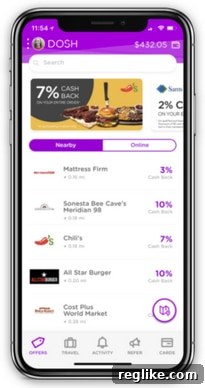
One compelling example of this strategic pivot comes from Austin, Texas, where a dynamic startup named Dosh has made significant waves in the fintech sector. I recently encountered their story and was struck by their forward-thinking approach to digital branding. Dosh, an Austin-based startup, has successfully raised an impressive recently raised $44 million in Series A funding alone, contributing to a substantial total of $57 million in capital, as reported by Crunchbase. This substantial backing from investors underscores the market’s confidence in their innovative business model and execution capabilities.
Dosh operates on a simple yet effective premise: it allows users to link their credit and debit cards to its platform and automatically receive cash back when making purchases at participating merchants. The concept of cash-back rewards isn’t entirely new, but Dosh’s seamless integration, user-friendly app, and robust network of partners have enabled it to achieve remarkable traction. With investors like PayPal on board and millions of users registering within a short period, Dosh has proven its ability to execute its vision effectively, cultivating a loyal user base eager for tangible savings. This success story isn’t just about financial innovation; it’s also deeply intertwined with their smart domain name strategy.
So, how does Dosh’s business acumen connect with domain names? The answer lies in their distinctive choice of digital address: Dosh.cash. This isn’t merely an arbitrary selection; it’s a meticulously chosen domain that perfectly encapsulates the company’s core offering. The .cash TLD immediately communicates the essence of Dosh’s service – providing users with cash back on their everyday spending. It’s an instant brand identifier, a clear and concise message delivered right in the URL. This semantic relevance makes Dosh.cash inherently memorable and reduces any ambiguity about what the company does.
Dosh primarily functions as an app-only platform. When users navigate to Dosh.cash, they are promptly directed to download the mobile application. This app-centric strategy further reinforces the power of their chosen domain. For an app-first company, the domain serves as a gateway to the app store, a digital business card rather than a traditional content-rich website. In this context, a domain that directly speaks to the app’s function is incredibly powerful. It streamlines the user journey, making the purpose of the domain clear even before reaching the landing page. The .cash extension acts as a strong call to action for anyone interested in financial rewards and savings, perfectly aligning with their app’s functionality.
This case vividly illustrates how a top-level domain name can beautifully complement the fundamental purpose of a business. It’s a prime example of strategic branding in the digital age, moving beyond the often-congested .com space to find a domain that is both available and exquisitely relevant. The decision to use Dosh.cash demonstrates a clear understanding of their target audience and the desire to create an unmistakable brand identity that resonates instantly. In a competitive market, such clarity and intentionality can be a significant differentiator, enhancing brand recall and user engagement.
Dosh isn’t an isolated incident. Another prominent Austin-based company, which has also secured substantial financial backing totaling $33 million, has similarly opted for a compelling alternative TLD. This company, uses the domain name Data.world. Their choice of .world further exemplifies the growing trend of businesses leveraging new gTLDs to build powerful and descriptive online brands. For a company operating in the vast and intricate field of data, a domain like Data.world immediately conveys a sense of comprehensiveness, global reach, or a complete “world” of data solutions. It positions the company as an authoritative source or platform for all things data-related, fostering trust and expertise from the first glance.
The strategic advantages of embracing new gTLDs extend far beyond mere availability. While finding a short, memorable, and relevant .com domain can be a daunting and often expensive task, gTLDs offer a vast ocean of possibilities. This expanded choice allows companies to select domain names that are keyword-rich, highly descriptive, and intrinsically linked to their business niche. Consider TLDs like .app, .tech, .shop, .store, .blog, .io, .ai, .cloud, .solutions, .guru, .photography, or .design. Each of these extensions instantly communicates the industry or focus of the website, providing immediate context to potential visitors. This inherent clarity can significantly improve a brand’s online visibility and user experience.
From an SEO perspective, while Google has consistently stated that it treats all gTLDs equally in its ranking algorithms (meaning a .cash domain is not inherently favored or penalized over a .com), the indirect benefits are substantial. A memorable and highly relevant domain name can lead to increased direct traffic, better brand recall, and higher click-through rates in search results as users recognize and trust the brand. Furthermore, a domain that clearly states its purpose can contribute to a stronger brand identity, which in turn fosters positive user signals like longer dwell times and lower bounce rates – all factors that contribute positively to search engine optimization. The goal isn’t just to rank, but to rank for a brand that resonates and converts.
Moreover, choosing a niche-specific gTLD can sometimes be more cost-effective than acquiring a premium .com domain, which might carry a hefty price tag due to its perceived value or historical ownership. This allows startups and growing businesses to allocate their marketing budget more efficiently, investing in content and user experience rather than an exorbitantly priced domain. It also signifies innovation and adaptability, showcasing a company that is forward-thinking and willing to embrace the evolving digital landscape rather than being constrained by outdated conventions. Such choices resonate with modern consumers and tech-savvy investors alike.
Of course, some might raise concerns about user familiarity and trust. For decades, internet users have been conditioned to type “.com” almost instinctively. However, this perception is rapidly changing. Younger generations, in particular, are more accustomed to a diverse array of TLDs, especially with the proliferation of mobile apps and social media platforms where the domain name is often secondary to the app experience. As more established and well-funded companies like Dosh and Data.world adopt these alternative TLDs, they contribute to their normalization, building broader public acceptance and trust. The key is consistent branding and a high-quality service or product behind the domain.
In conclusion, the decision by companies like Dosh and Data.world to embrace alternative TLDs like .cash and .world represents a significant evolutionary step in digital branding. It signals a strategic shift away from the automatic default of .com towards a more intentional and semantically rich approach to online identity. These companies are not just finding available domain names; they are crafting digital addresses that are powerful extensions of their brand, immediately communicating their purpose and value proposition. As the internet continues to expand and diversify, we can expect to see an accelerating trend of businesses leveraging relevant gTLDs to create distinct, memorable, and highly effective online presences. A domain name is no longer just a technical address; it’s a crucial branding asset that, when chosen wisely, can significantly enhance a company’s market position and resonance with its audience.