
Unveiling Key End-User Domain Sales: A Special Market Report
The digital landscape is in constant flux, and at its core, strategic domain name acquisition remains a pivotal element for businesses seeking to establish, protect, and expand their online presence. This special market report delves into a curated selection of recent end-user domain sales, offering an insightful look at notable acquisitions from both publicly reported channels and exclusive, non-disclosed transactions. These sales highlight not only the robust activity within the domain market but also the evolving strategies companies employ to secure valuable digital real estate.
Understanding who is buying which domains, and for what purpose, provides crucial indicators of market trends, brand development strategies, and the enduring value of premium domain names. From global tech giants making strategic plays in emerging sectors to established brands reinforcing their digital fortresses, these transactions underscore the strategic importance of a well-chosen domain name in today’s interconnected world. We’ll explore high-profile deals facilitated by leading platforms like Sedo and Afternic, alongside significant private sales that often go unnoticed but carry immense weight in the industry.
Strategic Acquisitions Driving Digital Growth: Non-Reported Sales Analysis
While many domain sales are openly reported through marketplaces, some of the most impactful acquisitions occur behind the scenes, negotiated privately to serve specific corporate objectives. These non-reported sales often involve substantial investments by major corporations, reflecting their long-term vision and commitment to securing critical digital assets.
IBM’s Visionary Play: SmarterCity.com and SmarterCities.com Acquisition
One of the most compelling non-reported transactions involves technology behemoth IBM. In a move that clearly signals its strategic focus on urban development and intelligent infrastructure, IBM has successfully acquired both SmarterCity.com and SmarterCities.com. These premium domain names were purchased from Justin Godfrey of Domain Investment Services for an impressive sum of $15,000. This acquisition is particularly significant given IBM’s long-standing “Smarter Planet” initiative, which aims to leverage data, analytics, and artificial intelligence to address global challenges, including those faced by urban environments.
The purchase of SmarterCity.com and SmarterCities.com strongly indicates IBM’s intention to solidify its digital footprint within the smart city sector. These domains are not merely website addresses; they are brand anchors, potential platforms for future products, services, and collaborative initiatives related to urban planning, IoT solutions for cities, sustainable development, and advanced infrastructure. For a company like IBM, securing exact-match, descriptive domains like these is a proactive measure to dominate a crucial technological and societal frontier, ensuring brand authority and preventing potential competitive or defensive registrations. The foresight of a domain investor like Justin Godfrey to recognize and hold such valuable assets, anticipating their strategic appeal to a global enterprise, exemplifies the acumen present in the domain investment community.
MallPlaza.com: Expanding Regional Presence to Global Reach
Another noteworthy non-reported sale highlights the trend of regional brands expanding their digital horizons. MallPlaza.cl, a prominent entity in the retail and shopping center sector, has strategically acquired MallPlaza.com for $10,000. This transaction, facilitated through the Afternic platform, underscores the critical importance for established regional businesses to secure their corresponding .com domain. While MallPlaza.cl serves its local market effectively with its country-code top-level domain (ccTLD), the acquisition of the generic .com version provides a universal and globally recognized identifier.
For MallPlaza.cl, MallPlaza.com represents more than just an additional domain; it’s an investment in brand protection, international credibility, and potential future expansion. It mitigates the risk of cybersquatting or a competitor acquiring the more authoritative .com, which could dilute its brand equity or confuse its audience. Furthermore, having the .com allows MallPlaza to present a unified, global brand image, regardless of whether it plans immediate international expansion or simply seeks to reinforce its digital authority within its existing market. This move reflects a broader trend where successful businesses, irrespective of their current geographical focus, recognize the unparalleled value and trust associated with a .com domain.
Key End-User Sales Spotlight: Insights from Sedo Marketplace
Domain marketplaces like Sedo play a crucial role in facilitating a vast array of end-user transactions, offering transparency and a structured environment for buying and selling. The following sales highlight diverse motivations, from brand extension to strategic future-proofing.
Match.com’s Brand Extension: MatchRadio.com
Leading internet dating giant, Match.com, has demonstrated a potential strategic move into new service offerings or content initiatives with its purchase of MatchRadio.com for $1,695. This acquisition suggests an intriguing direction for the dating platform, possibly exploring audio-based content, curated playlists, dating advice podcasts, or even an integrated music streaming service designed to enhance user experience. In the competitive realm of online dating, continuously innovating and expanding features is vital for user engagement and retention.
MatchRadio.com offers a clear, brand-aligned domain for such ventures. The relatively modest price for a domain that perfectly complements a globally recognized brand like Match.com indicates a savvy acquisition. It allows Match.com to either test new concepts in the audio space or solidify its ownership over names that could be relevant to future media consumption habits of its target audience. This is a classic example of a brand leveraging domain acquisition for strategic brand extension and future product development.
Veterans United Home Loans Secures VUBank.com
Veterans United Home Loans, a prominent lender specializing in VA loans for military service members, veterans, and their families, has acquired VUBank.com for $2,000. This purchase opens several strategic avenues for the company. Given the increasing convergence of lending and banking services, VUBank.com could signal Veterans United’s ambitions to expand its financial offerings beyond mortgages into broader banking services, such as checking accounts, savings accounts, or personal loans tailored for its specific clientele.
Alternatively, the acquisition could be a defensive move, protecting its brand from potential competitors or future developments in the financial sector. For a financial institution, a concise and memorable domain like VUBank.com carries significant weight for branding, trust, and ease of recall. It ensures that if the company decides to pivot or expand into banking, it already possesses a prime digital asset that aligns perfectly with such a direction, reinforcing its commitment to serving the financial needs of the veteran community comprehensively.
Russell & Smith Ford Enhances Local Branding with RSFord.com
Local businesses are increasingly recognizing the value of premium, easy-to-remember domain names. Houston, Texas-based car dealer Russell & Smith Ford has made a smart investment by purchasing RSFord.com for 1,799 EUR. While the dealership currently operates under the web address RussellSmithFord.com, the acquisition of RSFord.com provides a shorter, more memorable, and highly brandable alternative.
In the automotive industry, where marketing and advertising play a crucial role, a concise domain like RSFord.com can be invaluable for radio ads, print media, social media handles, and general customer recall. It streamlines branding efforts and makes it easier for customers to access the dealership’s online presence. Many businesses with longer names opt for acronyms or shortened versions as their primary digital identity. This acquisition is a proactive step by Russell & Smith Ford to optimize its online identity, enhance its local marketing efforts, and secure a premium domain that better reflects modern digital consumption habits.
The Mystery Surrounding Cocomo.com: A Case of Anonymous Acquisition
Some domain sales capture attention not just for their value, but for the enigma surrounding the buyer. Such is the case with Cocomo.com, which Sedo sold for a notable $33,000. However, the identity of the new owner remains obscured by a seemingly fabricated WHOIS record.
The screenshot below illustrates the typical red flags associated with anonymous or deliberately obfuscated domain registrations:
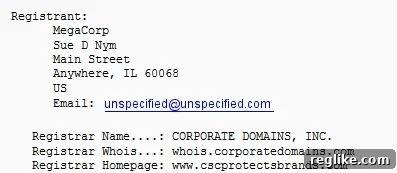
The use of bogus or privacy-shielded information in a WHOIS record, especially for a domain with significant value, raises questions about the buyer’s motivations. While some individuals or companies use privacy services to shield their identity from spammers or competitors, intentionally fake information can be a cause for concern, potentially violating registrar policies or ICANN regulations regarding WHOIS accuracy. It is somewhat surprising that a major corporate domain management service like CSC, which often handles critical digital assets for large enterprises, might be associated with a client using such questionable data.
It’s important to clarify that while the domain’s nameservers are currently pointing to Microsoft hosting services, this detail alone does not confirm Microsoft as the buyer. Large organizations, or even individual clients of major cloud providers, frequently utilize services from companies like Microsoft Azure for hosting and infrastructure. This practice is common and often indicates where the domain is being hosted rather than who legally owns it. The true identity of the buyer of Cocomo.com, and their strategic intent behind this significant acquisition, therefore, remains a compelling mystery within the domain industry. Potential uses could range from a new travel or entertainment venture to a specific product or brand name that requires a memorable and globally appealing domain.
Understanding the Dynamics of End-User Domain Acquisitions
The array of sales discussed in this report—from IBM’s multi-domain strategy to a local Ford dealership’s branding improvement—underscores the diverse motivations behind end-user domain acquisitions. These transactions are not merely financial exchanges; they are strategic investments in a company’s digital future, brand integrity, and competitive positioning.
Key drivers for end-user acquisitions include:
- Brand Protection: Securing variations of a brand name to prevent cybersquatting, trademark infringement, or consumer confusion.
- Market Expansion: Acquiring domains that facilitate entry into new markets, geographies, or product categories.
- Digital Fortification: Consolidating a brand’s online presence, ensuring consistency across all digital touchpoints.
- Marketing & Recall: Investing in shorter, more memorable, and highly relevant domains that improve advertising effectiveness and consumer recall.
- Future-Proofing: Anticipating future trends or potential business pivots by owning domains that align with potential new services or technologies.
- Competitive Advantage: Owning the most authoritative or category-defining domain in a specific niche.
The secondary domain market, facilitated by platforms like Sedo and Afternic, plays a crucial role in enabling these strategic moves. It provides a liquid marketplace where domain investors can bring valuable assets to market, and end-users can acquire the precise digital properties they need to achieve their business objectives. These transactions often highlight the significant value that descriptive, brandable, and keyword-rich .com domains continue to command, reaffirming their status as premier digital assets.
Conclusion: The Enduring Value of Premium Domains
This special edition report on end-user domain sales clearly illustrates the ongoing and growing importance of premium domain names in the global digital economy. Whether it’s a multi-billion dollar corporation like IBM making a strategic move into emerging tech sectors or a well-established regional brand like MallPlaza securing its global identifier, the underlying principle remains constant: a domain name is a foundational element of any successful online strategy.
The diverse nature of these sales—ranging from the high-stakes, non-reported acquisitions to the publicly disclosed purchases on marketplaces—reflects a vibrant and dynamic market. It serves as a testament to the fact that investing in the right digital real estate can yield significant long-term dividends, offering brand protection, market leverage, and a solid foundation for future growth. As businesses continue to navigate an increasingly digital world, the strategic acquisition of powerful domain names will undoubtedly remain a critical component of their success.