
Strategic Domain Ownership: Navigating UDRP and Maximizing Your Portfolio’s Defense
In the dynamic world of digital real estate, domain names represent valuable assets. For domain investors and businesses alike, owning a robust portfolio is crucial, yet it comes with the inherent risk of disputes, particularly those arising from trademark claims. The Uniform Domain-Name Dispute-Resolution Policy (UDRP) and India’s equivalent, the Indian Domain Name Dispute Resolution Policy (INDRP), stand as primary mechanisms for resolving such conflicts. These policies aim to curb “cybersquatting”—the act of registering, trafficking in, or using a domain name with the bad-faith intent to profit from the goodwill of someone else’s trademark.
Navigating the complexities of UDRP and INDRP can be a daunting challenge. A critical aspect often scrutinized in these disputes is the domain owner’s intent at the time of registration and subsequent use. Specifically, complainants frequently attempt to demonstrate that a domain name was registered with the explicit intention of selling it to a legitimate trademark holder, thereby proving “bad faith.” However, innovative solutions are emerging to empower domain owners with stronger defense mechanisms. One such development comes from Efty.com, a prominent domain name selling platform, which has introduced new landing page designs strategically crafted to bolster domain owners’ positions in potential UDRP and INDRP proceedings.
Understanding the UDRP and the “Bad Faith” Criterion
The UDRP, established by the Internet Corporation for Assigned Names and Numbers (ICANN), provides an administrative process for resolving domain name disputes without resorting to court litigation. To succeed in a UDRP complaint, the complainant must prove three essential elements:
- The domain name is identical or confusingly similar to a trademark or service mark in which the complainant has rights.
- The domain name holder has no rights or legitimate interests in respect of the domain name.
- The domain name has been registered and is being used in bad faith.
Of these three elements, “bad faith” is often the most contentious and challenging to prove conclusively. Evidence of bad faith can manifest in various ways, but a common strategy for complainants is to show that the respondent registered the domain name primarily for the purpose of selling, renting, or otherwise transferring the domain name registration to the complainant who is the owner of the trademark or service mark or to a competitor of that complainant, for valuable consideration in excess of your documented out-of-pocket costs directly related to the domain name.
Traditionally, a landing page explicitly stating “This Domain Name Is For Sale” could be interpreted by UDRP panelists as direct evidence of an intent to sell. While not automatically indicative of bad faith cybersquatting, especially if the domain is generic or descriptive, such a clear declaration could complicate a respondent’s defense, particularly when faced with a strong trademark claim. The key lies in demonstrating legitimate use or holding, rather than mere speculative registration targeting a trademark.
Efty’s Strategic Shift: From “Is For Sale” to “May Be For Sale”
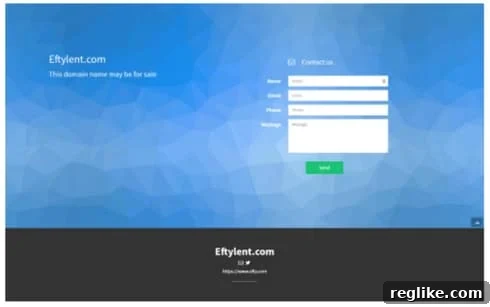
Recognizing this critical vulnerability, Efty.com has rolled out innovative landing page designs engineered to introduce a crucial layer of ambiguity regarding the intent to sell. Instead of making an unequivocal declaration, these new landers subtly rephrase the message to indicate that the domain name “may be for sale.” This seemingly minor linguistic adjustment carries significant weight in the context of domain name disputes.
The distinction between “is for sale” and “may be for sale” is not merely semantic; it represents a strategic legal nuance. An affirmative statement (“is for sale”) leaves little room for interpretation regarding the owner’s immediate intention. Conversely, “may be for sale” implies a possibility, a receptiveness to offers, rather than an active, predetermined intent to sell. This subtle shift places a higher burden on the complainant to prove bad faith, as they can no longer point to an explicit, unambiguous statement of intent to sell on the landing page itself. It forces complainants to look for additional, independent evidence of bad faith, rather than relying solely on the landing page copy.
This approach is particularly valuable for generic or descriptive domain names that coincidentally align with a trademark. For such domains, an owner might genuinely be open to selling without having registered it specifically to profit from a particular brand. By using “may be for sale,” Efty empowers domain owners to communicate interest in a transaction without inadvertently providing ammunition for a cybersquatting claim. These new designs typically maintain a clean, professional aesthetic, focusing on a clear call-to-action for inquiries without explicitly signaling a definitive intent to liquidate the asset.
The efficacy of this nuanced wording in UDRP cases will largely depend on the specific panelist and the broader context of the dispute, including how the domain owner responds to inquiries and defends their position. However, providing a less definitive statement from the outset certainly strengthens the domain owner’s standing by creating interpretive flexibility.
The INDRP Approach: “Business Inquiries” Only
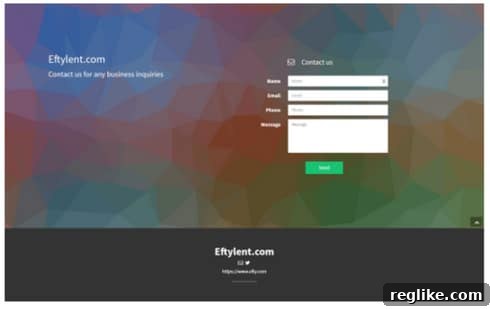
For domain names under the .in ccTLD, the Indian Domain Name Dispute Resolution Policy (INDRP) governs disputes. While sharing similarities with the UDRP, INDRP has its own procedural nuances and often presents unique challenges for domain owners. Recognizing this, Efty has developed an even more conservative approach for its INDRP-optimized landing pages.
These specialized INDRP landers go a step further than their UDRP counterparts: they do not even include the phrase “may be for sale.” Instead, they feature only a contact form for “business inquiries.” This strategy represents an extreme form of defensive posturing, effectively removing any direct mention of a potential sale from the public-facing page. By reframing the interaction as a general “business inquiry,” the domain owner avoids any implication of intent to sell, particularly to a trademark holder.
This minimalist approach significantly raises the bar for complainants attempting to prove bad faith under INDRP. Without any textual evidence suggesting a sale, complainants are forced to rely entirely on external factors, such as the timing of registration relative to trademark use, the nature of the domain name itself, or any direct communications with the domain owner. This strategy makes it considerably more difficult to establish the “intent to sell” component of a cybersquatting claim, offering a robust shield for domain owners against what can sometimes be an unpredictable arbitration process.
Beyond the Landing Page: A Holistic Defense Strategy
While the content of your domain’s landing page is an important piece of the puzzle, it is crucial to remember that it is only one factor considered in UDRP and INDRP proceedings. A truly robust defense against cybersquatting allegations requires a comprehensive strategy that goes beyond mere wording on a page. Domain owners must be prepared to demonstrate legitimate rights and interests in the domain name, and the absence of bad-faith registration and use.
Other vital elements of a strong UDRP defense include:
- Evidence of Legitimate Use: One of the most effective ways to counter a bad-faith claim is to show that the domain name is being used for a legitimate purpose, unrelated to the complainant’s trademark. This could include developing content relevant to a generic term, hosting a blog on a descriptive phrase, or even simply using the domain for personal email.
- Pay-Per-Click (PPC) Advertising: Counterintuitively, sometimes adding relevant pay-per-click ads to your landing page can actually *help* your UDRP defense. If the ads are for generic goods or services that align with the dictionary meaning of the domain name (e.g., ads for “travel insurance” on travelinsurance.com), they can demonstrate that the domain is being used for a bona fide commercial purpose. This shows that the owner is monetizing the generic nature of the domain, not targeting a specific trademark.
- Prior Rights or Registration: If you registered the domain name before the complainant acquired trademark rights, or if you can demonstrate a legitimate interest in the name (e.g., it’s your name, a commonly used phrase, or a geographic location), this can strongly support your case.
- Generic or Descriptive Nature: Domains that are generic or descriptive terms are inherently less likely to be considered cybersquatting, as they hold common meaning independent of any specific brand. Demonstrating that your domain falls into this category can be a powerful defense.
- Lack of Targeting: Proving that you had no knowledge of the complainant’s trademark at the time of registration, or that you did not specifically intend to target their brand, can be critical. This is where ambiguous landing page wording helps, as it avoids explicitly inviting offers from trademark holders.
SEO Best Practices and Proactive Domain Portfolio Management
For domain investors and businesses managing significant portfolios, adopting proactive measures is paramount. Leveraging tools like Efty’s new landing pages is a smart component of an overall SEO-friendly and dispute-resilient strategy. To further fortify your domain assets, consider these best practices:
- Due Diligence: Before acquiring any domain name, conduct thorough trademark searches to identify potential conflicts. This preemptive step can save considerable time, money, and legal headaches down the line.
- Categorize Your Domains: Understand the risk profile of each domain in your portfolio. Generic domains might require a different landing page strategy than exact-match domains that coincidentally align with a lesser-known trademark.
- Consistent Messaging: Ensure that your landing page content, any direct communications regarding the domain, and your overall online presence align to present a consistent narrative of legitimate use or holding.
- Maintain Records: Keep meticulous records of your domain acquisition, development efforts, and any communications related to offers or inquiries. This documentation can be invaluable evidence in a dispute.
- Educate Yourself: Stay informed about the latest developments in domain law, UDRP precedents, and best practices for domain management. Knowledge is your best defense.
The Evolving Landscape of Domain Disputes
The digital landscape is constantly evolving, and with it, the strategies employed in domain name disputes. Platforms like Efty are at the forefront of this evolution, providing domain owners with increasingly sophisticated tools to protect their investments. The shift from definitive “for sale” declarations to more nuanced “may be for sale” or “business inquiries” reflects a growing understanding of the legal implications of online communication.
These new options are not just minor design updates; they represent a strategic advantage for domain owners who might find their assets targeted by trademark holders. By proactively minimizing linguistic liabilities and focusing on a holistic defense, domain investors can significantly reduce their exposure to UDRP and INDRP losses, ensuring the long-term viability and profitability of their digital real estate portfolios. As domain values continue to climb, such protective measures become not just advisable, but absolutely essential for secure and strategic domain ownership.
Conclusion
Efty’s introduction of new landing page designs marks a significant step forward in empowering domain owners to navigate the complex world of UDRP and INDRP disputes. By strategically rephrasing or removing explicit “for sale” indicators, these pages help to create a more defensible position against claims of bad-faith intent. While the landing page is but one piece of a larger puzzle, it is a crucial one that can set the tone for a dispute. Coupled with a comprehensive understanding of UDRP criteria, meticulous record-keeping, and proactive portfolio management, these new tools offer domain investors a robust framework for protecting their valuable digital assets and fostering a more secure and profitable future in the domain market.