
Uber’s Strategic Move: Acquiring UberSucks.com for Brand Protection
In a fascinating turn of events that highlights the complexities of digital brand management, ride-hailing giant Uber has strategically acquired the domain name UberSucks.com. This significant move comes after a period of intense scrutiny and public relations challenges for the company, making the acquisition far more than a simple domain registration; it’s a calculated maneuver in the ongoing battle for brand reputation in the digital realm.
The past few years have presented Uber with a series of formidable hurdles, ranging from internal culture clashes to external regulatory battles. Amidst this backdrop of controversy, the ownership of a domain explicitly designed to criticize the company carries considerable weight. By bringing UberSucks.com under its control, Uber is not only neutralizing a potential hub for dissent but also making a powerful statement about its commitment to managing its online narrative.
A Tumultuous Period for the Ride-Hailing Innovator
Before delving into the intriguing history of UberSucks.com, it’s crucial to understand the context in which this acquisition occurred. Uber has, at various times, faced a barrage of criticism and PR nightmares that have collectively challenged its public image and operational ethics. These challenges created an environment ripe for critical domains to thrive, giving rise to platforms where user dissatisfaction could be amplified.
The Controversies That Shaped Uber’s Recent History
The controversies impacting Uber spanned several critical areas, each contributing to a perception of a company struggling with its identity and responsibilities. These incidents fueled public discussions and often led to calls for boycotts or increased regulation, intensifying the need for robust brand protection strategies.
- Initial Immigration Order Backlash: One of the earliest major PR crises for Uber erupted in response to President Trump’s initial immigration order. Uber’s perceived actions during a taxi strike at JFK Airport, interpreted by many as undermining the strike, led to widespread outrage. The hashtag #DeleteUber trended globally, resulting in a significant number of user account deletions and a profound dent in the company’s public image. This event underscored the hypersensitivity of public sentiment and the speed at which a brand’s reputation can be damaged in the age of social media.
- Sexual Harassment Allegations and Culture: Perhaps the most damaging blow to Uber’s reputation came with the detailed allegations of sexual harassment and a toxic workplace culture, notably brought to light by former engineer Susan Fowler. Her widely read blog post ignited a firestorm, leading to multiple internal investigations, the dismissal of numerous employees, and a complete overhaul of the company’s leadership and HR practices. These revelations painted a picture of a company where growth was prioritized over employee well-being and ethical conduct, forcing a reckoning with its core values.
- CEO Travis Kalanick’s Heated Exchange: Further eroding public trust was the emergence of a video showing then-CEO Travis Kalanick arguing heatedly with an Uber driver about fare cuts. The incident, caught on dashcam, showcased a leader seemingly out of touch with the concerns of the very drivers whose livelihoods depended on his company. Kalanick later issued an apology, acknowledging his need for leadership help, but the damage to his and Uber’s image as a driver-friendly platform was already done. It highlighted the challenges of balancing corporate strategy with the ground-level impact on its workforce.
- The “Greyball” Program Revelation: Another ethical controversy involved the revelation of Uber’s “Greyball” program. This sophisticated tool was designed to identify and circumvent regulatory authorities in cities where Uber operated either illegally or in defiance of local regulations. By showing a fake version of the Uber app to specific individuals identified as city officials or regulators, the company actively evaded enforcement. This program sparked serious legal and ethical questions about corporate accountability and challenged the company’s commitment to operating within legal frameworks.
These incidents, occurring in relatively quick succession, created a challenging environment for Uber to navigate. Each controversy added another layer of complexity to its public relations strategy, making the control of any critical online presence, such as UberSucks.com, increasingly vital for maintaining a semblance of brand integrity.
The Curious Case of UberSucks.com: A Domain’s Journey
The domain UberSucks.com itself has a rich and somewhat ironic history, reflecting changing attitudes towards Uber over the years. Its journey through various owners and intentions perfectly illustrates the dynamic nature of online criticism and the importance of domain monitoring for major corporations.
A Domain with a History of Discontent
The initial registration of UberSucks.com dates back to 2010, long before Uber became the global powerhouse it is today. In its earliest incarnation, the website displayed a surprisingly whimsical message:
“No it Doesn’t 😉”
This simple, almost playful defiance of the domain’s name suggested a nuanced perspective, perhaps from an early Uber enthusiast or someone poking fun at the nascent service. It was a minimalist approach to a potentially controversial name, indicating that the domain’s power had yet to be fully realized.
However, the domain’s purpose evolved significantly over time. After its initial registration expired, it was picked up by a new owner in January 2016. This individual, opting for Whois privacy to shield their identity, transformed UberSucks.com into a platform with a more direct and critical agenda: a forum for aggrieved Uber drivers. This shift marked a pivotal moment, as the domain moved from a lighthearted comment to a genuine hub for organized criticism and shared grievances, becoming a potential thorn in Uber’s side.
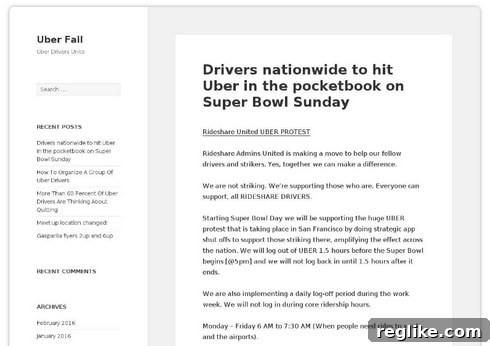
The existence of such a platform, dedicated to aggregating negative experiences from its core service providers, presented a tangible threat to Uber’s brand. It offered a centralized location for negative publicity and could potentially influence public perception and driver recruitment. Yet, like its predecessor, this iteration of UberSucks.com eventually fell victim to domain expiration.
The domain owner let the registration lapse earlier this year. The domain had been registered with BlueHost, a web hosting company known to have a partnership with GoDaddy for the management of expired domain names. This sequence of events created a window of opportunity that Uber, through its sophisticated brand protection mechanisms, was quick to seize.
Brand Protection in the Digital Age: Why Uber Acted
The acquisition of UberSucks.com is a textbook example of proactive brand protection in the digital landscape. For major corporations, managing their online presence extends far beyond simply owning their primary domain; it involves monitoring, acquiring, and neutralizing any digital assets that could potentially harm their reputation.
The Value of Defensive Domain Registrations
Companies like Uber understand that in an era where online sentiment can rapidly sway public opinion and impact market share, defensive domain registrations are not luxuries but necessities. Owning domains that contain negative keywords or are direct criticisms, even if never actively used, serves several critical purposes:
- Shielding Brand Reputation: The most obvious benefit is preventing malicious actors or organized groups from creating a prominent platform to spread negative information, false claims, or damaging content under a highly visible, critical domain name.
- Controlling the Narrative: By owning a critical domain, a company can ensure that if anyone searches for “Uber sucks,” they won’t immediately land on a hostile website. While it doesn’t eliminate criticism, it removes a centralized, easily accessible outlet for it, thereby giving the company more control over its digital narrative.
- Preventing Misinformation: Uncontrolled domains can become breeding grounds for misinformation, rumors, or even phishing attempts disguised as legitimate critique sites. Owning such domains mitigates these risks, protecting both the brand and its users.
In this instance, Uber’s brand protection domain name registrar, MarkMonitor, played a crucial role. MarkMonitor is a leading provider of enterprise brand protection solutions, specializing in digital asset management, domain name management, and anti-counterfeiting services. Their expertise lies in identifying and securing domains that could pose a threat to a brand’s integrity. As such, MarkMonitor interceded at the end of the expiration cycle to secure UberSucks.com. The domain’s Whois record currently lists “BrandCertified” as the registrant, which is one of MarkMonitor’s affiliated companies, confirming their involvement in this strategic acquisition.
Understanding Domain Expiration and Redemption
The process by which Uber acquired UberSucks.com is a common but often misunderstood aspect of domain name management. When a domain name expires, it doesn’t immediately become available for re-registration. There’s a multi-stage lifecycle designed to give the original owner a chance to renew, and then, if not renewed, to facilitate its eventual release or acquisition by others.
Typically, after the expiration date, a domain enters a “renewal grace period,” which can last anywhere from 0 to 45 days, depending on the registrar. During this time, the original owner can usually renew the domain at the standard rate. If not renewed, the domain then enters a “redemption grace period,” which commonly lasts for 30 days. During this phase, the domain can still be recovered by the original owner, but usually at a higher “redemption fee.” If the domain isn’t reclaimed during redemption, it then enters a “pending delete” status for a few days before finally being released back into the public pool for general registration. It is often during or immediately after the redemption grace period, sometimes through backorder services or strategic partnerships, that entities like MarkMonitor can intervene to acquire desirable domains for their clients.
Given the partnership between BlueHost (the previous registrar) and GoDaddy for expired domains, it’s highly probable that Uber, through MarkMonitor, was able to secure the domain through a direct acquisition process after it moved past the initial grace periods. This proactive monitoring and timely intervention underscore the sophistication required for effective brand protection in the digital landscape.
What Owning UberSucks.com Means for Uber
The acquisition of UberSucks.com is more than just a symbolic victory; it’s a strategic move with multiple implications for Uber’s ongoing efforts to rebuild its brand and navigate its complex public image.
A Symbolic Victory or Strategic Move?
While some might view this acquisition as merely symbolic, it holds significant strategic value. By owning UberSucks.com, Uber effectively prevents the creation of a high-profile, easily discoverable hub for organized criticism. It centralizes any potential future negative content under its own control, allowing the company to potentially redirect visitors or, at the very least, prevent the domain from being used in a way that directly harms its brand. This doesn’t silence critics entirely, but it certainly makes it harder for them to coalesce under a prominent, intuitive domain name.
This move also signals Uber’s commitment to proactive brand management. It demonstrates to investors, partners, and the public that the company is actively engaged in protecting its digital assets and reputation, even in the face of ongoing challenges. In a highly competitive market where public trust is paramount, such actions contribute to a more robust and resilient brand image.
The Broader Picture of Brand Management
The acquisition of UberSucks.com fits into a much broader strategy of brand management and reputation repair that Uber has undertaken. After its series of controversies, the company has made concerted efforts to change its corporate culture, improve driver relations, and adhere more closely to regulatory standards. Controlling critical domains is another layer in this comprehensive approach, ensuring that external criticism is managed as effectively as internal reforms.
For other brands, Uber’s move serves as a valuable precedent. It highlights the importance of not just securing positive or neutral domain names but also actively monitoring and, if necessary, acquiring negative ones. In an age where customer feedback, both positive and negative, is instantly shareable, managing all facets of a brand’s online presence is crucial for long-term success and stability.
Beyond .com: The Uber.sucks Connection
Interestingly, Uber’s brand protection strategy extends beyond the traditional .com top-level domain (TLD). For those wondering, Uber also owns Uber.sucks, a domain under the more recently introduced .sucks TLD.
Exploring the .sucks TLD
The .sucks TLD was introduced as part of a broader expansion of generic top-level domains, offering businesses and individuals new ways to brand themselves online. However, .sucks was specifically designed to be controversial, intended to serve as a platform for criticism or humorous dissent. Its very existence sparked debates among brand managers and intellectual property experts, as companies were often faced with the dilemma of acquiring their brand.sucks domain to prevent misuse, often at a premium cost.
Uber’s Proactive Move with Uber.sucks
Uber’s ownership of Uber.sucks demonstrates foresight and an early understanding of the potential threats posed by new TLDs. By acquiring this domain when it became available, Uber proactively prevented anyone from using the highly evocative “.sucks” extension to host negative content. This acquisition likely occurred earlier than UberSucks.com, showcasing a consistent strategy to corner potential avenues of criticism.
Comparing UberSucks.com and Uber.sucks
While both domains serve a similar purpose in brand protection, their acquisition context differs slightly. UberSucks.com was an existing domain with a history, acquired after it expired. Uber.sucks, on the other hand, was likely a proactive registration immediately after the .sucks TLD became available, specifically to prevent its use by third parties. Both demonstrate a comprehensive approach to managing online reputation, reflecting Uber’s dedication to defending its brand across various digital fronts, from legacy domains to newer, more provocative TLDs.
Conclusion: A Strategic Investment in Brand Future
The acquisition of UberSucks.com by Uber is a compelling case study in modern brand management and digital asset protection. It underscores the critical importance for companies to not only build positive online presences but also to actively monitor and control potential sources of negative sentiment. In an era where reputation can be made or broken online in moments, strategic domain acquisitions are an integral part of maintaining brand integrity and trust.
For Uber, a company that has faced its share of public scrutiny, taking ownership of UberSucks.com represents a calculated step towards consolidating its digital footprint and proactively managing its narrative. It’s a clear signal that the ride-hailing giant is investing in its brand’s future, ensuring that critical online spaces, however ironically named, remain within its sphere of influence.