
Estibot performs well for high-value one-word .com domains but is less reliable for multi-word names.
This piece is part of Domain Name Wire’s review series on automated domain appraisal tools.
Estibot is the longest-running automated domain appraisal service still in continuous operation. It attracts criticism when its valuations don’t match expectations, but it remains a scalable solution for analyzing large portfolios. Beyond a single-dollar estimate, Estibot delivers multiple data points that can help identify mispriced domains and potential opportunities across many names.
Each appraisal provides a concise summary of why the name has value, TLD availability, comparable sales, and search and advertising metrics. Some of those comparable sales can feel dated or tangential, and certain search data sources it still uses are quite old, which is a valid concern when interpreting results.
This year Estibot introduced an updated algorithm designed to better evaluate two- to four-word .com names. Our review considers values from both the legacy and the new model.
Two-word brandable domains
Two-word brandables are the most commonly traded domain type, so they are an important test for appraisal engines. We examined two representative sales that sit in the typical mid-market range: MakeMatter.com (sold for $15,000) and PressBridge.com (sold for $5,000). These examples were chosen to avoid outliers and reflect realistic expectations for two-word dictionary combinations.
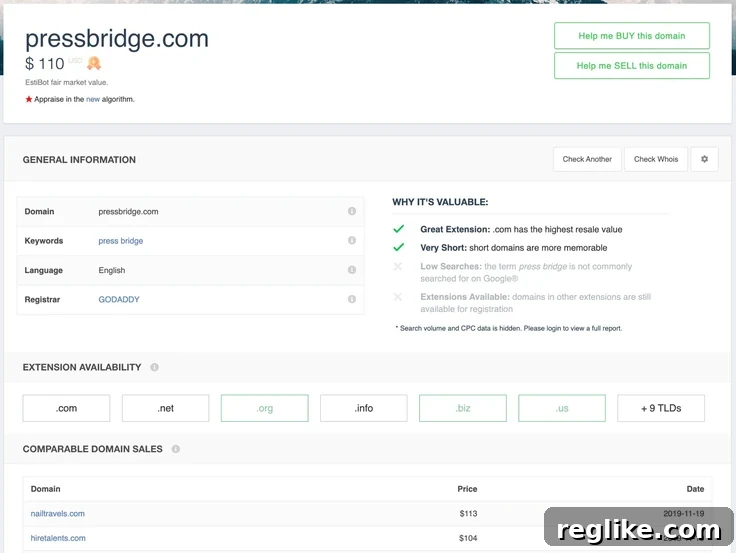
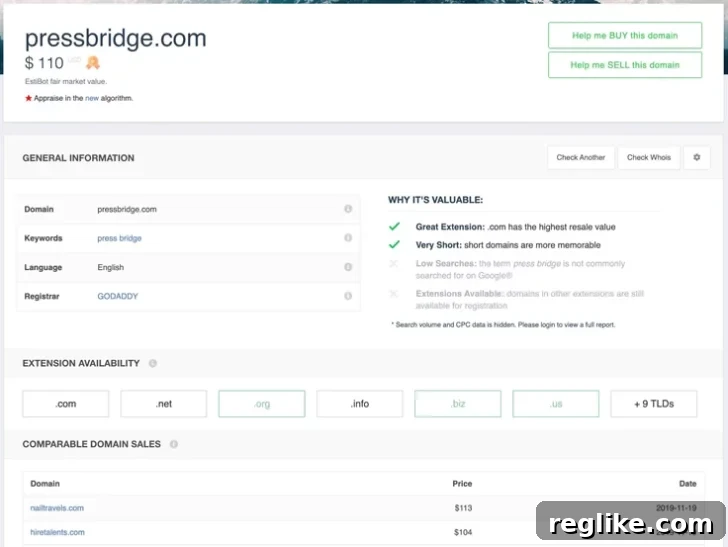
Despite the new algorithm, Estibot significantly underpriced these domains. MakeMatter.com received appraisals of $310 (old algorithm) and $314 (new algorithm). PressBridge.com was appraised at $110 by both versions. Those estimates fall well below the actual sale prices and do not reflect the auction outcomes or offers these names attracted.
To broaden the check, one reviewer examined eleven two-word or keyword-plus-suffix/prefix .com sales from the past year. The updated model improved results but still undervalued many names. Five of the eleven were appraised below $200, and one was given a zero valuation, despite real sale prices ranging from $2,000 to $10,000. In one notable case, a domain that generated multiple offers and ultimately sold on an installment deal with a roughly $30,000 total yielded an Estibot appraisal of $2,024 under the new model (compared to $25 under the old).
On the positive side, Estibot can correctly judge clearly weak names: an unregistered name with a decent keyword—CloudToaster.com—received a $0 valuation, which aligned with expectations about its lack of commercial appeal.
One-word, high-value .coms
One-word brandable .coms are notoriously difficult to value because their final price often depends on the buyer pool and seller motivation. We tested Dragonfly.com, a one-word sale handled under NDA. While the precise sale amount is confidential, context from related broker activity suggests a seven-figure outcome, and Estibot appraised Dragonfly.com at $684,000 on its legacy model and $773,000 on the new model.
High-value single-word names are where Estibot performs comparatively well. These domains are less about predictable metrics and more about perceived brand potential and buyer intent, which the tool approximates better for single-word dictionary terms than for many multi-word names.
Popular ccTLDs: .io and .ai
Country-code TLDs that act like generic extensions—especially .io and .ai—are in high demand among startups, so accurate valuations matter. We tested a one-word .io and a plural .ai.
Expedite.io, which sold for $14,995, was valued by Estibot at $270—an estimate far below the sale price. Another one-word .io bought at auction for $548 was appraised at $140. Conversely, kickers.ai, sold for $8,000, was appraised at $9,300, which was close to its actual outcome. Given how fast .ai demand has risen, appraisals in this space can easily lag market sentiment, but Estibot did hit a reasonable number for the .ai example.
Exact-match descriptive domains
Category-defining exact-match names can command major prices when they align with a large online business model. WaterFilters.com is a clear example—it’s listed at $3.5 million and represents an active, sizable retail niche. Estibot’s new algorithm valued it at $33,104, a figure far lower than some other appraisal tools provided. Our broader testing across appraisal services returned values for this name ranging from around $18,000 up to $2.5 million, highlighting the wide variance among automated valuations for descriptive, commercial keywords.
Three- and four-letter domains
Short letter combinations remain among the most liquid and tradable categories. We tested both pronounceable and non-pronounceable examples. Dujo.com, a pronounceable CVCV four-letter .com listed on Afternic for $36,000, received an Estibot valuation of $12,672—recognizing value but below the listing. MOTG.com, a non-pronounceable four-letter sale reported at $14,888, was appraised at $10,222.
For the three-letter example VJN.com, listed for $39,000, Estibot returned a $126,000 valuation, despite showing the listing price on the appraisal page. While a three-letter string could fetch a high price under the right circumstances, an appraisal that far exceeds the visible asking price—and does so while displaying that lower listing—raises questions about consistency between the tool’s models and market listings.
New generic TLDs
New gTLDs often lack deep sales histories, making automated valuation challenging. voicemail.app, bought in Early Access and later sold for $5,000, was appraised at $140 by Estibot. Timber.homes, sold for $2,899, was appraised at $1,700. Appraisal tools deserve some leeway in these newer namespaces, but results can swing widely: one appraisal engine overstated voicemail.app into a $75K–$185K range, which would place it among the top .app sales ever—an unlikely outcome for that name.
Conclusion
Estibot provides useful metrics, fast cached values, and portfolio-scale processing that make it a practical tool for triage and discovery. It excels more consistently with high-value one-word .coms and short letter domains than with multi-word brandables and many ccTLD or new gTLD examples. Comparable sales and coverage across extensions are helpful, but some comps feel outdated or irrelevant. Use Estibot as a directional tool to sort and prioritize names, rather than a definitive pricing oracle—especially for mid-market two-word domains and newer TLDs where the tool often undervalues relative to real-world transactions.