
New site provides registry and registrar data.
Since nTLDStats stopped updating, many domain industry observers and analysts have been searching for a reliable replacement to track top-level domain (TLD) activity. A new resource has now emerged to fill that gap: nTLDData, a project launched by domain registrar Porkbun. The service aims to offer comprehensive, up-to-date information about TLD registrations, registry performance, registrar market share, and other important domain industry metrics.
nTLDData is designed to cover every top-level domain, not only the newer generic TLDs. By broadening its coverage, the site provides a fuller picture of the domain name landscape across legacy TLDs like .com and country-code TLDs as well as industry-specific and brand-focused new gTLDs. This makes it useful for registrars, registries, domain investors, researchers, and anyone interested in trends in domain registrations and churn.
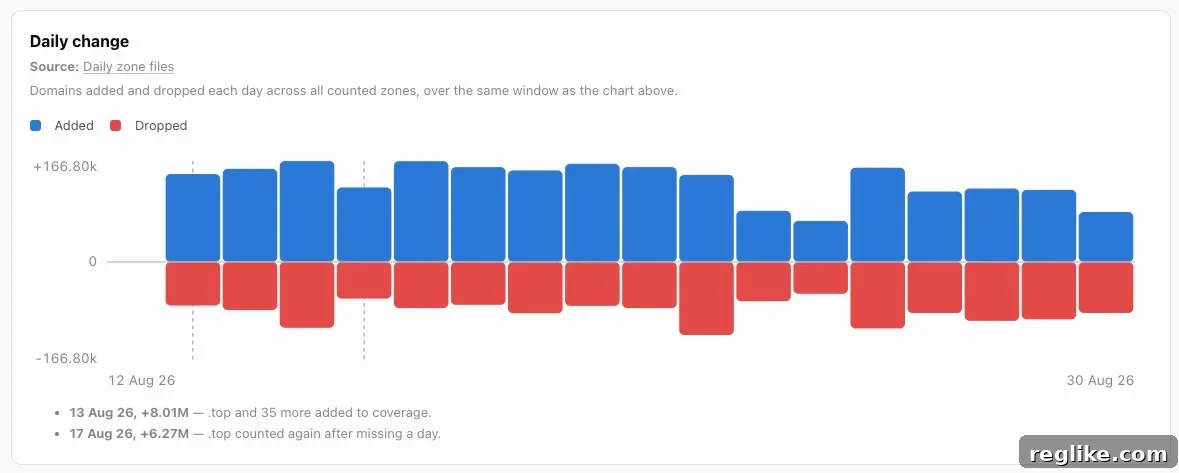
The backbone of nTLDData’s reporting is daily zone file analysis combined with registry reports provided to ICANN. Daily zone files allow the site to monitor registration counts and day-to-day changes in zone contents, which gives a near real-time view of registration volumes for individual TLDs. Zone file-based metrics are especially valuable for identifying short-term trends, sudden spikes or drops, and the effects of promotions or marketing campaigns.
To complement daily zone file data, nTLDData incorporates the monthly registry reports that registries submit to ICANN. Those reports contain detailed information on adds, drops, renewals, and registrar-specific activity. Using both data sources enables the site to report not only on raw counts but also on dynamics such as renewal behavior and registrar performance. Because ICANN reports include richer month-over-month and cohort data, they are instrumental in calculating metrics like renewal rates and the site’s “keep rates.”
The concept of a “keep rate” on nTLDData is analogous to renewal rate: it indicates how well registries retain names after the initial registration period. Based on the most recent available registry reports, nTLDData highlights variation among TLDs — some show very low keep rates while others retain the majority of registrations. For example, among TLDs with at least 50,000 registrations, some of the lowest keep rates reported include .bond, .sbs, and .makeup, while higher keep rates are observed for TLDs such as .nyc, .ovh, and .dev. These figures help identify which TLDs attract more durable registrations versus those that experience rapid churn.
One important limitation to be aware of is timing: ICANN registry reports are published with a delay, typically several months after the activity they describe. That lag means some of the most detailed analytics on adds, drops, and renewals will reflect activity from the recent past rather than the immediate present. Despite this delay, these reports remain the authoritative source of registry-level activity and are invaluable for rigorous historical analysis.
Zone file counts have their own caveats as well. While they show names present in DNS and can be updated daily, zone files do not account for so-called “dark domains” that exist in registration databases but lack nameserver records and thus do not appear in the zone. For a complete picture, combining zone file analysis with registry reports produces more robust insights.
Compared with previous services, nTLDData aims to offer expanded functionality and deeper metrics. It aggregates daily and monthly inputs into charts and tables that make it easier to track registrar market share, registry growth, churn patterns, and the impact of renewals. As the platform matures and accumulates a longer historical record of zone files, its charts and trend analyses will become even more valuable for long-term comparisons.
For domain industry watchers who relied on nTLDStats in the past, nTLDData represents a promising successor. It delivers a richer set of statistics and a broader coverage of TLDs, while leveraging the two primary authoritative data sources available: daily zone files and monthly ICANN registry reports. Over time, as the project builds its archive of historical zone file snapshots, users can expect more refined analytics and improved trend visibility across the global TLD ecosystem.