
The New Frontier of Online Identity: A Deep Dive into the Future of Top-Level Domains
The digital landscape is in constant flux, and at its core lies the domain name system – the fundamental architecture of our online identities. A recent insightful report from B. Riley & Co analyst Sameet Sinha casts a bright spotlight on the burgeoning market of new Top-Level Domains (TLDs), predicting a remarkable ascent “from Zero to $500MM in Three Years.” This ambitious forecast signals a significant shift in the domain industry, prompting businesses and investors alike to re-evaluate their strategies in this evolving digital real estate market. The report not only offers a comprehensive overview of the domain name industry but also initiates coverage of Rightside, a key player in the TLD space, with a confident ‘buy’ rating and an ambitious $15 price target, a substantial leap from its current trading value of approximately $10.
Sinha’s extensive analysis delves deep into the potential trajectory of new TLDs, offering a meticulously crafted vision of their growth and market integration. While the projections are undeniably bullish, a critical examination of the underlying assumptions is crucial to fully grasp the report’s implications. The sheer scale of the predicted growth—half a billion dollars in just three years—underscores the analyst’s conviction in the transformative power of these new extensions.
Unpacking the Projections: A Vision of Rapid Market Expansion
The core of Sinha’s report lies in its detailed financial projections, painting a vivid picture of how new TLDs are expected to carve out a substantial share of the domain market. Below is a summarized chart that encapsulates these forward-looking estimates, offering a snapshot of the anticipated growth:
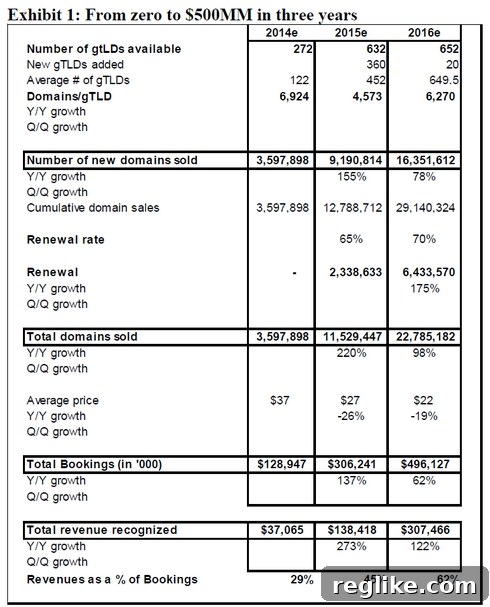
It’s important to note the specifics within these figures: the “domains/gTLD” line represents a quarterly average, while the “Number of new domains sold” provides the crucial annual total for understanding the overall sales volume forecasted. This distinction is vital for a precise interpretation of the market’s expected expansion.
Key Assumptions Fueling the Growth Forecast
Central to Sinha’s optimistic outlook are several key assumptions regarding domain sales and pricing. The report posits that, on average, a new gTLD will initially sell approximately 28,000 domains annually. This figure is then expected to moderate, settling at around 18,000 domains in 2015, before experiencing a resurgence to the 25,000 level in 2016. This anticipated increase is attributed to the launch of more generic and appealing domain extensions, which are likely to resonate with a broader audience and drive greater adoption. The availability of more intuitive and category-specific TLDs could significantly enhance their discoverability and perceived value, thereby stimulating demand.
Beyond sales volume, pricing dynamics play a crucial role in the financial model. The report anticipates a downward pressure on annual registration prices. Starting from an average retail price of $37 this year, this figure is projected to decrease to $22 by 2016. This shift suggests a market maturing rapidly, where increased competition among registries and registrars, coupled with a wider array of choices for consumers, leads to more competitive pricing. Such a trend could make new TLDs more accessible and attractive to a larger segment of the market, thereby fueling the volume growth. Furthermore, renewal rates, which represent the sustained interest and utility of registered domains, are a significant component of the model, influencing long-term revenue streams for registries and registrars alike.
Navigating the Uncharted: Challenges and Criticisms in TLD Forecasting
While Sinha’s report presents a compelling vision, the burgeoning new TLD market remains a complex and somewhat unpredictable landscape. Forecasting average domain registrations per domain is inherently challenging, especially given that the market for many new TLDs is less than a year old. Early data from the first batch of new TLDs, for instance, suggests registration numbers are trending well below the projected 28,000 names in their inaugural year, particularly in the absence of widespread public awareness campaigns. This discrepancy highlights the critical importance of marketing and brand recognition in driving adoption for these new extensions.
Another factor influencing the accuracy of these predictions is the price sensitivity of the market. It can be argued that the domains experiencing the highest registration volumes are often the less expensive ones, suggesting a correlation between affordability and mass adoption. If higher volumes are driven by lower price points, the overall revenue generation might differ from projections that assume a higher average price point. Moreover, the question of renewal rates for new TLDs is largely an unknown. The model draws its renewal rate assumptions from existing, well-established TLDs like .com or .net. However, the dynamics for new TLDs, many of which cater to niche markets or specific brand identities, could be drastically different. The longevity of interest in a new TLD, its perceived value over time, and the effectiveness of retention strategies will all play a significant role in determining actual renewal figures.
Market Share Ascendancy: New TLDs Poised for Disruption
Despite these uncertainties, Sinha’s report confidently forecasts that new TLDs will account for a substantial 20% of the total domain name registration revenue by 2016. This projection, if realized, would signify a remarkable and rapid disruption of the traditional domain market landscape. It suggests that new TLDs are not merely an experimental niche but are set to become a formidable force, challenging the long-standing dominance of legacy extensions.
This anticipated shift in market share has profound implications for all stakeholders. For registries operating new TLDs, it validates their investments and strategic decisions. For registrars, it underscores the importance of diversifying their offerings and actively promoting these new options to their customer base. And for businesses and individuals, it opens up new avenues for online branding, identity, and digital presence, moving beyond the crowded and often restrictive confines of traditional domain names.
Beyond the Numbers: The Broader Impact and Future of Digital Identity
The emergence and projected growth of new TLDs represent more than just a financial opportunity; they signify an evolution in how we perceive and utilize online identities. Unlike the generic .com, .net, or .org, new TLDs such as .tech, .shop, .nyc, or .cafe offer specific, descriptive, and often geographic relevance. This allows businesses and individuals to create more precise, memorable, and branded online presences, moving away from convoluted domain names to shorter, more impactful ones.
The Internet Corporation for Assigned Names and Numbers (ICANN) initiated the new gTLD program to foster innovation, competition, and choice in the domain name space. This expansion aims to democratize the internet’s naming system, providing more options for online branding and better reflecting the diversity of the global online community. For a startup in the technology sector, a .tech domain instantly conveys their industry focus. For a local coffee shop, a .cafe domain offers immediate recognition. These new extensions are transforming digital real estate, making it more intuitive, segmented, and ultimately, more valuable for specific purposes.
The Ongoing Debate: Bullish vs. Bearish Perspectives on Adoption
The domain name industry has always been characterized by dynamic shifts and diverse perspectives. While Sinha’s report leans heavily towards a bullish outlook, the debate surrounding new TLDs is far from settled. I’ve previously engaged with analysts from other firms who expressed more bearish sentiments, particularly in light of early registration numbers that indicated slower initial adoption than initially hoped. Factors such as a lack of widespread public awareness, the deeply ingrained habit of defaulting to .com, and the perceived higher costs of some premium new TLDs have contributed to this cautious viewpoint.
The bullish argument, however, centers on the long-term potential for market diversification, enhanced branding opportunities, and the eventual maturation of the ecosystem. As more generic and descriptive TLDs become available, and as marketing efforts intensify, advocates believe that these new extensions will inevitably gain traction. The promise of an internet where every brand, every city, and every niche has its own intuitive and unique online address continues to drive investment and innovation in this sector.
Strategic Implications for Businesses and Domain Investors
For businesses, the rise of new TLDs presents both an opportunity and a challenge. It’s an opportunity to secure a more relevant and impactful online identity, potentially at a lower cost or with greater availability than a traditional .com. It’s also a challenge to strategically choose the right TLD that aligns with their brand, target audience, and long-term vision. Adopting a new TLD requires careful consideration of its SEO implications, brand recognition, and consumer trust.
For domain investors, the market for new TLDs offers a fertile ground for speculative investment. Identifying promising new extensions, understanding their market potential, and acquiring valuable names can yield significant returns. However, it also comes with inherent risks, given the volatility and evolving nature of this relatively nascent market. The strategic acquisition of short, generic, or highly brandable names within popular new TLDs could prove to be a wise long-term play, especially as mainstream awareness and adoption continue to grow.
Conclusion: The Evolving Landscape of Digital Identity
Ultimately, placing concrete financial figures on the future trajectory of new TLDs, even just a year or two out, remains an incredibly challenging endeavor. The industry is in a state of rapid evolution, influenced by technological advancements, shifting consumer behaviors, and aggressive marketing strategies. While Sinha’s report is undoubtedly bullish and provides a valuable framework for understanding the potential financial impact, the true story of new TLDs will unfold over time. Only sustained growth, increasing public awareness, and robust renewal rates will confirm whether these ambitious projections become reality. The journey of new TLDs from experimental concepts to mainstream digital real estate is one that will continue to captivate industry observers and shape the future of our online world.