
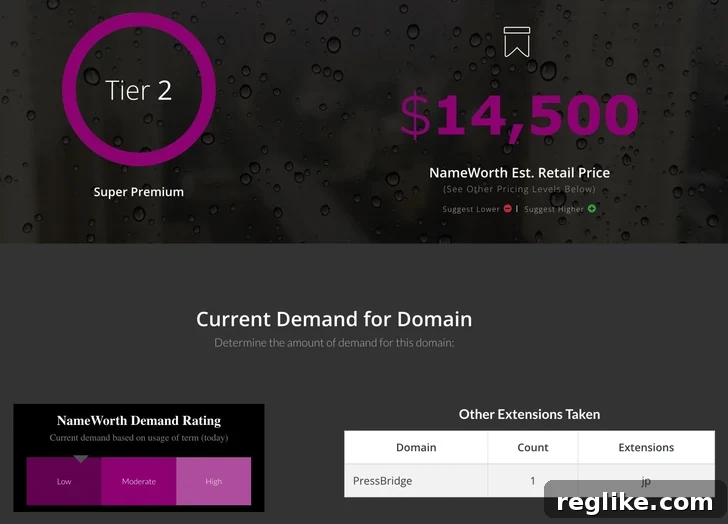
NameWorth’s backup data is incorrect, suggesting its valuations are based on faulty data.
This article is part of a broader review of automated domain appraisal tools.
NameWorth is an appraisal service aimed at domain investors, offering paid packages for bulk valuations while limiting free users to a small number of daily appraisals. For each domain it evaluates, NameWorth displays a “NameWorth Demand Rating,” a list of similar active websites, related registered domains, and the extensions under which the domain is registered.
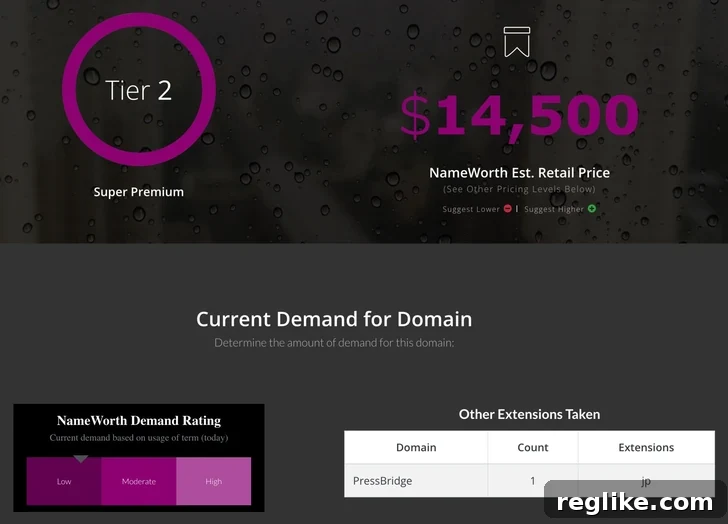
Unfortunately, the data it reports about registrations across other extensions is often incorrect. That raises concerns about the reliability of the platform’s other data and the valuations that rely on it.
Two-word brandables
To test NameWorth, we evaluated two common brandable domains: MakeMatter.com (a historical sale of $15,000) and PressBridge.com (a historical sale of $5,000). These names fall into the typical price range for two-dictionary-word brandables, generally between $3,000 and $15,000 depending on buyer preferences and market conditions.
NameWorth appraised MakeMatter.com at $17,500 and PressBridge.com at $14,500, which places both valuations reasonably within expected ranges for this category. The tool also demonstrated sensible behavior on unregistered domains by valuing CloudToaster.com at under $500, which is appropriate for a speculative, unused name.
One-word, high-value .com
For premium one-word .com domains, NameWorth produced higher valuations but not extreme underestimates. It appraised Dragonfly.com at $2.5 million. While the public sale details for this particular domain are unclear, feedback from industry sources suggests a seven-figure transaction, making NameWorth’s estimate plausible.
Midnight.com, which sold for $1.15 million this year, received a NameWorth valuation of $3 million. Valuing high-end single-word .com names is inherently difficult, and while NameWorth’s figure is aggressive, at least it did not collapse these names into low six-figure ranges as some other tools do.
Popular ccTLDs
NameWorth restricts appraisals to .com domains only. Some users may see this limitation as a downside, but there is value in a tool that recognizes the scope of its data and focuses on the most liquid and widely traded TLD.
Exact-match descriptive
Exact-match descriptive names can still command high prices in specific verticals. NameWorth gave WaterFilters.com a valuation of $250,000. The current seller is asking $3.5 million, but asking prices can be aspirational. Exact-match commercial names remain useful for ecommerce and niche markets, even as overall demand has softened compared with earlier years.
Three- and four-letter domains
Short, three- and four-letter .com domains are among the market’s most liquid assets. We tested a pronounceable CVCV four-letter domain, dujo.com, which is listed on Afternic for $36,000. NameWorth valued it at $150,000. Although high-priced sales for short, brandable names do occur, this estimate was well above comparable tools and higher than the listing price.
We also checked a four-letter, non-pronounceable domain. An example sale of MOTG.com was reported at $14,888, while NameWorth valued it at $54,500. For a three-letter domain, VJN.com is listed on Afternic for $39,000; NameWorth returned a $250,000 valuation. These examples suggest NameWorth tends to overvalue many three- and four-letter .com domains compared with market listings and recent sales.
New TLDs
NameWorth does not evaluate non-.com domains. Given the inconsistent results some appraisal tools produce for new gTLDs and country TLDs, limiting scope to .com appears to be a deliberate choice to reduce noise and avoid misleading valuations for less liquid extensions.
Final analysis
NameWorth can be useful for quick portfolio rank-ordering or for screening expired domains when searching for acquisition opportunities. It returns sensible values in several cases and recognizes its focus on .com names.
However, the platform’s backup data about matching registrations across TLDs is often inaccurate. If NameWorth’s valuation algorithms use this incorrect data as an input, the resulting appraisals may also be flawed. Another shortcoming is the lack of comparable sales (comps) presented alongside valuations, which limits transparency and makes it harder to judge the reasoning behind a given price estimate.
In summary, NameWorth can serve as a starting point for portfolio triage, but investors and sellers should treat its dollar estimates with caution, verify registrant and extension data independently, and seek transaction comps before relying on a valuation for pricing or negotiation.