
AGL Energy’s UDRP Battle for AGL.com: A Deep Dive into Domain Disputes and Premium Domain Ownership
The digital landscape is a fiercely competitive arena, particularly when it comes to coveted domain names. In a recent development highlighting the strategic importance of online real estate, AGL Energy Limited, a major Australian natural gas and electricity provider, has initiated a Uniform Domain-Name Dispute-Resolution Policy (UDRP) proceeding against the highly desirable three-letter domain name, AGL.com. This case underscores the complex interplay between corporate branding, trademark rights, and the intrinsic value of short, memorable domain assets.
AGL Energy currently operates its digital presence through the country-code top-level domain (ccTLD) AGL.com.au, firmly establishing its brand identity within its home market. However, the move to pursue AGL.com signifies a broader ambition for universal brand recognition and protection, recognizing the global reach and authoritative nature of a .com domain. Securing this premium domain is a strategic imperative for companies aiming for comprehensive online brand control and to mitigate potential consumer confusion or brand dilution.
The Contested Asset: AGL.com and Its History
The domain AGL.com holds significant value simply by virtue of its brevity. Three-letter .com domains are considered premium assets, highly sought after by businesses and investors alike due to their ease of recall, typing convenience, and perceived authority. These domains are scarce, making them prime digital real estate. This particular domain was first registered way back in 1999, a testament to its early acquisition in the internet’s formative years, long before many corporate entities had fully grasped the future importance of online identities.
Current ownership details for AGL.com are obscured by privacy protection services, a common practice among domain registrants. This anonymity can sometimes complicate UDRP proceedings, as the complainant must make their case against an unknown entity. However, historical WHOIS records, accessible through comprehensive domain research services like DomainTools, suggest that the current owner may have acquired the domain in 2004. This acquisition date is crucial, as it predates many trademark registrations and can significantly influence the outcome of a UDRP case, particularly concerning arguments of “bad faith registration” versus legitimate prior rights.
AGL Energy Limited: A Brand’s Quest for Global Dominance
AGL Energy Limited is a household name in Australia, boasting a rich history and a substantial customer base. As one of the largest integrated energy companies in the country, its brand recognition is exceptionally high domestically. Operating with AGL.com.au serves its existing Australian market effectively, providing a tailored online experience for local customers. However, in an increasingly interconnected and globalized world, a company like AGL Energy might seek to secure its primary three-letter .com counterpart for several compelling strategic reasons:
- Brand Unification and Authority: AGL.com provides a global, authoritative platform that transcends geographical boundaries, potentially preventing customer confusion or dilution of brand identity outside of Australia. It projects a universal image of trust and establishment.
- Typing Convenience and Memorability: The absence of the “.au” suffix makes the domain shorter and inherently easier to remember and type, reducing potential for errors and enhancing overall user experience. This simplicity is invaluable in an age of quick digital interactions.
- Prevention of Cybersquatting and Misuse: Securing the .com domain prevents others from potentially misusing the name for competitive, deceptive, or malicious purposes, thereby protecting the company’s reputation, intellectual property, and customer trust. It’s a proactive defense against potential online threats.
- Future Expansion and Digital Transformation: While AGL Energy primarily operates in Australia, owning AGL.com strategically positions the company for any future international ventures, digital service expansions, or diversification without brand impedance. It ensures a consistent brand presence for future growth.
- SEO and Traffic Benefits: A premium, short .com domain often benefits from inherent search engine optimization advantages, potentially attracting direct traffic and improving brand visibility organically.
Understanding the UDRP Process: A Framework for Domain Disputes
The Uniform Domain-Name Dispute-Resolution Policy (UDRP) is an administrative procedure established by the Internet Corporation for Assigned Names and Numbers (ICANN) to resolve disputes over the registration and use of internet domain names. It offers a quicker, more streamlined, and generally less expensive alternative to traditional court litigation for trademark holders who believe their rights are being infringed upon by a domain registration. The UDRP is a critical tool for online brand protection, providing a standardized framework for resolving cybersquatting cases.
For a complainant like AGL Energy to succeed in a UDRP action and have a domain name transferred from the current registrant to themselves, they must prove, on the balance of probabilities, three key elements against the domain owner (the respondent):
- The domain name is identical or confusingly similar to a trademark or service mark in which the complainant has rights. This element focuses on the similarity between the domain name and the complainant’s established brand.
- The registrant (domain owner) has no rights or legitimate interests in respect of the domain name. Here, the panel assesses whether the domain owner has any justifiable claim to the domain, such as prior business use, being commonly known by the name, or legitimate non-commercial use.
- The domain name has been registered and is being used in bad faith. This is often the most contentious element, requiring proof of malicious intent on the part of the domain owner when registering or using the domain.
Each of these elements presents unique challenges and opportunities for both the complainant and the respondent, requiring careful presentation of evidence and legal arguments.
Analyzing AGL Energy’s UDRP Claim Against AGL.com
Element 1: Identical or Confusingly Similar
AGL Energy holds robust trademark rights to “AGL” within Australia and potentially internationally. The domain name AGL.com is undeniably identical to the core “AGL” component of their trademark. UDRP panels generally disregard the top-level domain (.com, .net, .org, etc.) when assessing similarity, focusing solely on the second-level domain (what comes before the dot). Therefore, AGL Energy likely has a very strong case for fulfilling this first element, as “AGL” is the prominent, distinctive, and entirely matched part of their brand name.
Element 2: No Rights or Legitimate Interests
This is often where the domain owner’s defense comes into significant play. Legitimate interests can be demonstrated in several ways, according to UDRP policy:
- Using the domain name in connection with a bona fide offering of goods or services before any notice of the dispute.
- Being commonly known by the domain name, even without acquiring trademark or service mark rights.
- Making a legitimate non-commercial or fair use of the domain name, without intent for commercial gain to misleadingly divert consumers or to tarnish the trademark.
The nature of the content currently displayed on AGL.com, as a parked page generating revenue, will be heavily scrutinized here. The question will be whether this activity constitutes a legitimate interest or merely opportunistic commercial exploitation.
Element 3: Registered and Used in Bad Faith
Proving bad faith is often the most challenging element for a complainant. Indications of bad faith registration and use, as outlined in the UDRP policy, can include:
- Registering the domain primarily for the purpose of selling, renting, or otherwise transferring the domain name registration to the trademark owner or to a competitor of that trademark owner for an amount exceeding documented out-of-pocket costs directly related to the domain name.
- Registering the domain to prevent the trademark owner from reflecting the mark in a corresponding domain name, provided a pattern of such conduct is established.
- Registering the domain primarily for the purpose of disrupting the business of a competitor.
- Using the domain to intentionally attempt to attract, for commercial gain, Internet users to the registrant’s website or other online location, by creating a likelihood of confusion with the complainant’s mark as to the source, sponsorship, affiliation, or endorsement of the registrant’s website or location or of a product or service on the registrant’s website or location.
The current state of AGL.com, featuring a parked page with commercial links, will be central to AGL Energy’s argument for bad faith use. The timing of registration (1999) and acquisition (2004) relative to AGL Energy’s trademark prominence will also be key to the “bad faith registration” aspect.
The Domain Owner’s Predicament: Parked Pages and Potential Defenses
The domain AGL.com currently displays a parked page. Domain parking is a common monetization strategy where domain owners display advertisements or links on undeveloped domains, earning revenue from clicks. While not inherently problematic or indicative of bad faith in itself, the specific content on these parked pages can significantly impact a UDRP case, as it provides direct evidence of the owner’s use and commercial intent.
The following image depicts the nature of the parked page that was noted:
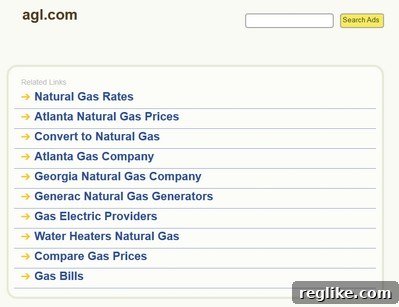
Crucially, the original report notes that some of these links were related to “Atlanta Gas Light.” This particular detail could form the cornerstone of the domain owner’s defense, especially if the parking page content is dynamic or context-sensitive.
The “Atlanta Gas Light” Defense
The domain owner could argue that when they registered or acquired AGL.com (potentially in 2004), their intent was not to target AGL Energy Limited of Australia, but rather to capitalize on the acronym for another legitimate entity, such as Atlanta Gas Light, a well-known utility company in the United States. If the domain owner can demonstrate a plausible connection to or genuine intent related to Atlanta Gas Light, this could significantly weaken AGL Energy’s claim of bad faith, particularly concerning the “bad faith registration” element. Such a defense would assert that the registration was aimed at a different, distinct entity.
However, the complainant (AGL Energy) might counter by arguing:
- Rotating Content: The parked pages rotate, suggesting a lack of consistent, dedicated intent towards a single entity and instead indicating a deliberate attempt to generate revenue from various keyword associations, some of which might overlap with AGL Energy’s brand.
- Automated Generation: The specific links might be automatically generated by the parking service based on algorithms, not reflecting the owner’s conscious targeting or deliberate choice. The owner’s responsibility, however, lies in managing the content displayed.
- Global Confusion: Even if Atlanta Gas Light was considered by the owner, the broadness and brevity of the three-letter acronym “AGL” might still lead to a likelihood of confusion with AGL Energy for a global audience, especially if the parking page serves broad energy-related advertisements or is accessed by non-U.S. users.
The “Three-Letter Domain” Argument
A more robust and common defense for owners of short, generic domains revolves around the inherent value and generic nature of three-letter acronyms. Many such domains are registered purely for their brevity, pronounceability, and market value as premium digital assets, not because they directly infringe on a specific trademark. The owner could argue they registered AGL.com as a valuable digital property, a short and memorable sequence of letters, independent of any specific existing entity named AGL. If this intent can be credibly established, especially if their acquisition in 2004 predates significant international recognition of AGL Energy’s brand or any U.S. trademark registrations by AGL Energy, it could be a powerful argument against bad faith registration.
The challenge for the owner, as highlighted in the original content, is that the very act of parking the domain with trademark-related links (like “Atlanta Gas Light” or even general energy links that could be associated with AGL Energy) can inadvertently damage this defense. It suggests a commercial intent that might align with the “bad faith use” criteria of the UDRP, even if the initial registration was benign.
Implications and Broader Lessons for Domain and Brand Owners
The AGL.com UDRP case serves as a poignant reminder of several critical aspects of online brand management and domain ownership in the current digital ecosystem:
- Proactive Brand Protection is Paramount: Companies with strong and expanding brands should consider securing relevant .com domains, alongside their ccTLDs, as early as possible. This proactive approach helps prevent future disputes, costly UDRP actions, and the need to retrieve essential brand assets from third parties.
- Due Diligence in Domain Acquisition: Domain investors and registrants must perform thorough trademark checks before acquiring or registering domains, especially short, acronymic ones. Understanding potential conflicts can mitigate significant legal risks down the line.
- Strategic Domain Monetization Requires Caution: While domain parking is a legitimate practice for generating revenue from undeveloped domains, owners must be acutely aware of the content displayed on their parked pages. Auto-generated links can unwittingly create evidence of bad faith or trademark infringement, even if the owner’s initial intent was benign. Careful selection of parking providers and active management of ad content is crucial to avoid legal pitfalls.
- The Enduring Value of Short Domains: The continuous battle over three-letter and four-letter .com domains underscores their enduring value as prime digital real estate. Their scarcity, universal appeal, and ease of use mean they will always be targets for brand owners seeking comprehensive online presence.
- Complexity of UDRP Cases: This case highlights the nuanced nature of UDRP proceedings, where intent, historical context, actual usage, and even the automated aspects of domain parking are all meticulously examined. A seemingly minor detail, like the specific content of a parked page, can become a pivotal piece of evidence.
Conclusion: A High-Stakes Battle for a Premium Digital Asset
The UDRP complaint filed by AGL Energy Limited against AGL.com represents a high-stakes battle for a premium digital asset. For AGL Energy, securing AGL.com is not just about a domain; it’s about reinforcing its global brand identity, protecting against potential consumer confusion, enhancing its digital presence, and future-proofing its digital strategy. For the current domain owner, it’s about defending their investment and demonstrating legitimate rights, despite the potentially compromising nature of their domain’s current parked status and its revenue-generating links.
The outcome of this case will undoubtedly offer valuable insights into how UDRP panels weigh the arguments surrounding generic versus trademarked three-letter domains, the implications of automated parked page content in determining bad faith, and the ever-evolving standards for establishing legitimate interest and bad faith registration and use. Regardless of the final decision, this dispute reinforces the undeniable truth: in the digital age, a domain name is far more than just a web address—it is a critical component of a company’s identity, a vital marketing tool, and one of its most fundamental online assets, worth fiercely contending for.